
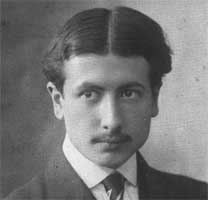
Henri-Alban Fournier, better known by his pen name Alain-Fournier, is a name that resonates deeply in French literary circles. Born on October 3, 1886, in La Chapelle-d’Angillon, France, Alain-Fournier’s life was tragically short, but his contributions to literature have left a lasting impact. Best known for his singular novel, “Le Grand Meaulnes,” his work captures the poignant transition from childhood to adulthood, blending reality and dream with poetic finesse. This article explores the life, literary journey, and the significant milestones of Alain-Fournier.
Early Life and Education
Henri-Alban Fournier was born into a family of educators. His father, an elementary school teacher, and his mother, who also had a background in education, provided a stimulating intellectual environment. This nurturing backdrop likely sparked his early interest in literature and learning. Fournier spent his childhood in the French regions of Sologne and Lower Berry, areas that would later serve as the idyllic settings for his literary works.
In 1898, Fournier began his formal education at the Lycée Voltaire in Paris, where he lived as a boarding student. His initial ambition was to join the prestigious Ecole Navale, inspired by his idealistic nature. In 1901, he transferred to the Lycée of Brest to pursue this goal, but for reasons that remain unclear, he soon abandoned this dream and left the school.
Fournier’s educational journey saw him attending various institutions, culminating in his attainment of the baccalaureate at the Lycée of Bourges in 1903. He then moved to the Lycée Lakanal in Sceaux, near Paris, where he prepared rigorously for the entrance examination to the renowned École Normale Supérieure. Despite his best efforts, Fournier did not pass the exam.
Literary Beginnings and Personal Influences
During his time at Lycée Lakanal, Fournier formed a lifelong friendship with Jacques Rivière, who later married Fournier’s younger sister, Isabelle. This deep bond is immortalized in the extensive correspondence between the two, which spanned from 1905 until Fournier’s death in 1914. These letters, later published as “Correspondance avec Jacques Rivière” between 1926 and 1928, offer valuable insights into Fournier’s thoughts and literary aspirations.
A pivotal moment in Fournier’s life occurred in June 1905 when he met Yvonne de Quiévrecourt during a walk along the Seine River. This brief but profound encounter left an indelible mark on him and inspired the character of Yvonne de Galais in his novel “Le Grand Meaulnes.” Although they met only once more in 1913, by which time Yvonne was married with children, the impact of their meeting is evident in Fournier’s work.
Professional Life and Literary Pursuits
Fournier’s early professional life was marked by his service in the French military, which he completed from 1908 to 1909. In 1910, he returned to Paris and began working as an editor for the Paris-Journal. During this period, he mingled with notable literary figures such as André Gide and Paul Claudel, which enriched his literary environment and inspired his writing.
Despite his burgeoning literary career, Fournier left the Paris-Journal in 1912 to pursue a role in politics, becoming the secretary to the politician Casimir Perrier. Concurrently, he began writing his magnum opus, “Le Grand Meaulnes.” The novel, deeply autobiographical, reflects his childhood experiences and his idealistic visions of youth and love.
“Le Grand Meaulnes” and Literary Success
“Le Grand Meaulnes,” published in 1913, is a poignant narrative that weaves together themes of adolescence, idealism, and the bittersweet passage from childhood to adulthood. The novel tells the story of François Seurel and his friend Augustin Meaulnes, who discover a mysterious and enchanting world that epitomizes their youthful dreams and aspirations. The work is celebrated for its lyrical prose and its exploration of the fleeting nature of idealism.
The novel was first serialized in the Nouvelle Revue Française before being published in its entirety by Émile-Paul. It quickly garnered critical acclaim and was nominated for the prestigious Prix Goncourt. Its success cemented Alain-Fournier’s reputation as a significant literary voice, despite his young age.
Personal Struggles and Tragic End
The year following the publication of “Le Grand Meaulnes” was tumultuous for Fournier. He re-encountered Yvonne de Quiévrecourt, only to find that she was now married. This revelation deeply affected him, as reflected in his later poetry and writings. He also attempted to branch into theater, working on the play “La Maison dans la Forêt” and beginning a second novel, “Colombe Blanchet,” neither of which he completed.
With the outbreak of World War I in August 1914, Fournier enlisted in the French army as a lieutenant. Tragically, he was reported missing in action on September 22, 1914, during the early battles near Verdun. It was not until 1991 that his remains were discovered in a mass grave, providing closure to his mysterious disappearance.
Posthumous Publications and Legacy
Despite his brief life, Alain-Fournier’s literary legacy endures. Following his death, several of his works were published posthumously. In 1924, a collection of his poems titled “Miracles” was released, showcasing his lyrical talent and emotional depth. In 1944, “La Femme de la Sorcière” (The Witch’s Wife), a long narrative story, was published, further demonstrating his narrative skill.
In 1957, Pauline Benda, a French actress and the wife of Claude Casimir-Périer (for whom Fournier had worked as a secretary), revealed that she had a romantic relationship with Fournier. This revelation was supported by the publication of their correspondence, “Alain-Fournier, Madame Simone, Correspondance 1912-1914,” in 1992, offering new insights into the personal life of the writer.
Cultural and Literary Impact
“Le Grand Meaulnes” remains a cornerstone of French literature, often studied in schools and celebrated for its timeless exploration of youth and idealism. Alain-Fournier’s ability to capture the essence of adolescence and the longing for a lost paradise resonates with readers across generations. His work has influenced numerous writers and continues to be a source of inspiration for its poetic and dreamlike quality.
Fournier’s singular novel has been adapted into films and plays, further cementing its place in cultural history. The themes of nostalgia, the search for meaning, and the tension between reality and idealism in “Le Grand Meaulnes” have universal appeal, ensuring its continued relevance.
Conclusion
Alain-Fournier’s life, though tragically short, was marked by profound literary achievements. His novel “Le Grand Meaulnes” stands as a testament to his talent and his ability to encapsulate the fleeting beauty of youth. His writings, enriched by personal experiences and emotional depth, continue to captivate readers and scholars alike.
Alain-Fournier’s legacy is one of poignant beauty and enduring influence. His exploration of the human condition, the idealism of youth, and the inevitable passage of time resonates deeply, offering a timeless reflection on life’s complexities. As his work continues to be celebrated and studied, Alain-Fournier remains an indelible figure in the annals of literary history.


