
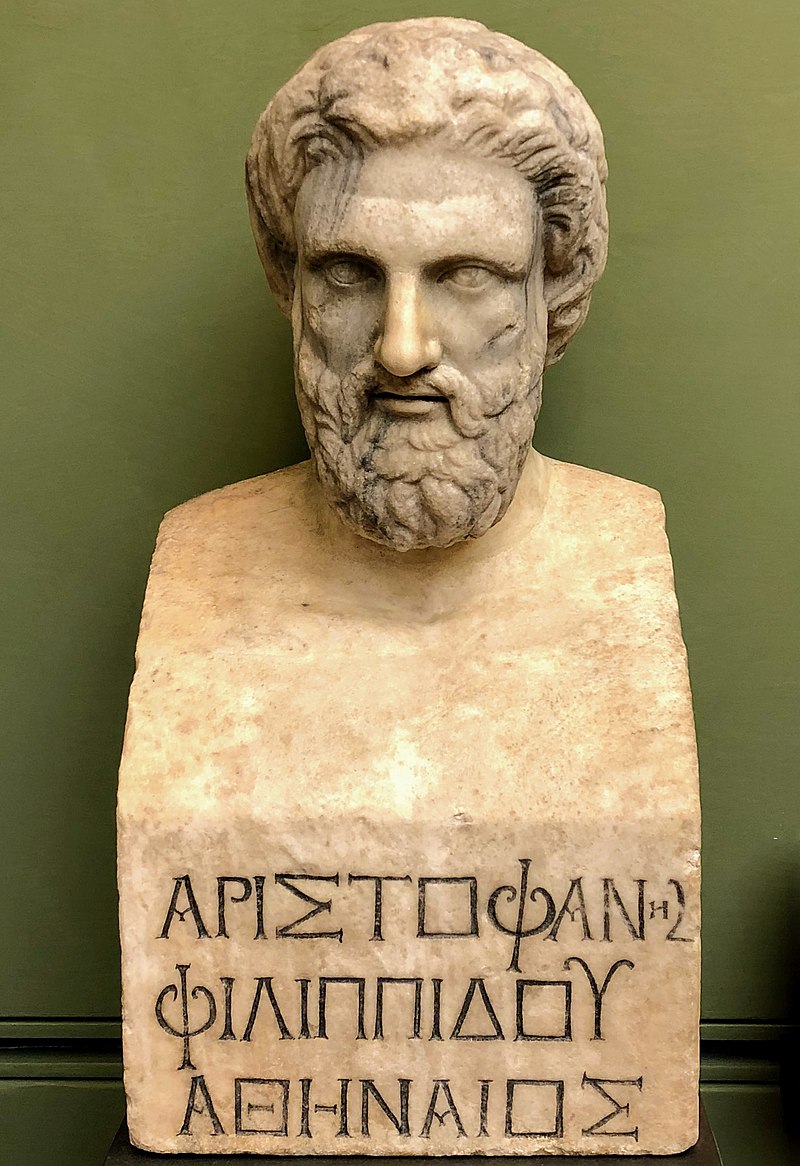
Aristophanes, one of the most illustrious figures of ancient Greek literature, was born around 450 BC in the active deme of Cidatene, a region in ancient Athens. Though much of his life remains shrouded in mystery, his legacy as the foremost playwright of ancient comedy endures. The details of his life are sparse, primarily gleaned from his extensive body of work, which continues to be studied and celebrated for its sharp wit, political satire, and profound insights into Athenian society.
Early Life and First Forays into Comedy
Aristophanes made his theatrical debut at a young age in 427 BC with his play The Banqueters. This work, produced during the early years of the Peloponnesian War between Athens and Sparta, did not follow the traditional path where the poet himself served as the chorus leader; instead, this role was taken up by Callistratus. The The Banqueters, though largely lost to history with only fragments remaining, is understood to have addressed the clash between the old educational values (paideia) and the new cultural currents of the time, reflecting the broader societal shifts and conflicts.
His second play, The Babylonians, produced in 426 BC, is similarly known only through scant remnants. This work was significant for its bold accusations of corruption and mismanagement directed at the Athenian demagogue Cleon, a powerful figure in Athenian politics who was often a target of Aristophanes’ sharp satire.
Rise to Fame: The Acharnians and Knights
Aristophanes’ third play, The Acharnians, staged in 425 BC, is the earliest of his works to have survived in its entirety. Set against the backdrop of the Peloponnesian War, which had entered its sixth year, The Acharnians focuses on the desires of ordinary Athenians for peace, amid the city’s economic collapse and isolation from vital trade routes. The play highlights the suffering caused by the war, using the character of Dikaiopolis, a peasant driven to negotiate his own private peace treaty with Sparta, to critique the futility of the ongoing conflict and the political leadership that perpetuated it.
This critique of Athenian democracy continued in Knights (424 BC), where Aristophanes again targeted Cleon, this time under the pseudonym “Paphlagonian.” The play portrays Cleon as a deceitful and manipulative figure who exploits the Athenian people for his own gain, contrasting him with the Knights, who represent the more traditional, wealthier class of Athenian society.
Clouds and the Critique of Sophistry
Perhaps Aristophanes’ most famous work, Clouds, was first performed in 423 BC. In this play, Aristophanes directs his satire at the intellectual currents of the time, particularly the Sophists, and their perceived corrosive influence on Athenian democracy. The story revolves around Strepsiades, an Athenian citizen who sends his son to study under Socrates (portrayed in the play as a leading Sophist) to learn how to evade his debts through clever but unethical arguments. Despite its innovative and bold content, Clouds was not initially well-received, leading Aristophanes to revise it extensively; however, this version never saw the stage and is the one that survives today.
Exploring Legal Corruption and War Fatigue: Wasps and Peace
The theme of societal corruption continues in Wasps (422 BC), where Aristophanes examines the Athenian legal system and the power dynamics between the older and younger generations, as well as between the populace and demagogues. The play criticizes the exploitation of the legal system by demagogues who manipulate the public and the judicial system for their benefit, depicting the citizen-jurors as being easily swayed by corrupt leaders.
Following this, Aristophanes produced Peace in 421 BC, a comedy that reflects the widespread war fatigue among the Athenian populace. The protagonist, Trygaeus, a farmer, flies to heaven on a giant dung beetle to rescue the personification of Peace, buried by the gods. This fantastical plot underscores the longing for the end of the Peloponnesian War and the absurdity of the continued conflict.
Utopian Visions and Social Commentary: Birds and Women-Centered Plays
In 414 BC, Aristophanes staged Birds, a play that presents a utopian vision in which two Athenians, tired of the political turmoil in their city, decide to create a new city in the sky, called Cloudcuckooland, where they can live in peace. The play is notable for its imaginative setting and the exploration of themes related to power, society, and the desire for a better life.
By 411 BC, Aristophanes had turned his attention to the role of women in society with two plays: Thesmophoriazusae and Lysistrata. The former is a comedic critique of the playwright Euripides’ portrayal of women, suggesting that his focus on private concerns and individual psychology detracts from more important political matters. In contrast, Lysistrata presents a bold, humorous solution to the war—women from across Greece, led by the titular character, agree to withhold sex from their husbands until they agree to end the war. The play is celebrated for its progressive view of women’s potential influence on public affairs, albeit in a comedic and exaggerated form.
Final Years and Lasting Legacy: Ecclesiazusae and Plutus
Aristophanes continued to explore the theme of women’s power in Ecclesiazusae (393 BC), which imagines a society where women, disguised as men, take over the Athenian Assembly and implement socialist reforms. The play offers a satirical look at governance and gender roles, blending humor with serious social commentary.
The final known work of Aristophanes is Plutus (388 BC), a play that critiques the distribution of wealth in society. The story follows Chremylus, a poor but honest man, who encounters the god of wealth, Plutus, blinded to prevent him from distributing wealth fairly. By restoring Plutus’ sight, Chremylus ensures that wealth is distributed according to merit rather than favoritism or corruption.
Aristophanes passed away around 385 BC, leaving behind a body of work that remains influential in the fields of literature, drama, and political thought. His comedies not only entertained the citizens of Athens but also provoked them to think critically about the society they lived in.
Aristophanes’ Impact on Literature and Society
Aristophanes’ works are more than just comedic plays; they are insightful commentaries on the social, political, and intellectual life of ancient Athens. His plays often used humor to criticize the political leaders and philosophers of his time, making them a powerful tool for public discourse. His portrayal of characters like Socrates and Cleon, though exaggerated for comedic effect, reflects the concerns of ordinary Athenians about the direction their city was taking.
Moreover, Aristophanes’ plays have had a lasting impact on the genre of comedy itself. His use of satire, parody, and political commentary has influenced countless playwrights and comedians over the centuries, from the Roman playwright Plautus to modern satirists like Jon Stewart and Stephen Colbert. The themes he explored—war, peace, justice, power, and the role of women in society—are universal and continue to resonate with audiences today.
Conclusion
Aristophanes is a towering figure in the history of Western literature, and his works provide a window into the complexities of Athenian society during one of its most turbulent periods. Through his sharp wit and incisive commentary, he not only entertained but also challenged his audience to think critically about the world around them. Today, his plays are studied not only for their artistic merit but also for the light they shed on the political and social dynamics of ancient Athens. As such, Aristophanes remains a vital figure in the canon of classical literature, with his works continuing to inspire and provoke discussion across the ages.


