
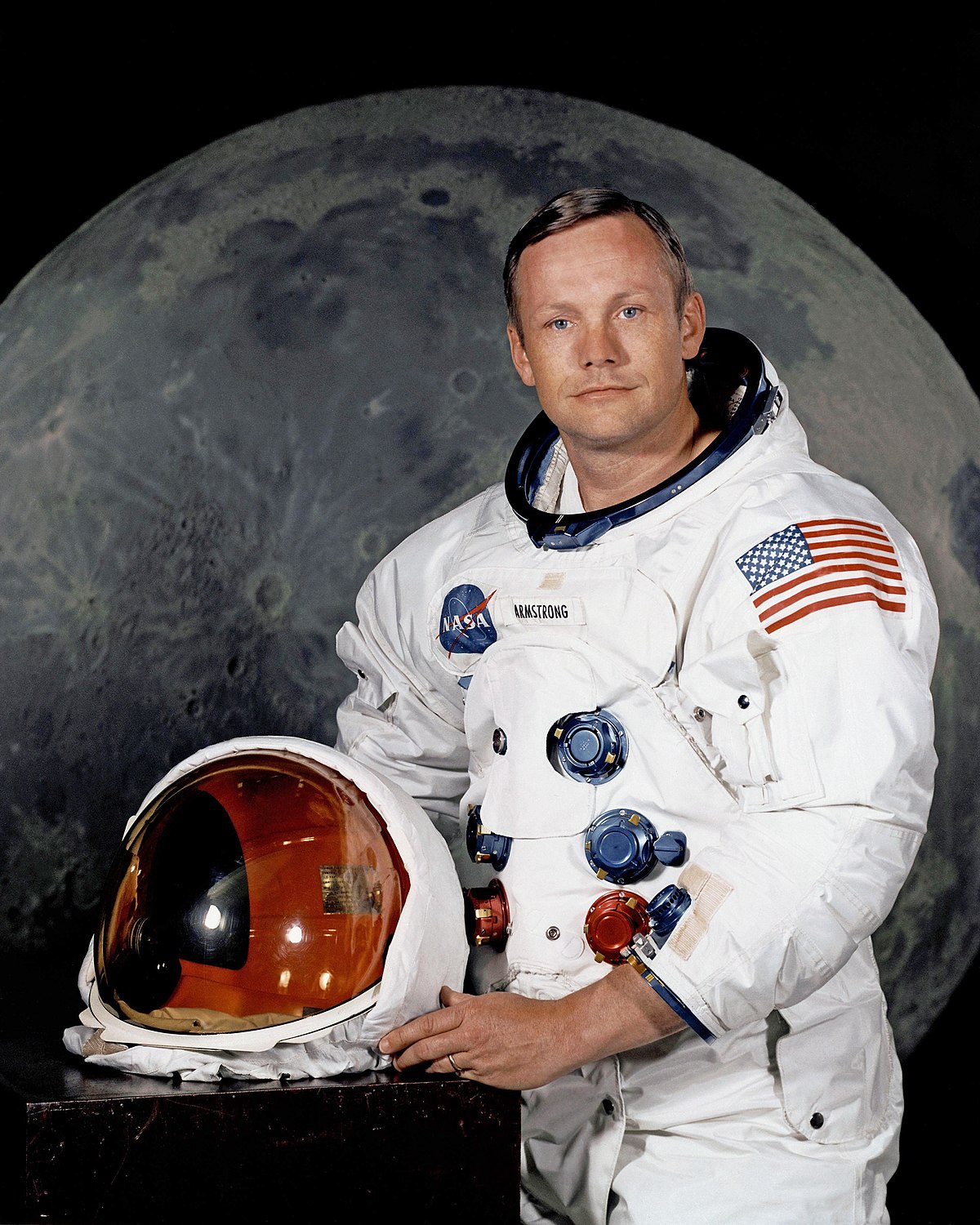
Neil Armstrong, an iconic figure in the annals of space exploration, is celebrated for his pioneering journey to the moon. This article delves into his life, achievements, and the historical context that shaped his legacy.
Early Life and Education
Neil Alden Armstrong was born on August 5, 1930, in Wapakoneta, Ohio. His fascination with aviation began early, inspired by a flight in a Ford Trimotor, known as the “Tin Goose,” when he was six. Armstrong’s passion for flying only grew, leading him to earn his pilot’s license at the age of 16, even before he obtained his driver’s license.
Armstrong pursued his higher education at Purdue University, where he earned a degree in aeronautical engineering. His education was briefly interrupted by his service as a U.S. Navy pilot during the Korean War. After the war, he returned to Purdue and completed his degree. Armstrong later earned a Master’s degree in aerospace engineering from the University of Southern California.
Military and Test Pilot Career
From 1949 to 1952, Armstrong served as an aviator in the U.S. Navy, flying 78 combat missions during the Korean War. His experience as a naval aviator honed his skills and prepared him for the rigorous demands of a test pilot career. After leaving the Navy, Armstrong joined the National Advisory Committee for Aeronautics (NACA), the precursor to NASA.
As a test pilot, Armstrong flew over 200 different models of aircraft, including jets, rockets, helicopters, and gliders. Notably, he flew the X-15 rocket plane, which could reach speeds of 4,000 miles per hour and altitudes of up to 207,500 feet. His work as a test pilot was critical in advancing aviation technology and safety.
NASA and the Gemini Program
In 1962, Armstrong was selected as an astronaut by NASA. His first spaceflight was in 1966 as the command pilot of Gemini 8. During this mission, Armstrong and his fellow astronaut, David Scott, achieved the first successful docking of two spacecraft in orbit. However, the mission faced a serious challenge when a thruster malfunctioned, causing the spacecraft to spin uncontrollably. Armstrong’s quick thinking and piloting skills averted disaster, showcasing his composure under pressure.
Apollo 11: The Historic Moon Landing
Armstrong’s most famous mission was Apollo 11, where he served as the mission commander. Launched on July 16, 1969, Apollo 11 aimed to fulfill President John F. Kennedy’s goal of landing a man on the moon and returning him safely to Earth. On July 20, 1969, Armstrong descended the lunar module’s ladder and set foot on the moon, uttering the immortal words, “That’s one small step for man, one giant leap for mankind.”
Armstrong and lunar module pilot Buzz Aldrin spent approximately two and a half hours exploring the lunar surface, collecting samples, and conducting experiments. Their successful mission was broadcast live to millions around the world, cementing Armstrong’s place in history.
Post-NASA Career
After the Apollo 11 mission, Armstrong continued to work with NASA, contributing to the development of space exploration technologies. In 1971, he left NASA to teach aerospace engineering at the University of Cincinnati, where he influenced a new generation of engineers and scientists. Armstrong remained in academia until 1979.
In the mid-1980s, Armstrong served on the National Commission on Space and chaired the presidential commission that investigated the Space Shuttle Challenger disaster in 1986. His expertise and leadership were instrumental in shaping U.S. space policy and safety standards.
Personal Life and Legacy
Neil Armstrong was married twice and had three children. His first marriage to Janet Shearon in 1956 produced two sons, Eric and Mark, and a daughter, Karen, who tragically died of a brain tumor in 1962. Armstrong and Shearon divorced in 1994. He married Carol Held Knight in 1994 and remained with her until his death.
Armstrong lived a relatively private life, avoiding the limelight despite his fame. He resided in Ohio, working for various corporations and serving on several boards. His humility and dedication to his work earned him numerous accolades, including the Presidential Medal of Freedom, the Congressional Space Medal of Honor, and the NASA Distinguished Service Medal.
Historical Context and Impact
The significance of Armstrong’s moon landing extends beyond his personal achievements. It marked a pivotal moment in the Cold War, showcasing American technological superiority and innovation during a period of intense competition with the Soviet Union. The success of Apollo 11 inspired a generation of scientists, engineers, and explorers, driving advancements in numerous fields.
Armstrong’s journey to the moon also highlighted the collaborative efforts of thousands of scientists, engineers, and technicians who worked tirelessly to make space exploration possible. His achievement was not just a triumph of individual skill but a testament to human ingenuity and perseverance.
Conclusion
Neil Armstrong’s life is a testament to the power of curiosity, dedication, and resilience. From his early fascination with flight to his historic moon landing and beyond, Armstrong’s contributions to aviation and space exploration have left an indelible mark on history. His legacy continues to inspire those who dream of exploring the unknown and pushing the boundaries of what is possible.


