
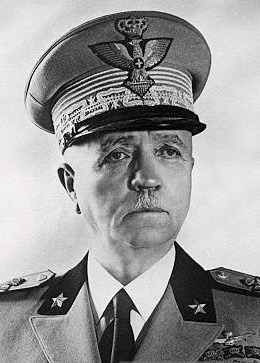
Pietro Badoglio was a prominent Italian military figure and statesman whose life spanned significant events in Italian and world history. Born on September 28, 1871, in Grazzano Monferrato, Italy, Badoglio’s career was marked by his involvement in Italy’s colonial campaigns, World War I, and World War II. His complex legacy includes both military successes and controversial decisions, reflecting the turbulent era in which he lived.
Early Life and Military Beginnings
Birth and Family Background
Pietro Badoglio was born into a modest family in the Piedmont region of Italy. His father, Mario Badoglio, was a small landowner, and his mother, Antonietta Pittarelli, came from a family of modest means. Despite their limited resources, the Badoglio family valued education, which played a crucial role in Pietro’s early development.
Education and Early Military Career
Badoglio’s military career began at the Military Academy of Turin, where he enrolled at the age of 16. His early education emphasized discipline, strategy, and leadership—qualities that would define his military service. Graduating in 1890, Badoglio was commissioned as a second lieutenant in the Italian Army.
Colonial Campaigns and Rise to Prominence
Italo-Turkish War
Badoglio’s first significant military engagement was during the Italo-Turkish War (1911-1912), where Italy sought to seize control of Libya from the Ottoman Empire. Serving as a staff officer, Badoglio distinguished himself with his strategic acumen and leadership. His performance in Libya earned him a promotion and set the stage for his future military career.
World War I and Caporetto
Badoglio’s reputation further solidified during World War I. By 1915, Italy had entered the war on the side of the Allies. Badoglio played a key role in the Italian campaigns on the Isonzo Front. However, his most notable, yet controversial, involvement came during the Battle of Caporetto in 1917. The Italian Army suffered a devastating defeat, and Badoglio, as Chief of Staff, was partly blamed for the failure. Despite the controversy, he managed to retain his position and later contributed to Italy’s recovery and eventual victory in the war.
Interwar Period and Fascist Italy
Political and Military Roles
In the interwar period, Badoglio’s career transitioned from purely military roles to more political ones. He held various high-ranking positions, including the role of Chief of the General Staff. His loyalty to the monarchy and adept political maneuvering allowed him to navigate the complex political landscape of Italy during this time.
Role in the Abyssinian Campaign
Badoglio’s military career reached a peak during the Second Italo-Ethiopian War (1935-1936), where he was appointed as the commander of Italian forces. His strategy led to the rapid and brutal conquest of Ethiopia, a campaign marked by the use of chemical weapons and significant civilian casualties. The victory earned him the title of Duke of Addis Ababa, but also cast a long shadow over his legacy due to the war crimes committed.
World War II and Changing Allegiances
Initial Support for Mussolini
At the outbreak of World War II, Badoglio initially supported Mussolini’s Fascist regime. However, Italy’s disastrous military campaigns and the Allied invasion of Sicily in 1943 led to widespread disillusionment with Mussolini’s leadership.
The Fall of Mussolini and Badoglio’s Leadership
In July 1943, as Italy faced military collapse and internal dissent, King Victor Emmanuel III dismissed Mussolini and appointed Badoglio as Prime Minister. Badoglio’s government negotiated an armistice with the Allies, announced on September 8, 1943, effectively ending Italy’s alliance with Nazi Germany. This decision was fraught with complexity, as it led to German occupation of northern Italy and a civil war between Fascist loyalists and the Resistance.
Badoglio’s Leadership During Transition
Badoglio’s leadership during this tumultuous period was marked by efforts to stabilize the country and align with the Allies. His government faced enormous challenges, including internal divisions, German reprisals, and the need to rebuild the Italian military to support Allied operations. Despite these efforts, Badoglio’s tenure as Prime Minister was controversial, with critics arguing that his actions were driven more by pragmatism and self-preservation than by a genuine commitment to democratic principles.
Post-War Years and Legacy
Retirement and Later Life
After World War II, Badoglio retired from public life. He faced criticism for his wartime actions and his role in Italy’s Fascist regime, but he was never prosecuted. He lived relatively quietly until his death on November 1, 1956.
Legacy and Historical Assessment
Pietro Badoglio’s legacy is complex and multifaceted. As a military leader, he was both praised for his strategic abilities and criticized for his involvement in controversial campaigns. His political career was similarly marked by significant achievements and contentious decisions. Modern historians view Badoglio as a product of his time, navigating the challenging and often contradictory demands of military and political life in early 20th-century Italy.
Historical Context
To fully understand Badoglio’s impact, it is essential to consider the broader historical context. The late 19th and early 20th centuries were periods of significant change and upheaval for Italy, as the country transitioned from a newly unified state to a major player on the international stage. Badoglio’s career reflects these broader trends, from Italy’s imperial ambitions in Africa to its turbulent experience in World War I and the rise and fall of Fascism.
Impact on Italian Military Doctrine
Badoglio’s influence on Italian military doctrine was profound. His emphasis on discipline, strategic planning, and adaptability shaped the Italian Army’s approach to warfare. However, his controversial use of chemical weapons and his role in the disastrous Battle of Caporetto also highlighted the limitations and moral ambiguities of his leadership.
Nuances of Badoglio’s Decisions
Badoglio’s decisions were often driven by a complex interplay of personal ambition, loyalty to the monarchy, and pragmatic considerations. His support for Mussolini was likely influenced by a desire to maintain stability and his position within the military hierarchy. Similarly, his later decision to align with the Allies was driven by a recognition of Italy’s dire situation and the need to secure a more favorable position in the post-war order.
Conclusion
Pietro Badoglio’s life and career encapsulate the turbulent history of Italy in the first half of the 20th century. From his early days as a young officer to his roles in major military campaigns and his controversial tenure as Prime Minister, Badoglio’s story is one of ambition, conflict, and resilience. His legacy, though mixed, offers valuable insights into the challenges and complexities of leadership during one of the most volatile periods in modern history.
In summary, Pietro Badoglio was a pivotal figure whose actions and decisions had a lasting impact on Italy and its role in global affairs. His military achievements, political maneuvering, and the controversies surrounding his career continue to be subjects of debate and study. As we look back on his life, we can appreciate the nuanced and often contradictory nature of his legacy, reflecting the broader currents of Italian and world history.


