
Introduction
Jean-Michel Basquiat, born on December 22, 1960, in Brooklyn, New York, is celebrated as one of the most influential artists of the 20th century. Known for his groundbreaking work in graffiti and neo-expressionist painting, Basquiat’s artistic vision and unique style have left an indelible mark on contemporary art. This article delves into his life, career, and the milestones that defined his path to fame.
Early Life and Background
Jean-Michel Basquiat was born to Gerard Basquiat, a Haitian immigrant, and Matilde Andrades, of Puerto Rican descent. From an early age, Basquiat showed a keen interest in art, heavily influenced by his mother, who often took him to art museums in New York City. Despite his parents’ divorce in 1968, his mother continued to support his artistic pursuits.
Basquiat attended the City-As-School, an experimental high school in Manhattan designed for students who struggled in traditional academic environments but showed talent in other areas. It was here that he began to explore his artistic talents more seriously.
Emergence as SAMO
In 1976, at the age of 17, Basquiat, along with his friend Al Diaz, started creating graffiti art under the pseudonym SAMO, which stood for “Same Old Shit.” Their graffiti, characterized by enigmatic and provocative phrases, began appearing on buildings and subway trains in Lower Manhattan. SAMO’s work gained significant attention, culminating in an article in the Village Voice in 1978.
Despite dropping out of high school and leaving home, Basquiat continued to develop his art. He survived by selling hand-painted postcards and T-shirts. During this time, he experienced the hardships of homelessness, often sleeping in parks and friends’ apartments.
Rise to Fame
Basquiat’s break into the art world came through his appearances on Glenn O’Brien’s public access television show “TV Party.” He also formed a band called Gray with Michael Holman, inspired by “Gray’s Anatomy,” a book of medical illustrations. This period marked the beginning of his immersion in the East Village’s vibrant cultural scene.
In 1980, Basquiat participated in “The Times Square Show,” an influential exhibition organized by the artist collective COLAB. This show helped him gain recognition within the art community. The following year, he was featured in the “New York/New Wave” exhibition at the P.S.1 Contemporary Art Center, further establishing his presence in the art world.
Artistic Style and Themes
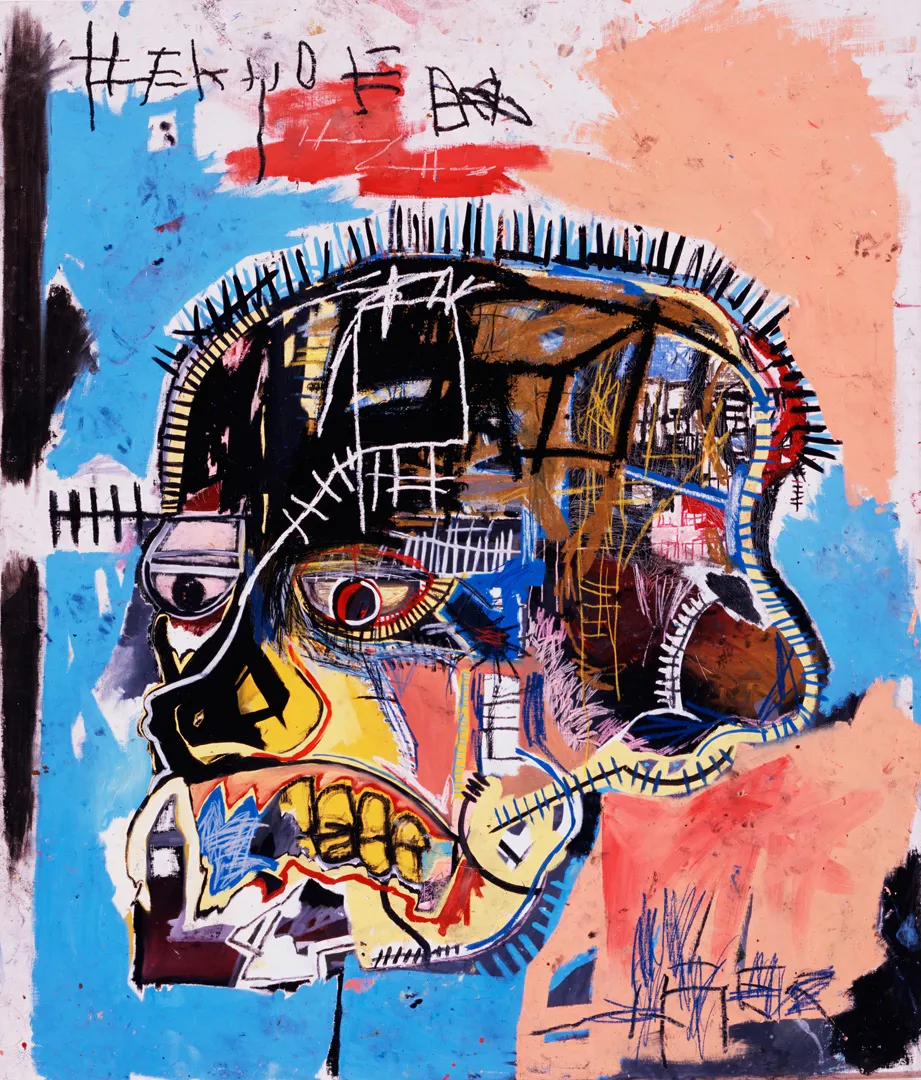
Jean-Michel Basquiat’s artwork is renowned for its raw, expressive quality and its incorporation of text and imagery. His paintings often reflect his experiences as a black man in America and address themes of race, identity, and social inequality. Basquiat’s style is a fusion of graffiti, abstract expressionism, and primitive art, characterized by bold colors, dynamic compositions, and a mix of words and symbols.
One of his significant early influences was the Italian artist Francesco Clemente, as well as American artists like David Salle and Julian Schnabel. His collaboration with Andy Warhol, which began in the early 1980s, was particularly impactful. The duo created a series of works together, blending their distinctive styles and generating significant media attention.
Major Exhibitions and Critical Acclaim
Basquiat’s career skyrocketed in the early 1980s. He held solo exhibitions in prestigious galleries worldwide, including the Galerie Bruno Bischofberger in Zurich, the Delta Gallery in Rotterdam, the Kestner-Gesellschaft in Hannover, and the Akira Ikeda Gallery in Tokyo. His work was characterized by its vibrant energy and powerful commentary on contemporary issues.
In 1985, Basquiat graced the cover of the New York Times Magazine with the headline “New Art, New Money: The Making of an American Artist.” This cover story solidified his status as a leading figure in the art world and highlighted his rapid ascent to fame.
Personal Struggles and Relationships
Despite his professional success, Basquiat faced significant personal challenges. He struggled with drug addiction, a problem exacerbated by the pressures of fame and the intense scrutiny of the art world. His close relationship with Andy Warhol was both a source of support and strain. The death of Warhol in 1987 deeply affected Basquiat, leading to increased depression and drug use.
Basquiat had a notable relationship with the then-unknown singer Madonna in the early 1980s. This relationship, along with his numerous interactions with other prominent figures in the art and entertainment worlds, added to his complex and often tumultuous personal life.
Untimely Death and Legacy
Jean-Michel Basquiat’s life was tragically cut short when he died of a heroin overdose on August 12, 1988, at the age of 27. Despite his brief career, Basquiat’s impact on the art world was profound. His work continues to be celebrated for its boldness, originality, and social commentary.
Posthumously, Basquiat’s art has gained even greater acclaim. His pieces have fetched record prices at auctions, with “Untitled” (1982) selling for $110.5 million at Sotheby’s in 2017, setting a record for an American artist. Exhibitions of his work continue to draw large audiences worldwide, affirming his enduring influence and relevance.
Cultural Impact and Representation
Basquiat’s influence extends beyond the art world into popular culture. His life and work have been the subject of numerous books, documentaries, and films. The 1996 film “Basquiat,” directed by Julian Schnabel and starring Jeffrey Wright as Basquiat, brought his story to a wider audience. David Bowie portrayed Andy Warhol in the film, adding to its cultural resonance.
Basquiat’s legacy as a pioneering black artist in a predominantly white art world has made him a symbol of resistance and creativity. His ability to blend high and low culture, and to infuse his work with personal and political meaning, has inspired generations of artists.
Reflections on His Art
Basquiat’s art is often described as a visual diary, reflecting his thoughts, experiences, and observations. His use of text and imagery creates a layered and complex narrative that invites viewers to explore themes of identity, power, and resilience. Basquiat once said, “I cross out words so you will see them more; the fact that they are obscured makes you want to read them.”
Critics have praised his work for its energy, spontaneity, and emotional depth. Henry Geldzahler, a longtime curator at the Metropolitan Museum of Art, described Basquiat’s work as having “the incisive simplicity of late Roman inscriptions.” His ability to convey complex ideas through seemingly chaotic compositions is a testament to his genius.
Influence on Contemporary Art
Jean-Michel Basquiat’s influence on contemporary art is immeasurable. His fusion of graffiti and fine art has paved the way for street artists to gain recognition in the mainstream art world. Artists like Banksy and KAWS owe a debt to Basquiat’s trailblazing efforts.
Moreover, Basquiat’s exploration of identity and race has resonated with artists who seek to address social and political issues through their work. His legacy is evident in the continued relevance of his themes and the ongoing appreciation of his unique artistic voice.
Conclusion
Jean-Michel Basquiat’s life and career, though tragically short, left an indelible mark on the art world. From his early days as a graffiti artist to his rise as an internationally acclaimed painter, Basquiat’s journey is a testament to his extraordinary talent and vision. His work continues to inspire and challenge audiences, solidifying his place as one of the most important artists of the 20th century.
Basquiat’s story is a powerful reminder of the potential for art to transcend boundaries and address profound human experiences. As his legacy endures, Jean-Michel Basquiat remains a radiant figure in the world of art, his work a beacon of creativity, defiance, and expression.


