
Introduction
Saul Bass, born on May 8, 1920, in the Bronx, New York, is celebrated as one of the most influential graphic designers and filmmakers of the 20th century. Renowned for his innovative title sequences, film posters, and corporate logos, Bass revolutionized visual communication in both cinema and commercial design. This article delves into his life, career, and the milestones that defined his path to fame.
Early Life and Education
Saul Bass was born into a modest family in New York City. His father was a furrier, a trade he emigrated to the United States to pursue. Bass’s early exposure to art came from his mother, who encouraged his interest in drawing and design. In 1938, Bass won a scholarship to attend the Art Students League in Manhattan, where he began his formal education in art and design.
During the early 1940s, Bass worked as an assistant in the art department of Warner Bros. in New York, gaining invaluable experience in the field of design. His education continued at the Brooklyn College, where he studied under the Hungarian-born graphic designer Gyorgy Kepes. Kepes, a former student of Laszlo Moholy-Nagy, introduced Bass to the Bauhaus principles and constructivism, profoundly influencing his design philosophy.
Move to Los Angeles and Career Beginnings
In 1946, Bass moved to Los Angeles, seeking new opportunities in the burgeoning advertising and film industries. He worked at several design firms before founding his own studio, Saul Bass & Associates, in 1952. This move marked the beginning of a prolific career that would change the face of graphic design and motion graphics.
Breakthrough with Otto Preminger
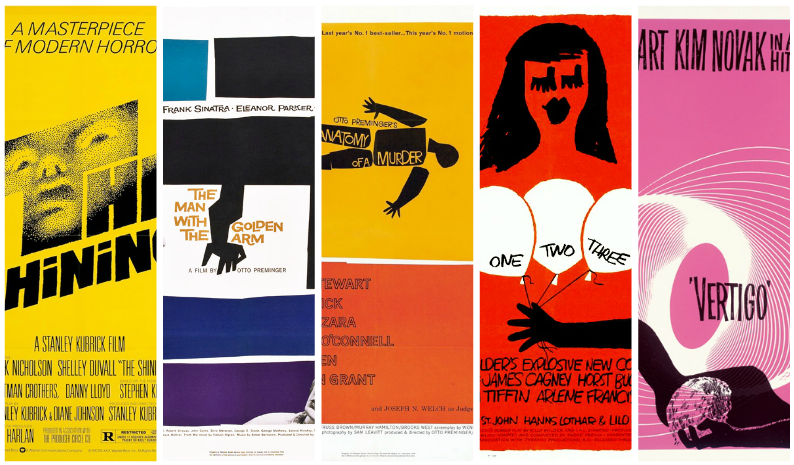
Bass’s big break came in 1954 when he was hired by director Otto Preminger to design the poster for the film “Carmen Jones.” Impressed by Bass’s work, Preminger also commissioned him to create the title sequence for the film. This collaboration marked the beginning of a long and fruitful partnership, with Bass designing iconic title sequences for Preminger’s films such as “The Man with the Golden Arm” (1955) and “Anatomy of a Murder” (1959).
Pioneering Title Sequences
Saul Bass is best known for revolutionizing the art of film title sequences. His work transformed these often overlooked elements into integral parts of the cinematic experience, setting the tone and mood for the films they introduced. Bass’s title sequences were characterized by their simplicity, bold typography, and innovative use of motion graphics.
Collaborations with Alfred Hitchcock
One of Bass’s most notable collaborations was with director Alfred Hitchcock. Bass designed the title sequences for several of Hitchcock’s films, including “Vertigo” (1958), “North by Northwest” (1959), and “Psycho” (1960). His work on “Psycho” extended beyond the title sequence to the famous shower scene, where his storyboard and design concepts played a crucial role in its execution.
Other Significant Projects
Bass’s influence extended to collaborations with other major directors such as Stanley Kubrick, for whom he designed the titles and promotional material for “Spartacus” (1960), and Billy Wilder, for whom he created the titles for “The Seven Year Itch” (1955). His work on “Spartacus” included creating the epic’s poster and consulting on several scenes.
Directorial Ventures
In addition to his work as a graphic designer, Saul Bass also directed several films. His feature film “Phase IV” (1974), a science fiction thriller about intelligent ants, showcased his talent for visual storytelling. Although it received critical acclaim, it was not a commercial success. Bass also directed the Oscar-winning short documentary “Why Man Creates” (1968), which explores the nature of creativity.
Corporate Identity and Logo Design
Beyond the film industry, Saul Bass made significant contributions to corporate branding. He designed some of the most recognizable logos of the 20th century, including those for AT&T, United Airlines, Minolta, and Bell System. His work in this area was characterized by its simplicity, functionality, and timeless appeal.
Notable Logos
- AT&T: Bass designed the iconic globe logo for AT&T, symbolizing global communication and technological advancement.
- United Airlines: The minimalist “tulip” logo for United Airlines became an enduring symbol of the airline’s brand.
- Minolta: The logo Bass created for Minolta featured a sleek, modern design that conveyed innovation and precision.
Later Career and Legacy
In the 1980s and 1990s, Saul Bass continued to work on film title sequences and corporate design projects. He formed a notable partnership with director Martin Scorsese, designing the title sequences for “Goodfellas” (1990), “Cape Fear” (1991), “The Age of Innocence” (1993), and “Casino” (1995). These collaborations demonstrated Bass’s enduring relevance and adaptability in the ever-evolving field of design.
Bass’s contributions to graphic design and motion graphics were recognized with numerous awards and honors. He received an Academy Award for his documentary short “Why Man Creates” and was inducted into the Art Directors Hall of Fame. His work continues to inspire designers and filmmakers around the world.
Death and Posthumous Recognition
Saul Bass passed away on April 25, 1996, in Los Angeles, California, at the age of 75. His legacy lives on through his groundbreaking work, which remains a benchmark in the fields of graphic design and film. Posthumously, his influence has been celebrated in numerous exhibitions, books, and retrospectives.
Influence on Modern Design
Bass’s innovative approach to design has had a lasting impact on both the graphic design and film industries. His ability to distill complex ideas into simple, powerful visuals set a new standard for visual communication. Modern designers and filmmakers continue to draw inspiration from his work, recognizing the timeless quality of his designs.
Conclusion
Saul Bass’s life and career are marked by extraordinary achievements and contributions to the fields of graphic design and film. From his early days in New York to his influential work in Hollywood, Bass’s creative vision and innovative spirit have left an indelible mark on the world of design. His legacy as a pioneer in motion graphics and corporate identity design continues to inspire and influence generations of designers and filmmakers.
As we look back on his remarkable career, Saul Bass stands as a testament to the power of creativity and the enduring impact of visionary design. His work remains a vital part of our visual culture, reminding us of the profound influence that design can have on our everyday lives.


