
Introduction
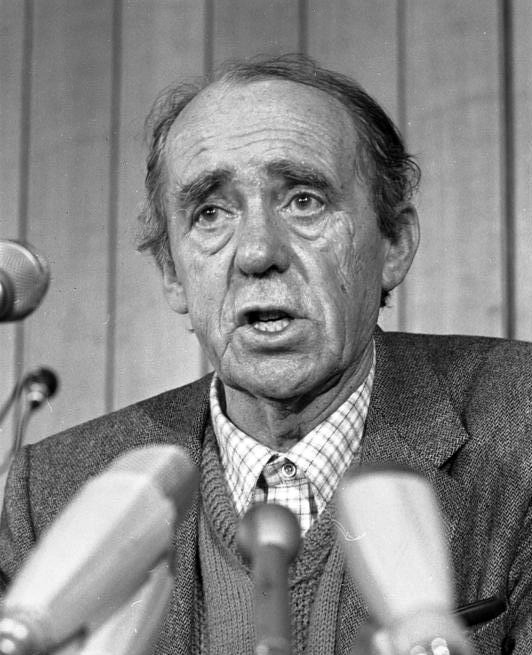
Heinrich Böll stands as one of the most influential German writers of the 20th century, renowned for his profound literary contributions and poignant critiques of post-war German society. Born on December 21, 1917, in Cologne, Böll’s life was shaped by the tumultuous events of the 20th century, from the rise and fall of Nazi Germany to the post-war reconstruction and beyond. This article explores Böll’s age, his rise to fame, and the key highlights of his life, offering a comprehensive view of this Nobel laureate’s legacy.
Early Life and Family Background
Heinrich Böll was born into a Catholic family during the final years of the German Empire. His father, Viktor Böll, was a master carpenter with a passion for wood sculpting, while his mother, Maria, came from a family of brewers. This artisan background, combined with a strong Catholic faith, influenced Böll’s early worldview, instilling in him values of craftsmanship, humility, and a deep sense of moral responsibility.
Education and Early Career
Böll completed his secondary education in 1937 and found himself drawn to literature. He began working as an apprentice in a bookstore, where he indulged his passion for reading and writing. In 1939, he wrote his first novel, “On the Edge of the Church,” and commenced his studies in literature and philology. However, his academic pursuits were interrupted by the outbreak of World War II.
World War II and Military Service
The Nazi regime, which Böll and his family opposed, conscripted him into the military. He served for six years, fighting on various fronts from France to Russia. His experiences in the war, including being wounded and eventually captured by American forces, deeply affected him. These harrowing experiences would later be recounted in his posthumously published work, “The Legacy,” highlighting the despair and anger of a young man forced into a war he detested.
During these years, Böll corresponded with Annemarie Cech, a childhood friend who became his wife in 1942. Their letters provided him with emotional solace during the war’s darkest moments.
Post-War Years and Literary Beginnings
Returning to a bombed-out Cologne after the war, Böll struggled to rebuild his life. He assisted his brother in a carpentry business while continuing to write. His early short stories were published in various literary magazines, marking the beginning of his literary career. Böll resumed his university studies and, in 1949, published his first novel, “The Train Was on Time.” This work began to establish his reputation as a significant voice in German literature.
Rise to Fame
Böll’s breakthrough came with the publication of “Traveler, If You Come to Spa…” in 1950, a collection of twenty-five short stories that garnered critical acclaim. The following year, he was invited to join “Group 47,” a prominent literary circle that played a crucial role in post-war German literature. Böll won a prestigious award from the group for his satirical story “The Black Sheep,” further solidifying his status as a rising literary star.
Major Works and Themes
Throughout the 1950s and 1960s, Böll’s literary output was prolific. His 1953 novel, “And Never Said a Word,” is one of his most celebrated works, featuring his initial critiques of the Catholic Church, which he perceived as being overly concerned with political and economic power rather than addressing the needs of the impoverished. His 1959 novel, “Billiards at Half-Past Nine,” delves into the psychological aftermath of the war and the moral dilemmas faced by individuals in a rapidly changing society.
In 1963, Böll published “The Clown,” a novel that received widespread acclaim and became one of his most recognized works. The story critiques post-war German society and its hypocrisies through the eyes of a disillusioned clown. This work solidified Böll’s reputation as a sharp and insightful critic of contemporary German life.
Health Issues and Later Career
From 1966 onwards, Böll’s health began to decline, forcing him to reduce his literary activities. Despite this, he continued to write and explore other forms of expression, including radio dramas and theater. His commitment to social and political issues remained strong, and he became an active voice in the peace movement.
Nobel Prize and International Recognition
In 1971, Böll became the president of the International PEN Club, an organization dedicated to promoting literature and defending free expression. That same year, he published “Group Portrait with Lady,” a novel that provides a realistic and introspective account of German society from the end of the empire to the student protests of the 1960s. This novel’s success was capped by Böll receiving the Nobel Prize in Literature in 1972, the highest honor for a writer, recognizing his extensive body of work and his impact on world literature.
Continued Contributions and Final Years
Even after receiving the Nobel Prize, Böll continued to write and engage in social activism. His 1974 novel, “The Lost Honor of Katharina Blum,” addresses the manipulation and sensationalism of the media, a theme that remains relevant today. His subsequent works, including “The Safety Net” (1979) and “Women in a River Landscape” (1985), continued to explore the complexities of post-war German society.
Böll was also known for his humanitarian efforts. In 1974, he provided refuge to Soviet dissident Alexander Solzhenitsyn in his home in Langenbroich, demonstrating his commitment to human rights and freedom of expression.
Death and Legacy
Heinrich Böll passed away on July 16, 1985, at the age of 68, in his home in Langenbroich, North Rhine-Westphalia. His death marked the end of a prolific career that left an indelible mark on German and world literature. Böll’s works continue to be studied and celebrated for their incisive critiques, moral depth, and exploration of the human condition.
Literary Influence and Historical Context
Böll’s writing is deeply rooted in the historical context of 20th-century Germany. His firsthand experiences of World War II and the post-war reconstruction shaped his perspectives and themes. Böll’s critiques of the Catholic Church, the political establishment, and societal norms reflected the disillusionment of a generation that witnessed the horrors of war and the challenges of rebuilding a nation.
His works often depict ordinary people grappling with moral and ethical dilemmas, providing a voice to those who suffered under both the Nazi regime and the subsequent economic and social transformations. Böll’s commitment to pacifism, justice, and human dignity resonates throughout his oeuvre, making him a powerful advocate for these values.
Conclusion
Heinrich Böll’s life and work offer a profound exploration of the human spirit in the face of adversity. From his early years in Cologne to his experiences in World War II and his rise as a leading literary figure, Böll’s journey is a testament to the resilience and creativity of the human mind. His contributions to literature and his unwavering commitment to social justice continue to inspire readers and writers around the world.
Böll’s legacy is not only found in his extensive bibliography but also in his impact on literary and social discourse. As a Nobel laureate, his work transcends national boundaries, addressing universal themes of humanity, morality, and the quest for a just society. Heinrich Böll remains a towering figure in literature, whose insights and critiques are as relevant today as they were during his lifetime.


