
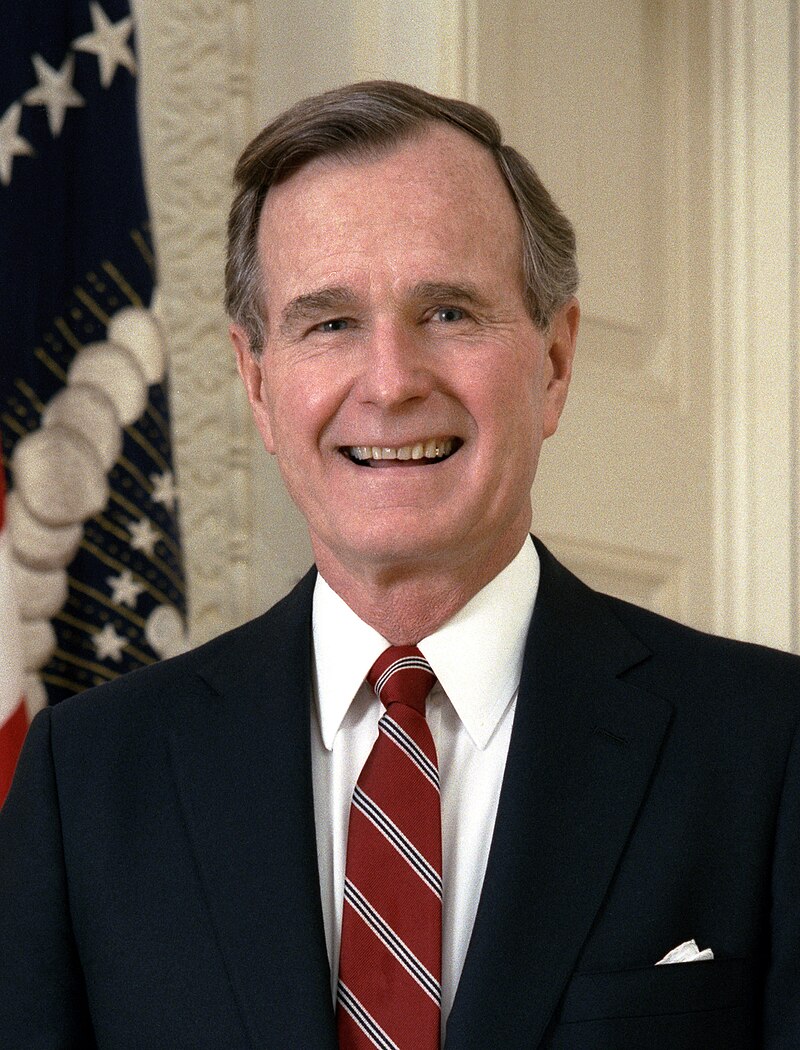
George Herbert Walker Bush, often referred to as George H.W. Bush or George Bush Senior, was the 41st President of the United States, serving from 1989 to 1993. Born on June 12, 1924, in Milton, Massachusetts, Bush was a prominent figure in American politics, known for his deep commitment to public service, which spanned several decades. His presidency marked a period of significant global change, with the end of the Cold War, the fall of the Berlin Wall, and the Gulf War, among other pivotal events. Bush’s life and career were characterized by a dedication to his country, a strong sense of duty, and a legacy that continues to influence American politics.
Early Life and Education
George H.W. Bush was born into a family with a strong tradition of public service. His father, Prescott Sheldon Bush, was a successful banker who later became a U.S. Senator from Connecticut. Growing up in a privileged environment, Bush was instilled with values of responsibility, patriotism, and service from a young age. He attended Phillips Academy in Andover, Massachusetts, a prestigious boarding school where he excelled both academically and athletically.
After graduating from Phillips Academy in 1942, Bush enlisted in the U.S. Navy on his 18th birthday, becoming one of the youngest aviators in the Navy during World War II. He flew 58 combat missions during the war, and in 1944, his plane was shot down by Japanese forces over the Pacific. Despite being rescued by a U.S. submarine, this experience profoundly shaped his perspective on life and service. For his bravery, Bush was awarded the Distinguished Flying Cross, among other honors.
Following his military service, Bush attended Yale University, where he earned a degree in Economics in 1948. At Yale, he was a member of the Phi Beta Kappa honor society and served as captain of the baseball team, leading them to the College World Series twice. His time at Yale further honed his leadership skills and prepared him for a life in public service.
Early Career and Entry into Politics
After graduating from Yale, Bush moved to Texas, where he entered the oil business. He co-founded the Zapata Petroleum Corporation in 1953, which later became a successful independent oil company. His success in the oil industry provided him with the financial independence that allowed him to pursue a career in politics.
Bush’s first significant step into politics came in 1964 when he ran for the U.S. Senate as a Republican from Texas. Although he lost the election, the experience solidified his commitment to public service. In 1966, he was elected to the U.S. House of Representatives from Texas’s 7th district, where he served two terms. As a congressman, Bush was known for his moderate stance on issues, supporting civil rights legislation and advocating for a balanced approach to government spending.
In 1970, Bush made another bid for the Senate but was again defeated. However, this loss did not deter him; instead, it opened doors to various high-profile appointments. President Richard Nixon appointed Bush as the U.S. Ambassador to the United Nations in 1971, a role in which he served until 1973. His tenure at the U.N. was marked by his diplomatic skills and his ability to navigate complex international issues during a turbulent time in global politics.
Following his service at the U.N., Bush was appointed as the Chairman of the Republican National Committee (RNC) in 1973, during the Watergate scandal. His leadership at the RNC was challenging, as he had to balance loyalty to the Republican Party with the growing demands for accountability and transparency in government. Bush’s principled approach during this period earned him respect across the political spectrum.
In 1974, President Gerald Ford appointed Bush as the Chief of the U.S. Liaison Office in the People’s Republic of China. This role, though not officially recognized as ambassadorial due to the lack of formal diplomatic relations, was crucial in managing the delicate relationship between the U.S. and China. Bush’s time in China further broadened his understanding of global affairs and strengthened his credentials in foreign policy.
In 1976, Bush was appointed Director of the Central Intelligence Agency (CIA), where he served for one year. His leadership at the CIA was marked by efforts to restore the agency’s morale and reputation following the scandals of the previous decade. Bush’s tenure at the CIA was critical in reinforcing his image as a capable and trustworthy public servant.
Vice Presidency under Ronald Reagan
In 1980, Bush sought the Republican nomination for President but lost to Ronald Reagan. Recognizing Bush’s experience and broad appeal, Reagan chose him as his running mate. The Reagan-Bush ticket won a decisive victory in the 1980 election, and Bush became the 43rd Vice President of the United States.
As Vice President, Bush played a key role in several domestic and international issues. He chaired task forces on deregulation and combating drug abuse, reflecting his commitment to both economic growth and social issues. Bush was also an active representative of the Reagan administration abroad, visiting numerous countries and strengthening U.S. alliances around the world.
One of Bush’s most notable actions as Vice President was his involvement in foreign policy, particularly in Latin America. He supported Reagan’s efforts to combat communist influence in the region, including the controversial Iran-Contra affair, where arms were sold to Iran to fund Nicaraguan rebels. Although Bush’s role in the affair was scrutinized, he maintained that he was not fully aware of the details of the operation.
Presidency (1989-1993)
In 1988, George H.W. Bush ran for President as the Republican candidate, with the campaign slogan “A Kinder, Gentler Nation.” He won the election, defeating Democratic candidate Michael Dukakis, and was inaugurated as the 41st President of the United States on January 20, 1989.
Bush’s presidency was marked by significant global changes and challenges. One of the most notable events during his administration was the end of the Cold War. Bush played a crucial role in managing the peaceful dissolution of the Soviet Union and the reunification of Germany. His diplomatic skills were instrumental in maintaining stability during this period of global transition.
Another major achievement of Bush’s presidency was the successful prosecution of the Gulf War in 1991. After Iraq, led by Saddam Hussein, invaded Kuwait in August 1990, Bush led a coalition of 34 nations in Operation Desert Storm to liberate Kuwait. The military campaign was swift and effective, resulting in the withdrawal of Iraqi forces and the restoration of Kuwait’s sovereignty. Bush’s handling of the Gulf War was widely praised and boosted his approval ratings at home.
Domestically, Bush’s presidency faced several challenges, particularly in the area of economic policy. Despite his campaign pledge of “no new taxes,” Bush was forced to raise taxes in 1990 as part of a budget agreement with Congress to reduce the federal deficit. This decision was politically costly, leading to a decline in his popularity and contributing to his loss in the 1992 presidential election to Bill Clinton.
Bush also faced criticism for his handling of domestic issues such as the economy, healthcare, and civil rights. While his administration achieved some successes, such as the passage of the Americans with Disabilities Act (ADA) in 1990, which prohibited discrimination based on disability, many felt that Bush was more focused on foreign policy than on addressing the needs of everyday Americans.
Post-Presidency and Legacy
After leaving office in 1993, George H.W. Bush remained active in public life, though he largely avoided the political spotlight. He dedicated much of his time to humanitarian causes, often working alongside his former political rival, Bill Clinton. The two former presidents collaborated on various initiatives, including disaster relief efforts following the Indian Ocean tsunami in 2004 and Hurricane Katrina in 2005. Their partnership was widely praised and became a symbol of bipartisanship and cooperation.
Bush also supported his sons’ political careers. His eldest son, George W. Bush, served as the 43rd President of the United States from 2001 to 2009, while his younger son, Jeb Bush, served as the Governor of Florida from 1999 to 2007. Despite his advanced age, Bush remained engaged in public affairs and continued to be a respected elder statesman.
George H.W. Bush passed away on November 30, 2018, at the age of 94. His death marked the end of an era in American politics, and he was remembered as a dedicated public servant who guided the nation through a time of significant global change. His legacy is one of statesmanship, diplomacy, and a deep commitment to the values of freedom and democracy.
Conclusion
George H.W. Bush’s life was one of extraordinary service and dedication to his country. From his early days as a Navy pilot in World War II to his years in the White House, Bush exemplified the qualities of leadership, integrity, and compassion. His presidency, marked by the end of the Cold War and the successful Gulf War, left a lasting impact on the world and shaped the course of American history. Even after leaving office, Bush continued to serve his country and the world, earning the respect and admiration of people across the political spectrum. His legacy as a statesman, leader, and patriot will endure for generations to come.


