
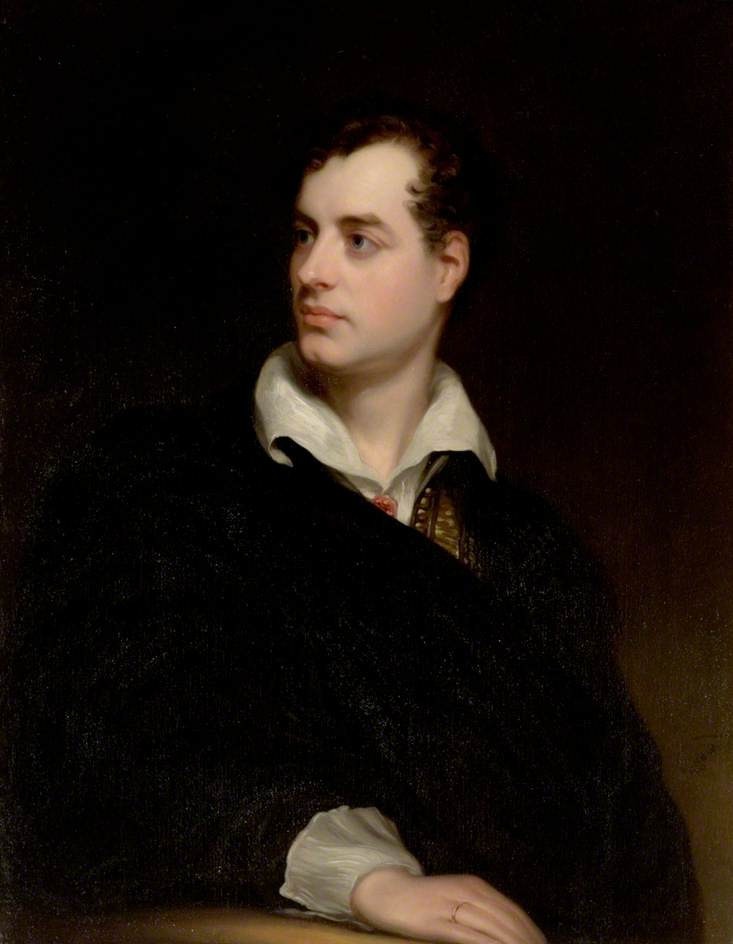
George Gordon Noel Byron, famously known as Lord Byron, remains one of the most iconic figures of English Romanticism. Born on January 22, 1788, in London, Byron’s life was a tapestry of passion, controversy, and literary genius. His influence on literature, as well as his impact on society, continues to be a subject of fascination.
Early Life and Family Background
George Byron’s early life was marked by both privilege and hardship. Born into the aristocracy, he was the son of Captain John “Mad Jack” Byron, a man known for his reckless behavior and financial irresponsibility. This left young Byron and his mother, Catherine Gordon of Gight, in a state of relative poverty. They relocated to Aberdeen, Scotland, where Byron spent much of his childhood. The rugged landscapes of Scotland, with its dramatic coastlines and mountains, deeply influenced his later poetic works.
Byron’s early exposure to the Calvinist doctrine of predestination instilled in him a complex understanding of guilt and fate, themes that would permeate his writings throughout his life. Despite his noble lineage, Byron’s upbringing was far from idyllic, characterized by emotional and financial instability.
The Making of a Poet: Education and Early Works
Byron began writing poetry at the tender age of 12, spurred by a youthful infatuation with a cousin. His early poetic endeavors were a mix of personal reflection and an exploration of the human condition. In 1805, Byron entered Trinity College, Cambridge, where his intellectual and creative talents began to flourish. However, his academic career was marked by a rebellious spirit, often clashing with the rigid norms of the time.
In 1806, Byron published his first collection of poetry, “Fugitive Pieces,” anonymously. The collection was later revised and reissued as “Poems on Various Occasions” in 1807. It wasn’t until the third reissue, under the title “Hours of Idleness,” that Byron’s name appeared on the cover. This collection received harsh criticism from the “Edinburgh Review,” prompting Byron to pen his first significant satirical work, “English Bards and Scotch Reviewers,” where he mercilessly attacked the literary establishment of his day.
The Grand Tour: Travels and Inspiration
In 1809, Byron embarked on a journey across Europe, a tradition among British aristocrats known as the “Grand Tour.” Accompanied by his close friend, John Cam Hobhouse, Byron set sail from Falmouth to Lisbon, marking the beginning of a series of travels that would significantly shape his literary output. His travels took him through Spain, Gibraltar, Malta, and Greece, among other locations.
Byron’s time in Greece was particularly transformative. He was captivated by the country’s ancient history, its landscapes, and its ongoing struggle for independence from the Ottoman Empire. These experiences would later be immortalized in his work “Childe Harold’s Pilgrimage,” which brought him widespread fame upon his return to Britain in 1811.
Rise to Fame: Literary Achievements and Public Image
Byron’s return to Britain coincided with the publication of the first two cantos of “Childe Harold’s Pilgrimage” in 1812. The work was an instant success, catapulting Byron to literary stardom. His portrayal of the brooding, melancholic hero in “Childe Harold” resonated with the public, establishing the archetype of the “Byronic hero”—a figure characterized by a deep sense of melancholy, defiance, and a mysterious past.
Byron’s fame was not limited to his literary achievements. His striking good looks, charismatic personality, and scandalous love affairs made him a celebrity in the truest sense of the word. His relationship with Lady Caroline Lamb, one of the most admired women in London society, became the talk of the town. It was Lady Caroline who famously described Byron as “mad, bad, and dangerous to know.”
Scandal and Exile
Byron’s personal life was as tumultuous as his literary career. In 1815, he married Anna Isabella Milbanke, a union that produced a daughter, Augusta Ada (later known as Ada Lovelace, a pioneer in computing). However, the marriage quickly fell apart, leading to a highly publicized separation in 1816. Rumors swirled about Byron’s relationships, including allegations of an incestuous affair with his half-sister, Augusta Leigh, and speculations about his homosexuality.
The scandal surrounding Byron became so intense that he chose to leave England for good in 1816. His self-imposed exile led him to Switzerland, where he spent time with the poet Percy Bysshe Shelley, Mary Shelley, and her stepsister Claire Clairmont, with whom he had a brief affair resulting in the birth of his daughter Allegra.
The Italian Years and Literary Masterpieces
After Switzerland, Byron settled in Italy, living in Venice, Rome, and eventually moving to Ravenna. During this period, Byron produced some of his most significant works, including the satirical epic “Don Juan.” “Don Juan” was a daring, innovative work that defied the conventions of its time, blending humor, social critique, and a deep understanding of human nature. It remains one of his most celebrated contributions to English literature.
Byron’s Italian years were also marked by his involvement in the political movements of the time. He became actively engaged with the Carbonari, a secret revolutionary society fighting for Italian independence. His political activism further cemented his reputation as a radical figure, willing to challenge the status quo.
Final Chapter: The Greek War of Independence and Byron’s Legacy
In 1823, Byron took his commitment to the cause of liberty to a new level by joining the Greek War of Independence against the Ottoman Empire. He arrived in Greece in 1824, determined to support the struggle for freedom. Byron’s involvement in the Greek cause was more than just a symbolic gesture; he used his wealth to fund the resistance and even took command of a rebel force.
Tragically, Byron’s time in Greece was cut short by illness. He contracted a fever, which worsened and led to his death on April 19, 1824, in Missolonghi. He was just 36 years old. Byron’s death was mourned across Europe, and he was hailed as a hero in Greece, where he is still remembered as a national figure of importance.
Conclusion: The Enduring Legacy of Lord Byron
George Byron’s life was a whirlwind of passion, creativity, and controversy. His literary works continue to be studied and admired for their emotional depth, satirical edge, and innovative style. Beyond his literary contributions, Byron’s life story has inspired countless biographies, films, and academic studies, making him one of the most enduring figures of the Romantic era.
Byron’s legacy is multifaceted—he was a poet, a lover, a revolutionary, and a cultural icon. His influence can be seen not only in literature but also in the broader cultural landscape, where the “Byronic hero” continues to be a powerful archetype in art and popular culture.
In the end, George Byron’s life and works offer a profound exploration of the human condition, filled with all its contradictions, passions, and complexities. His story is a reminder of the enduring power of art and the relentless pursuit of freedom, both personal and political.


