
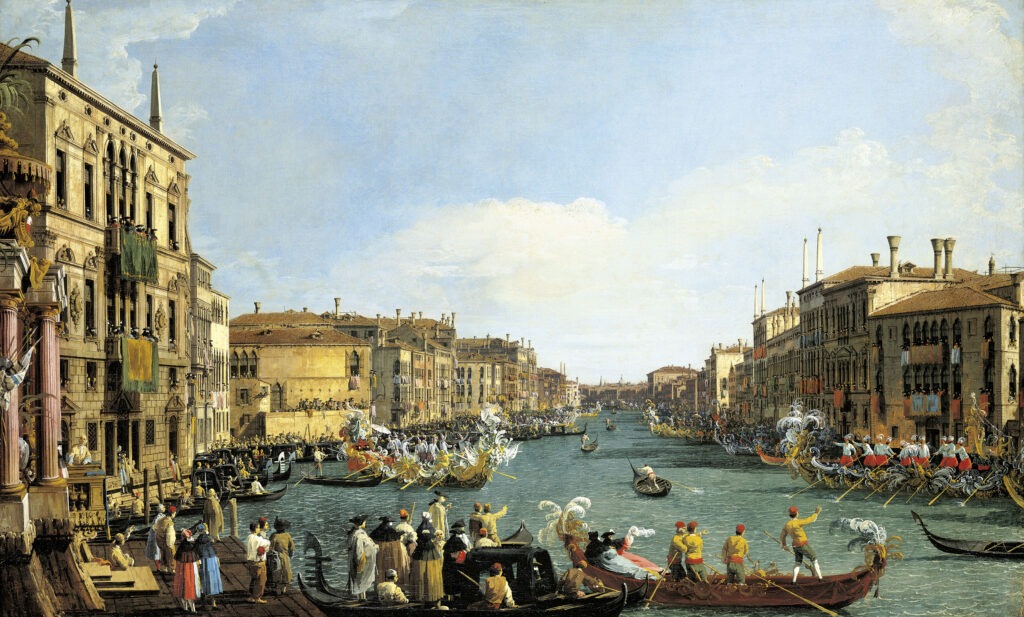
Giovanni Antonio Canal, famously known as Canaletto, is a name that has been etched into the annals of art history for his extraordinary contributions to the genre of Vedutismo—the art of capturing cityscapes and landscapes with meticulous detail. His works, primarily centered on the grandeur of Venice, have left an indelible mark on both European and global art. Born on October 17, 1697, in Venice, Canaletto’s life and career were marked by an international flair that brought Venetian art into the limelight on the world stage.
Early Life and Artistic Beginnings
Canaletto was born into a well-to-do Venetian family in the parish of San Lio. His father, Bernardo Canal, was a renowned theatrical scene painter, which significantly influenced Canaletto’s initial foray into the world of art. Alongside his brother Cristoforo, Canaletto honed his skills in his father’s workshop, mastering the craft of scenic decoration for theatrical productions in Venice.
Between 1718 and 1720, Canaletto traveled to Rome with his father and brother, a journey that proved to be pivotal in his artistic development. During this period, he was introduced to the genre of Vedutismo. His exposure to artists like Viviano Codazzi and Giovanni Ghisolfi, who specialized in painting ruins, as well as Gaspar Van Wittel, who was a pioneer of Dutch Vedutismo, helped shape Canaletto’s artistic vision.
Rise to Fame: The Venetian Vedutismo
Returning to Venice, Canaletto immersed himself in the world of Vedutismo, interacting with leading local artists such as Luca Carlevarijs and Marco Ricci. By the early 1720s, Canaletto had established himself as a prominent figure in Venetian art, known for his meticulously detailed and luminous portrayals of Venice’s architectural splendor.
The period between 1722 and 1723 marked a significant turning point in Canaletto’s career. He began working for Joseph Smith, a future English consul and an ardent art collector. This collaboration opened doors to the English market, with Canaletto’s works soon adorning the walls of prestigious residences across Britain.
Canaletto’s International Success: The British Connection
The influence of the English market on Canaletto’s career cannot be overstated. From 1725 to 1726, he was commissioned by Owen McSwiney, an Irish impresario, further cementing his relationship with the English-speaking world. This connection proved invaluable, particularly in the 1730s, when Canaletto’s primary patrons in Britain, such as Anton Maria Zanetti the Elder and Joseph Smith, began commissioning his works almost exclusively.
During this period, Canaletto expanded his repertoire, moving beyond the iconic Venetian views of San Marco and the Rialto Bridge to include capriccios—imaginary landscapes—featuring ruins, countryside scenes, and Roman vistas. His ability to combine reality with elements of fantasy made his works highly sought after by collectors across Europe.
The London Years: Overcoming Challenges
The outbreak of the War of the Austrian Succession in 1740 posed a significant challenge for Canaletto. The conflict disrupted the flow of English visitors to Venice, which had been a vital source of his commissions. In response, Canaletto made a bold move in 1746—he relocated to London. Armed with a letter of introduction to the Duke of Richmond, a former client, Canaletto sought to reestablish his market in Britain.
Despite initial skepticism from British art circles, Canaletto’s reputation soon soared. Two advertisements in the Daily Advertiser effectively dispelled doubts about his authenticity, paving the way for numerous commissions from the British aristocracy. His London period saw a shift in subject matter, with Canaletto now focusing on English landscapes, castles, palaces, and urban scenes.
Return to Venice and Later Years
After nearly a decade in London, punctuated by brief returns to Venice, Canaletto decided to settle permanently in his beloved Venice in 1755. His later years were marked by continued success, including a significant commission from the German merchant Sigismund Streit. This period saw a resurgence of the capriccio in his work, characterized by a blend of reality and imaginative landscapes.
In 1763, Canaletto’s contributions to art were formally recognized when he was admitted to the Venetian Academy of Painting and Sculpture. His health, however, began to decline in his later years, leading to his death on April 19, 1768, in his home near the Church of San Lio in Venice.
Canaletto’s Legacy: A Lasting Impact
Canaletto’s legacy is one of artistic innovation and international influence. His works are celebrated for their precision, use of light, and the ability to capture the essence of a place. His paintings not only serve as visual records of Venice’s splendor during the 18th century but also reflect the broader cultural exchanges between Italy and Britain.
Canaletto’s art continues to be revered, with his paintings held in major museums and private collections worldwide. His ability to merge the real and the fantastical in his landscapes has inspired countless artists and remains a testament to his genius.
The Nuances of Canaletto’s Art
Canaletto’s art is often characterized by its photographic realism, but it’s crucial to understand the creative liberties he took. His works are not mere reproductions of scenes but are carefully composed to heighten their visual impact. This approach reflects the broader Rococo movement of the time, which emphasized elegance, lightness, and decoration.
One of the defining features of Canaletto’s work is his use of camera obscura—a device that projected scenes onto a surface, allowing him to trace them with precision. While this technique helped achieve accuracy in perspective, Canaletto often manipulated the actual layout of buildings and spaces to create more harmonious compositions.
Moreover, Canaletto’s paintings served not just as art but as cultural artifacts. For his British patrons, his Venetian scenes were more than just souvenirs; they were symbols of the Grand Tour—a rite of passage for the English elite. Owning a Canaletto was a way to bring a piece of Venetian culture back to Britain, and his works were often displayed as evidence of the owner’s cultural sophistication.
Historical Context: The Grand Tour and Canaletto’s Market
The Grand Tour was a cultural phenomenon in the 18th century, where young aristocrats from Britain and other parts of Europe traveled through France and Italy to experience the art, architecture, and history of these countries. Venice, with its rich history and unique architecture, was a key destination on this tour.
Canaletto’s rise to fame is intrinsically linked to this tradition. His patrons were often Grand Tourists who desired to take home a visual record of their travels. Canaletto’s ability to depict Venice with both accuracy and artistic flair made his paintings the perfect mementos. This demand created a robust market for his works, particularly in Britain, where the Grand Tour was a well-established tradition.
SEO Considerations: Canaletto and Modern Search Intent
When discussing Canaletto in the context of modern search engine optimization (SEO), it’s essential to consider the relevance of keywords and search intent. Terms like “Canaletto biography,” “Venetian painter Canaletto,” “Canaletto’s influence on Vedutismo,” and “Canaletto’s works in British collections” are crucial for attracting readers interested in art history, Venetian culture, and 18th-century European art.
Ensuring that these keywords are seamlessly integrated into the content, while maintaining a natural flow, is key to both enhancing the article’s readability and improving its visibility on search engines. Additionally, providing detailed insights into Canaletto’s techniques, his impact on art, and the historical context of his works will cater to a broad audience, ranging from casual art enthusiasts to serious scholars.
In conclusion, Canaletto’s life and work represent a fascinating intersection of art, culture, and history. His ability to capture the essence of Venice and translate it into timeless works of art has cemented his place as one of the great masters of European painting. Whether viewed through the lens of historical significance or artistic technique, Canaletto’s legacy continues to resonate, offering a window into the world of 18th-century Venice and the enduring appeal of its landscapes.


