
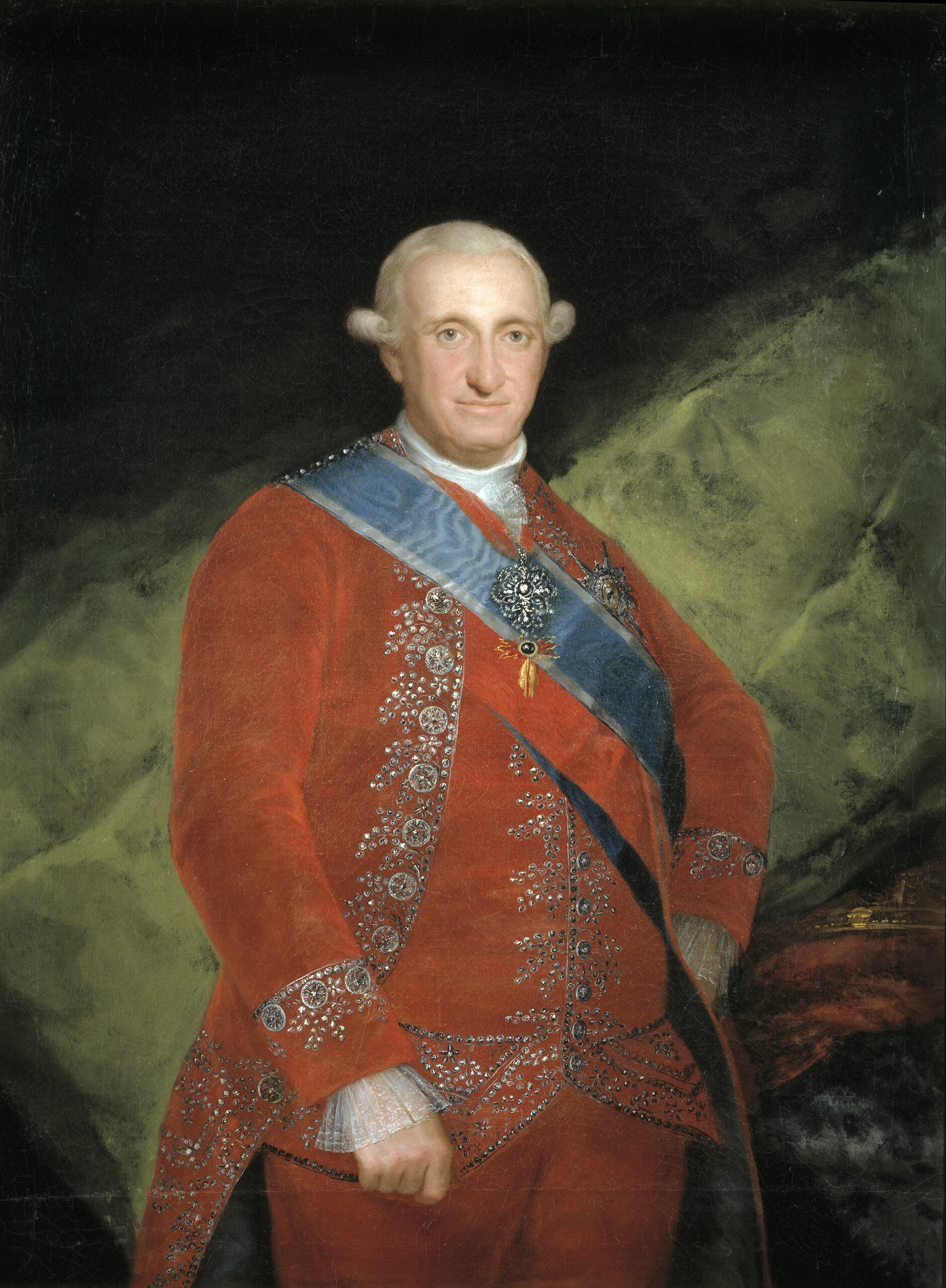
Carlo IV di Spagna, born on November 11, 1748, in Portici, Naples, was a monarch whose reign was marked by political turmoil, personal struggles, and the gradual decline of Spain’s global influence. As the second son of Carlo III of Spain and Maria Amalia of Saxony, Carlo IV inherited a kingdom facing the pressures of a changing Europe. His reign, from 1788 to 1808, was a period of significant historical events, including the French Revolution and the rise of Napoleon Bonaparte, which had profound effects on Spain and its monarchy.
Early Life and Ascension to the Throne
Carlo IV was born into a royal family with deep connections to the European powers of the 18th century. His father, Carlo III, was a strong and reformist monarch who had secured the Kingdom of Naples and later the throne of Spain. Growing up in this environment, Carlo IV was groomed for leadership, but he lacked the decisive nature and political acumen of his father. In 1765, Carlo married Maria Luisa of Parma, a union that would later play a crucial role in his reign.
Carlo IV ascended to the Spanish throne on December 14, 1788, following the death of his father. His reign began just months before the storming of the Bastille in France, an event that would signal the start of the French Revolution. This revolution would have far-reaching consequences for all European monarchies, including Spain’s.
The French Revolution and Its Impact
The early years of Carlo IV’s reign were overshadowed by the revolutionary fervor sweeping across Europe. As the French Revolution gained momentum, it posed a direct threat to the stability of neighboring monarchies. Like many other European rulers, Carlo IV was alarmed by the developments in France, particularly the execution of King Louis XVI in January 1793. This event sent shockwaves through the royal courts of Europe, leading to the formation of the First Coalition, an alliance of European powers including Spain, Britain, Austria, and Russia, aimed at containing the spread of revolutionary ideas.
Spain’s involvement in the wars against revolutionary France proved disastrous. The Spanish army suffered several defeats, and by 1795, Spain was forced to sign the Treaty of Basel, ceding territories to France. This treaty marked the beginning of Spain’s decline as a major European power and underscored the weaknesses in Carlo IV’s leadership.
Influence of Maria Luisa and Manuel de Godoy
Carlo IV’s reign was heavily influenced by his wife, Queen Maria Luisa, and her confidant, Manuel de Godoy. Godoy, who rose rapidly through the ranks of the Spanish court, became the de facto ruler of Spain due to his close relationship with the queen. Appointed as Prime Minister in 1792, Godoy wielded considerable power, much to the dismay of many Spanish nobles and members of the royal family.
Godoy’s influence over the king and queen led to a series of controversial decisions, including Spain’s alliance with Napoleonic France. In 1796, Spain signed the Treaty of San Ildefonso, allying with France against Britain. This alliance, however, proved to be a double-edged sword. While it temporarily secured Spain from French aggression, it also dragged the country into a costly and ultimately unsuccessful war against Britain. The Spanish navy, once a dominant force, was decimated at the Battle of Trafalgar in 1805, a defeat that left Spain vulnerable and further eroded its influence on the world stage.
Internal Struggles and the Rise of Ferdinand VII
Carlo IV’s reign was also marked by internal strife, particularly with his son, Ferdinand. The prince resented Godoy’s influence over his parents and saw him as a usurper of royal authority. This familial tension came to a head in 1808 during the Mutiny of Aranjuez, a popular uprising supported by Ferdinand that forced Carlo IV to abdicate in favor of his son.
However, the abdication was short-lived. Napoleon Bonaparte, who had his own designs on Spain, saw the turmoil within the Spanish royal family as an opportunity. Napoleon invited both Carlo IV and Ferdinand VII to Bayonne, where he coerced them into renouncing their claims to the Spanish throne. Napoleon then placed his brother, Joseph Bonaparte, on the Spanish throne, a move that ignited widespread resistance across Spain and led to the Peninsular War.
Exile and Later Life
After his forced abdication, Carlo IV and Maria Luisa were exiled to France, where they lived under the protection of Napoleon. Later, they were allowed to move to Rome, where they spent their remaining years in relative obscurity. Despite his fall from power, Carlo IV was treated with respect by Napoleon, who granted him a generous pension in exchange for his abdication.
Carlo IV spent the final years of his life in Rome, far removed from the political turmoil that had characterized his reign. He died on January 20, 1819, at the age of 71. His legacy is one of a monarch who, despite his best intentions, was unable to navigate the complex and rapidly changing political landscape of Europe in the late 18th and early 19th centuries.
Legacy and Historical Significance
Carlo IV’s reign is often viewed as a period of decline for Spain. His inability to effectively govern, coupled with his reliance on Maria Luisa and Godoy, led to a series of missteps that weakened the Spanish monarchy and contributed to the loss of Spain’s global standing. The alliance with Napoleon, in particular, is seen as a critical error that ultimately led to Spain’s involvement in the Peninsular War and the eventual collapse of the Spanish Empire in the Americas.
Historically, Carlo IV is remembered as a well-intentioned but ineffective ruler. His reign highlights the challenges faced by monarchs during a time of significant social and political upheaval. The French Revolution, the rise of Napoleon, and the internal divisions within Spain all contributed to the difficulties of his reign. While he is not celebrated as one of Spain’s great kings, his reign offers important lessons about the dangers of weak leadership and the consequences of relying too heavily on advisors and allies.
The famous painting by Francisco Goya, “The Family of Carlos IV,” painted in 1800-1801, serves as a visual reminder of the complexities and contradictions of Carlo IV’s reign. The painting, which depicts the royal family in a somewhat unflattering light, has been interpreted by many as a subtle critique of the king’s rule and the dysfunction within the Spanish court.
SEO Considerations
For those researching Carlo IV di Spagna, key phrases to focus on include “Carlo IV biography,” “Spanish monarchy history,” “Napoleon and Spain,” and “decline of the Spanish Empire.” Additionally, terms like “Manuel de Godoy influence,” “Peninsular War impact,” and “abdication of Carlo IV” will help attract readers interested in the broader historical context of his reign.
To optimize for search engines, it is important to maintain a keyword density of around 1-2%, ensuring that relevant terms such as “Carlo IV’s reign,” “Spanish royal family,” and “Napoleonic wars” are integrated naturally throughout the text. This approach will help improve the article’s visibility while ensuring it remains engaging and informative for readers.
In conclusion, Carlo IV di Spagna’s life and reign were shaped by the tumultuous events of his time. His struggles to maintain control over a declining empire, his reliance on advisors like Godoy, and his eventual abdication under pressure from Napoleon all contribute to his complex legacy. While his reign may not be remembered as a high point in Spanish history, it remains an essential period for understanding the broader forces that shaped modern Europe.


