
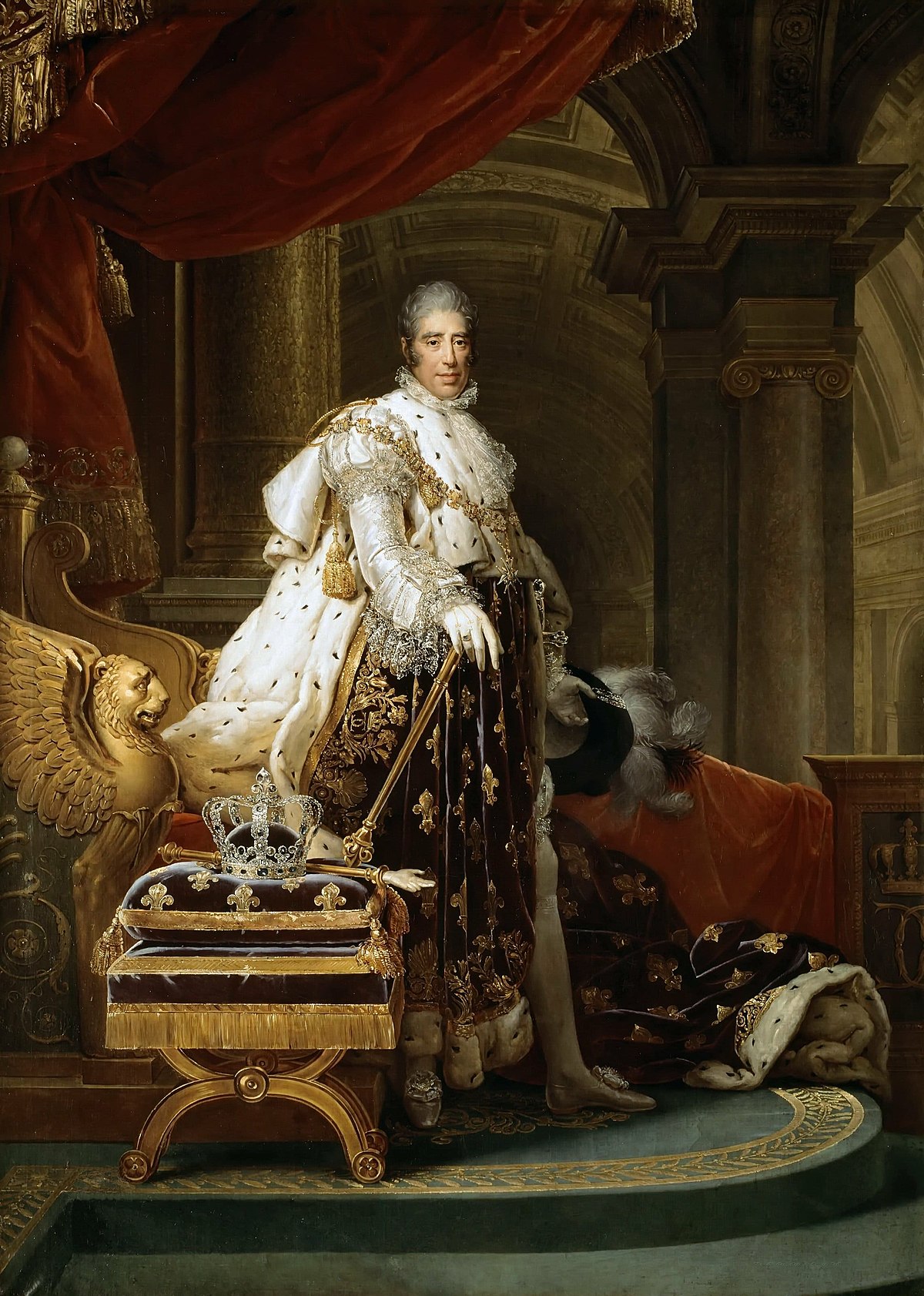
Carlo X di Francia, born on October 9, 1757, in Versailles, was a monarch whose reign marked the final chapter of the Bourbon dynasty in France. He was the last of the Bourbon kings to rule over France before the July Revolution of 1830 led to his abdication and the end of the Bourbon Restoration. Carlo X’s life and reign were deeply intertwined with the turbulent events of the French Revolution, the Napoleonic Wars, and the Restoration, making him a pivotal figure in the transition from the old monarchical order to the modern era.
Early Life and Background
Carlo X was born Charles-Philippe, Count of Artois, the youngest son of Louis Ferdinand, Dauphin of France, and Maria Josepha of Saxony. As the grandson of Louis XV and brother to both Louis XVI and Louis XVIII, Carlo X was raised in the opulent environment of the French court at Versailles, where he was steeped in the traditions and values of the Ancien Régime. His early life was marked by privilege and influence, and he quickly became known for his conservative and deeply religious views.
In 1773, Carlo X married Maria Teresa of Savoy, the daughter of Victor Amadeus III of Sardinia and Maria Antonia Ferdinanda of Spain. This marriage solidified his ties to other European royal families and further entrenched his position within the aristocratic elite of the time.
The French Revolution and Exile
Carlo X’s life took a dramatic turn with the outbreak of the French Revolution in 1789. As the revolution gathered momentum and the old order began to crumble, Carlo emerged as one of the most ardent opponents of the revolutionary movement. He became the leader of the ultraroyalists, a faction of the nobility that sought to preserve the absolute monarchy and the privileges of the aristocracy.
As the revolution intensified, Carlo was forced to flee France in 1789, becoming one of the many émigrés who sought refuge in other European countries. During his years in exile, Carlo worked tirelessly to garner support for the royalist cause, aligning himself with the European powers that were hostile to the revolution. He participated in several unsuccessful attempts to restore the monarchy, including supporting the counter-revolutionary forces in the War of the First Coalition.
The execution of his brother, Louis XVI, in 1793 was a devastating blow to Carlo and further fueled his determination to restore the Bourbon monarchy. He continued his efforts throughout the Napoleonic Wars, even as France underwent profound changes under the leadership of Napoleon Bonaparte.
The Bourbon Restoration and Ascension to the Throne
The defeat of Napoleon in 1814 marked the beginning of the Bourbon Restoration, a period during which the monarchy was restored under Carlo’s elder brother, Louis XVIII. Carlo returned to France, where he assumed the title of Count of Artois and became a key figure in the restored monarchy. His influence grew steadily, and he became the leader of the ultra-royalist faction, which sought to undo many of the changes brought about by the revolution and the Napoleonic era.
Upon the death of Louis XVIII in 1824, Carlo X ascended to the throne of France. His coronation took place at Reims, the traditional site of French royal coronations, where he insisted on the full ceremonial pomp of the Ancien Régime. This insistence on traditionalism reflected Carlo X’s deep-seated belief in the divine right of kings and his desire to restore the absolute monarchy.
Reign of Carlo X: Policies and Controversies
Carlo X’s reign was marked by his efforts to reverse the liberal reforms that had been implemented during the Revolution and under his brother’s reign. He sought to restore the privileges of the Catholic Church and the nobility, which had been significantly diminished during the revolutionary period. One of his most controversial measures was the introduction of the “Law of Indemnity” in 1825, which compensated émigrés for the losses they had suffered during the Revolution. This law was highly unpopular with the broader French population, who saw it as an unjust reward for those who had abandoned the country during its time of need.
Carlo X also took steps to reassert the influence of the Catholic Church in French society. He encouraged the reestablishment of religious orders that had been suppressed during the Revolution and supported measures that reinforced the Church’s role in education and public life. His policies reflected his belief in the need to restore moral order to France, but they also alienated many of the more liberal and secular elements of French society.
The growing opposition to Carlo X’s rule culminated in the appointment of Jules de Polignac as his chief minister in 1829. Polignac, an ultra-royalist like Carlo, pursued a hardline conservative agenda that further exacerbated tensions within France. His government became increasingly unpopular, particularly among the middle classes and the press, who saw it as an attempt to return to the absolute monarchy of the pre-revolutionary era.
The July Revolution and Abdication
The final crisis of Carlo X’s reign began in July 1830, when he issued the “Four Ordinances of Saint-Cloud.” These decrees dissolved the newly elected Chamber of Deputies, restricted the freedom of the press, reduced the electorate, and called for new elections under a more restrictive franchise. The ordinances were widely seen as an attempted coup d’état, a direct assault on the constitutional liberties that had been established during the Restoration.
The response was swift and dramatic. From July 27 to 29, 1830, Paris erupted in revolt in what became known as the “Three Glorious Days” (Les Trois Glorieuses). The streets of Paris were filled with barricades as workers, students, and members of the National Guard rose up against the king’s decrees. The revolution quickly spread, and Carlo X, realizing that he had lost control of the situation, fled to the royal residence at Rambouillet.
On August 2, 1830, Carlo X abdicated the throne in favor of his grandson, Henri, Duke of Bordeaux, who was nominally declared King Henri V. However, the abdication did little to stem the tide of revolution. The French Chamber of Deputies refused to recognize Henri as king, instead offering the crown to Louis-Philippe, Duke of Orléans, who was proclaimed “King of the French” on August 9, 1830. This marked the beginning of the July Monarchy, a more liberal constitutional regime that replaced the Bourbon monarchy.
Exile and Death
After his abdication, Carlo X went into exile once again, this time taking refuge in Scotland before eventually settling in Prague under the protection of the Austrian Empire. The remainder of his life was spent in relative obscurity, far from the political turmoil that had defined his reign. Carlo X continued to hope for a restoration of the Bourbon monarchy, but he never returned to France.
Carlo X died on November 6, 1836, in Gorizia, a town in the Austrian Empire (now in Italy), at the age of 79. His death marked the end of an era, not only for the Bourbon dynasty but also for the Ancien Régime in France. The July Revolution of 1830 had effectively closed the chapter on the traditional monarchical order in France, paving the way for a more modern constitutional monarchy under Louis-Philippe.
Legacy and Historical Significance
Carlo X’s reign is often viewed as the last attempt to restore the absolute monarchy in France. His conservative policies and reactionary stance made him deeply unpopular with the emerging liberal and republican forces in French society, leading to his eventual downfall. The July Revolution of 1830, which forced him from the throne, is seen as a critical turning point in French history, marking the definitive end of the Ancien Régime and the rise of a new political order.
Historically, Carlo X is remembered as a king who was out of step with the changing times. His failure to adapt to the political and social realities of post-revolutionary France led to his downfall and the end of the Bourbon Restoration. While he was deeply committed to his principles, his inability to compromise ultimately doomed his reign.
Carlo X’s legacy is complex. On one hand, he is seen as a symbol of the old monarchical order, steadfast in his commitment to traditional values and authority. On the other hand, his reign is often criticized for its inability to reconcile the demands of a modern, changing society with the principles of absolute monarchy. His abdication and the subsequent establishment of the July Monarchy marked a significant shift in French history, one that paved the way for the further democratization of French political life.
SEO Considerations
For those researching Carlo X di Francia, key phrases to focus on include “Carlo X biography,” “French monarchy history,” “Bourbon Restoration,” and “July Revolution of 1830.” Additionally, terms like “Ancien Régime,” “ultra-royalists in France,” and “abdication of Carlo X” will attract readers interested in the broader historical context.
To optimize for search engines, it is important to maintain a keyword density of around 1-2%, ensuring that relevant terms such as “Carlo X’s reign,” “French Bourbon dynasty,” and “French Revolution impact” are integrated naturally throughout the text. This will help improve the article’s visibility while ensuring it remains engaging and informative for readers.
In conclusion, Carlo X di Francia was a king whose reign represented the last stand of the Bourbon monarchy in France. His commitment to traditional monarchical values in the face of a rapidly modernizing society ultimately led to his downfall and the end of the Ancien Régime. His life and reign remain a significant chapter in the history of France, illustrating the challenges of maintaining an absolute monarchy in an era of revolutionary change.


