
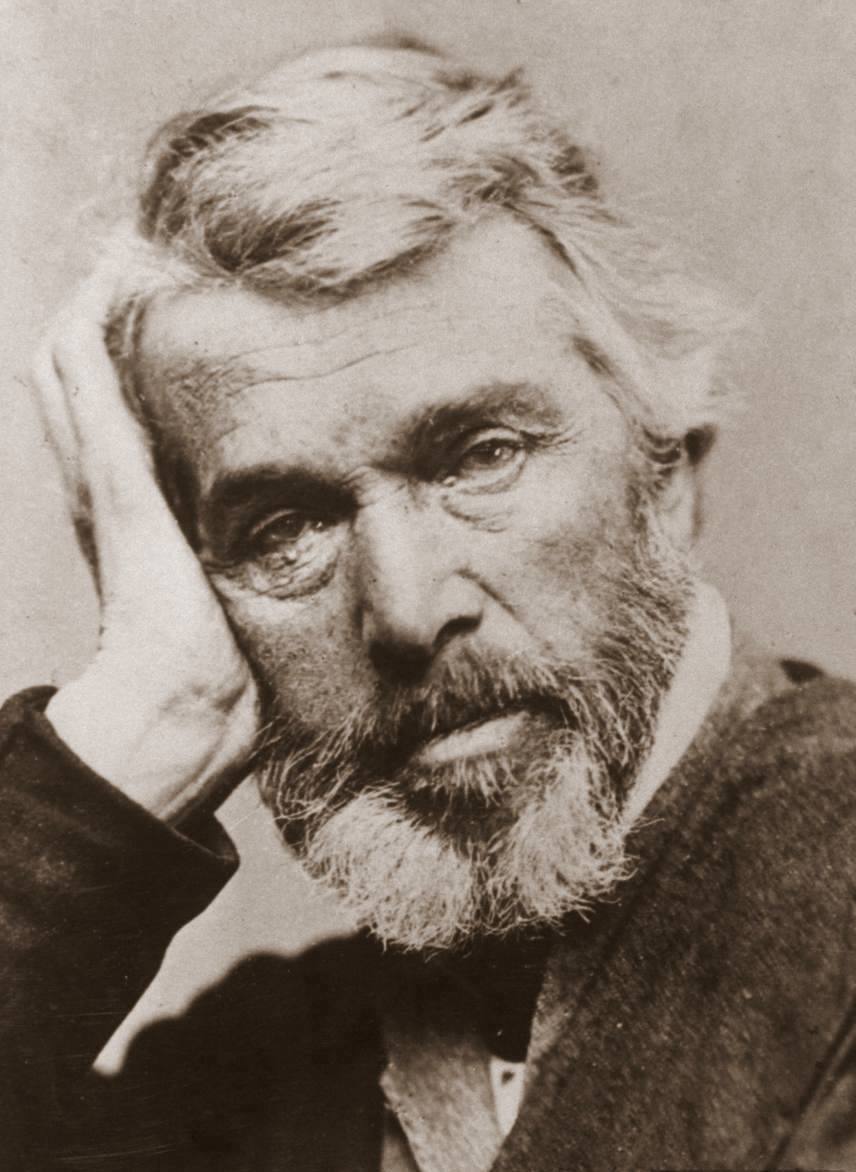
Thomas Carlyle, born on December 4, 1795, in Ecclefechan, Scotland, was a pivotal figure in 19th-century philosophy, history, and literature. His influence on Victorian thought and beyond cannot be overstated. Carlyle was a man of deep intellectual rigor, a philosopher, essayist, historian, and a critic of modernity whose works continue to resonate today. His life and work encapsulate the spirit of a turbulent era, marked by the tension between progress and tradition, individualism and collective identity, and spiritual depth versus materialism.
Early Life and Education
Thomas Carlyle was born into a poor Calvinist family, which profoundly shaped his worldview. The strict Calvinist upbringing instilled in him a deep sense of spirituality and a moralistic approach to life, themes that would later permeate his writings. Despite the family’s modest means, Carlyle’s parents placed a high value on education, which led him to attend the University of Edinburgh.
Initially, Carlyle was set on a path toward a career in the Church, as was customary for someone from his background. However, during his studies, he developed a passion for philosophy and literature, leading him to abandon his ecclesiastical ambitions in favor of a more secular intellectual pursuit. His time at Edinburgh was transformative; he immersed himself in the works of German philosophers, particularly Johann Gottlieb Fichte and Immanuel Kant, which influenced his developing philosophical outlook.
Carlyle’s deep interest in German literature and philosophy would later distinguish him from many of his contemporaries, making him one of the early proponents of German idealism in Britain. This intellectual foundation was critical to his later works, which blended German idealism with his native Calvinist morality.
Literary Beginnings and Sartor Resartus
Carlyle’s early career was marked by his struggles as a writer. His first significant work, Sartor Resartus (“The Tailor Re-Tailored”), was published between 1833 and 1834, though it initially struggled to find a publisher and audience. This work, which can be described as a philosophical novel, is both allegorical and autobiographical, reflecting Carlyle’s own spiritual journey and intellectual struggles.
Sartor Resartus is a complex, satirical, and often enigmatic work that explores themes of existential despair, the search for meaning, and the critique of contemporary society. The book presents itself as a commentary on the fictional writings of a German philosopher, Diogenes Teufelsdröckh, whose “philosophy of clothes” serves as a metaphor for the human condition. Through this metaphor, Carlyle examines the superficiality of society and the need to look beyond appearances to grasp the true nature of reality.
Despite its initial lukewarm reception, Sartor Resartus later became recognized as a groundbreaking work, influencing a generation of writers and thinkers, including Ralph Waldo Emerson, who helped promote Carlyle’s work in the United States. The book’s blend of satire, philosophical inquiry, and moral seriousness set the tone for much of Carlyle’s subsequent writing.
The French Revolution and Historical Writings
Carlyle’s reputation as a historian was firmly established with the publication of The French Revolution: A History in 1837. This three-volume work is not just a historical account but a vivid, dramatic retelling of the events that shook France and the world in the late 18th century. Carlyle’s narrative style was unique for its time—rich in imagery, emotional intensity, and moral judgment. He brought history to life, not as a mere sequence of events, but as a profound human drama driven by forces of destiny and the actions of great individuals.
The French Revolution, for Carlyle, was a cataclysmic event that symbolized the collapse of the old order and the birth of a new, uncertain era. His portrayal of the revolutionaries, the chaos, and the ultimate rise of Napoleon Bonaparte was infused with his belief in the role of “heroes” in shaping history. Carlyle’s concept of hero-worship would become a central theme in his later works, most notably in On Heroes, Hero-Worship, and the Heroic in History (1841).
In On Heroes, Carlyle argues that history is shaped by the actions of great individuals—heroes—who possess unique qualities that allow them to guide and influence the masses. These heroes, whether they be prophets, poets, or kings, are seen as manifestations of divine will, the visible “receptacles of God” in the world. Carlyle’s hero-worship reflects his rejection of the emerging democratic ideals of his time, which he saw as leading to mediocrity and moral decline.
Another significant historical work by Carlyle is The Life of John Sterling (1851), a biography of his close friend. Although lesser-known than his other works, this biography is important for understanding Carlyle’s views on religion, morality, and the struggles of the human spirit.
Critique of Industrial Society
Carlyle was also a sharp critic of the industrial revolution and the social changes it brought. His essay Signs of the Times (1829) and the book Past and Present (1843) are scathing critiques of the materialism and dehumanization that Carlyle believed were the results of industrialization. He coined the term “the mechanical age” to describe a society increasingly driven by technology and economic progress at the expense of spiritual and moral values.
In Past and Present, Carlyle contrasts the degraded condition of contemporary society with the more organic, communal life of medieval times. He idealizes the past as a time when work was meaningful, and social bonds were strong, in stark contrast to the alienation and exploitation he saw in the modern industrial world. Carlyle’s criticism of capitalism and his longing for a return to more traditional values would influence later social thinkers, including the likes of John Ruskin and William Morris.
His essay Chartism (1839) addresses the social unrest among the working classes and the rise of the Chartist movement, which demanded political reforms including universal male suffrage. While sympathetic to the plight of the poor, Carlyle was critical of the democratic aspirations of the Chartists, reflecting his belief that leadership should be in the hands of the capable few rather than the many.
Later Years and Major Works
Carlyle continued to write prolifically throughout his life, though his later works are often overshadowed by his earlier achievements. Among his most significant later works is Oliver Cromwell’s Letters and Speeches: With Elucidations (1845), which aimed to rehabilitate the reputation of Cromwell, a figure often vilified in British history. Carlyle saw Cromwell as a true hero, a man of action guided by a deep sense of divine purpose.
Carlyle’s final major work was History of Friedrich II of Prussia, Called Frederick the Great (1858-1865), a six-volume study of the Prussian king. This monumental work took over a decade to complete and is often seen as a reflection of Carlyle’s own beliefs in strong, authoritative leadership. Frederick the Great, like Cromwell, was portrayed as a hero who shaped his nation’s destiny through sheer force of will.
Despite his successes, Carlyle’s later years were marked by personal tragedy and disillusionment. The death of his wife, Jane Welsh Carlyle, in 1866, profoundly affected him, leading to a period of deep grief and introspection. Their marriage, while intellectually fruitful, was often strained, and Carlyle’s guilt over his treatment of Jane in their later years added to his sorrow.
Influence and Legacy
Thomas Carlyle’s influence extends far beyond his own time. His ideas on leadership, history, and society have continued to resonate, particularly in times of crisis. Carlyle’s critique of modernity, his skepticism of democracy, and his call for strong, moral leadership found echoes in later political movements, though not always in ways he would have approved.
In the 20th century, Carlyle’s ideas were appropriated by various thinkers and political leaders, some of whom used his concept of hero-worship to justify authoritarian regimes. This darker aspect of Carlyle’s legacy has led to a more critical reassessment of his work in recent years. However, his contributions to literature, history, and philosophy remain significant.
Carlyle’s writing style, characterized by its intense, prophetic tone and vivid imagery, influenced many authors, including Charles Dickens, George Eliot, and Ralph Waldo Emerson. His historical works, particularly The French Revolution, set a new standard for historical writing, blending rigorous scholarship with a narrative style that made history accessible and compelling.
Conclusion
Thomas Carlyle was a complex figure whose life and work reflected the tensions and contradictions of the Victorian era. He was a man of deep convictions, often at odds with the mainstream ideas of his time, yet profoundly influential in shaping the intellectual landscape of the 19th century. Carlyle’s legacy is one of both inspiration and caution—a reminder of the power of ideas and the responsibility that comes with them.
As we reflect on Carlyle’s life, we see a man who was unafraid to challenge the status quo, to speak out against what he saw as the moral failings of his society, and to advocate for a vision of history and leadership that continues to provoke debate today. His life highlights the enduring power of the written word to shape thought, inspire action, and challenge the world to live up to its highest ideals.


