
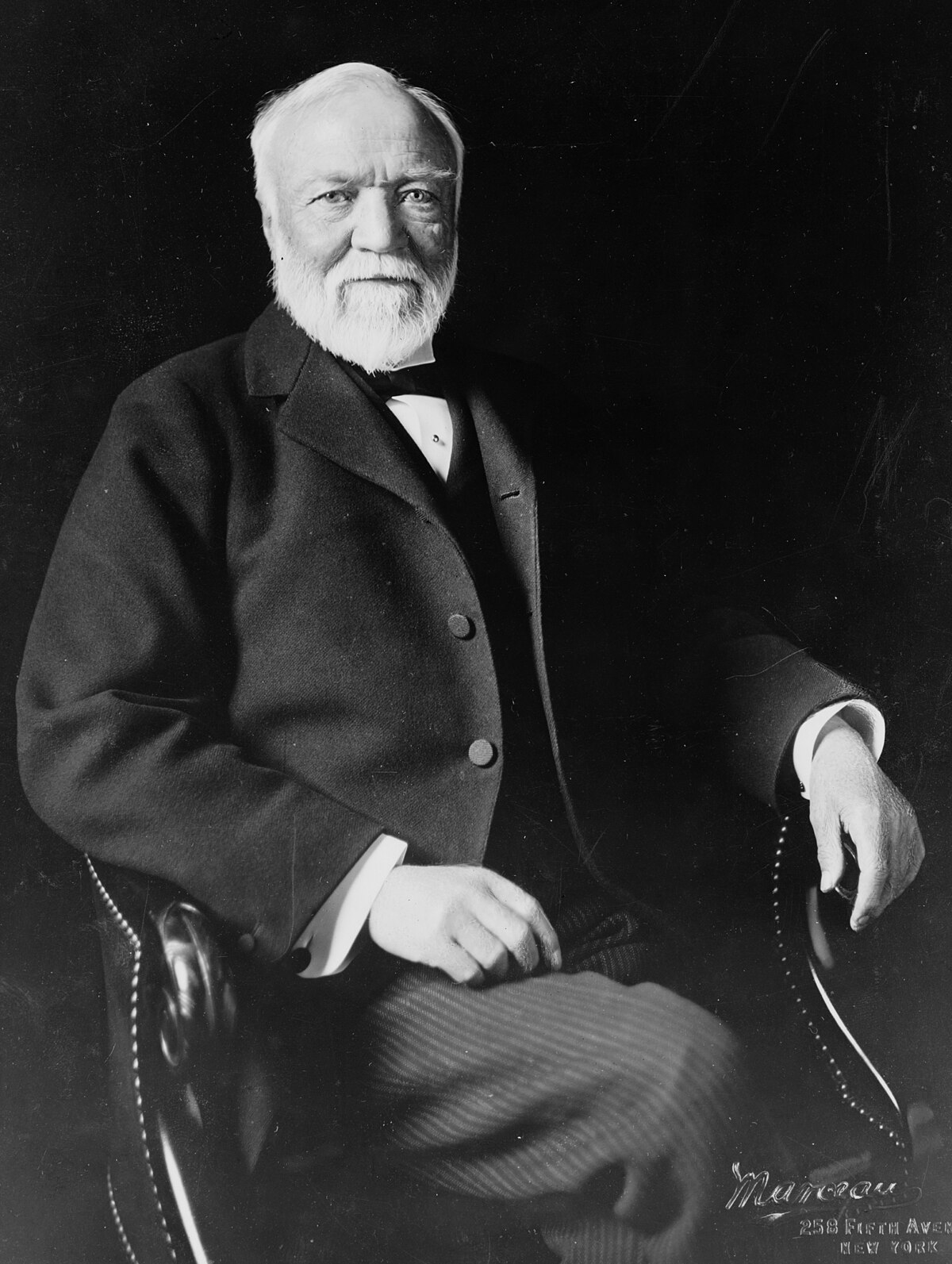
Andrew Carnegie, one of the most influential figures in American history, was born on November 25, 1835, in Dunfermline, Scotland. His journey from a humble immigrant to a titan of industry and later a renowned philanthropist is a quintessential example of the American Dream. This article delves into Carnegie’s life, exploring his rise to fame, his contributions to industry, and his enduring legacy in philanthropy.
Early Life and Emigration to America
Andrew Carnegie was born into a working-class family in Scotland. His father, William Carnegie, was a weaver, while his mother, Margaret Morrison Carnegie, was the daughter of a cobbler. The family’s financial struggles were evident early on, particularly as the Industrial Revolution began to disrupt traditional industries like handloom weaving, which was William Carnegie’s trade. This economic hardship prompted the Carnegie family to emigrate to the United States in search of better opportunities.
In 1848, when Andrew was just 13 years old, the family settled in Allegheny, Pennsylvania. The move to America was a turning point in Carnegie’s life, setting the stage for his future success. The Carnegies borrowed money from their relatives, the Lauder family, to finance their journey—a debt that would be repaid many times over as Andrew Carnegie’s fortunes grew.
The Beginnings of a Business Empire
Upon arriving in America, Andrew Carnegie took his first job as a bobbin boy in a cotton factory, earning a meager $1.20 per week for working 12-hour days, six days a week. Despite the grueling labor, Carnegie was determined to improve his circumstances. His big break came in 1850 when he became a telegraph messenger for the Ohio Telegraph Company in Pittsburgh. Carnegie’s work ethic and attention to detail were quickly noticed. He memorized the faces of important clients and the locations of key businesses in the city, gradually building a network of influential contacts.
Carnegie’s ability to distinguish telegraph signals by ear—a skill he developed through practice—led to his promotion within a year. This marked the beginning of his ascent through the business world.
The Railroads and Early Investments
In 1853, at the age of 18, Carnegie was employed as a secretary and telegraph operator by Thomas A. Scott of the Pennsylvania Railroad Company. Scott, recognizing Carnegie’s potential, became a mentor to the young immigrant. Under Scott’s guidance, Carnegie quickly advanced, eventually becoming the superintendent of the Pittsburgh Division of the Pennsylvania Railroad.
Scott also introduced Carnegie to the world of investments. In 1855, Carnegie made his first investment of $500 in the Adams Express Company, a move that laid the foundation for his future wealth. His involvement in the railroad industry provided him with valuable insights into management and cost control, skills that would later prove crucial in his ventures in the steel industry.
The Civil War and Industrialization
Carnegie’s career took another significant turn during the Civil War. In 1861, Thomas Scott, who had become the Assistant Secretary of War for transportation, appointed Carnegie as the superintendent of the military railways and the telegraph lines in the eastern United States. In this role, Carnegie was responsible for ensuring the efficient transportation of troops and supplies, a task that underscored the critical importance of railroads and telegraphy to the Union’s war effort.
The war also highlighted the importance of industry in modern warfare, a realization that would influence Carnegie’s future business decisions. After the war, Carnegie continued to expand his investments, including a profitable venture in the oil fields of Venango County, Pennsylvania, which yielded significant returns.
The Rise of Carnegie Steel
The post-war period marked the beginning of Andrew Carnegie’s true rise to prominence. In 1865, he founded the Keystone Bridge Company, which focused on replacing wooden bridges with stronger, more durable iron ones. This venture laid the groundwork for Carnegie’s entry into the steel industry, which would soon make him one of the wealthiest men in the world.
Carnegie’s success in steel can be attributed to his relentless pursuit of efficiency and innovation. He was an early adopter of the Bessemer process, a method for producing steel that was faster and cheaper than traditional methods. In 1875, he established the J. Edgar Thomson Steel Works in Pittsburgh, named after the president of the Pennsylvania Railroad. This facility became the backbone of his steel empire.
By the 1880s, Carnegie’s steel operations were producing more steel than all of Great Britain, a testament to the scale and efficiency of his business. The Carnegie Steel Company, founded in 1892, dominated the American steel industry, and its success made Carnegie one of the richest individuals in history.
Philanthropy and the Gospel of Wealth
Despite his immense wealth, Andrew Carnegie is perhaps best remembered for his philanthropy. In 1901, at the age of 65, Carnegie sold his steel company to J.P. Morgan for $480 million, making him one of the wealthiest men in the world. However, Carnegie had long held a belief that the rich had a moral obligation to give back to society. This belief was encapsulated in his 1889 essay, “The Gospel of Wealth,” in which he argued that the wealthy should live modestly and use their excess wealth to benefit society.
Carnegie spent the latter part of his life fulfilling this philosophy. He donated over $350 million to various causes, focusing on education, libraries, and scientific research. One of his most significant contributions was the establishment of the Carnegie Corporation of New York, which funded the creation of public libraries across the United States and the world. By the time of his death, Carnegie had funded the construction of over 2,500 libraries, earning him the nickname “The Patron Saint of Libraries.”
In addition to his contributions to education, Carnegie also established the Carnegie Endowment for International Peace, the Carnegie Institution for Science, and the Carnegie Mellon University in Pittsburgh. His philanthropic legacy is a testament to his belief in the power of education and knowledge to improve society.
Personal Life and Legacy
Andrew Carnegie married Louise Whitfield in 1887 when he was 51 years old, and she was 21 years his junior. The couple had one child, a daughter named Margaret, born in 1897. Carnegie’s personal life was marked by his close relationships with his family and his strong commitment to his Scottish heritage, despite his success in America.
Carnegie’s legacy is a complex one. On one hand, he is celebrated for his philanthropy and his contributions to education and culture. The Carnegie Hall in New York City, one of the most famous concert venues in the world, was funded by him and stands as a symbol of his commitment to the arts. On the other hand, his role in labor disputes, particularly the infamous Homestead Strike of 1892, has left a more controversial legacy. The strike, which resulted in a violent clash between steelworkers and private security forces, highlighted the tensions between labor and management during the Gilded Age.
Carnegie’s influence on American industry and society was profound. He died on August 11, 1919, at the age of 83, in Lenox, Massachusetts. His life story, from a poor Scottish immigrant to one of the richest and most influential men in the world, remains a powerful narrative of opportunity and philanthropy. Carnegie’s contributions to industry, education, and philanthropy have left an indelible mark on the world, making him a central figure in American history.
Conclusion
Andrew Carnegie’s life is a remarkable tale of rags to riches, driven by ambition, innovation, and a deep sense of responsibility to society. His impact on the steel industry was transformative, and his philanthropic efforts have had a lasting influence on education and culture. As we look back on his life, it is clear that Andrew Carnegie was more than just a businessman; he was a visionary who used his wealth to make the world a better place. His legacy continues to inspire generations, reminding us of the power of giving and the importance of using success to benefit others.


