
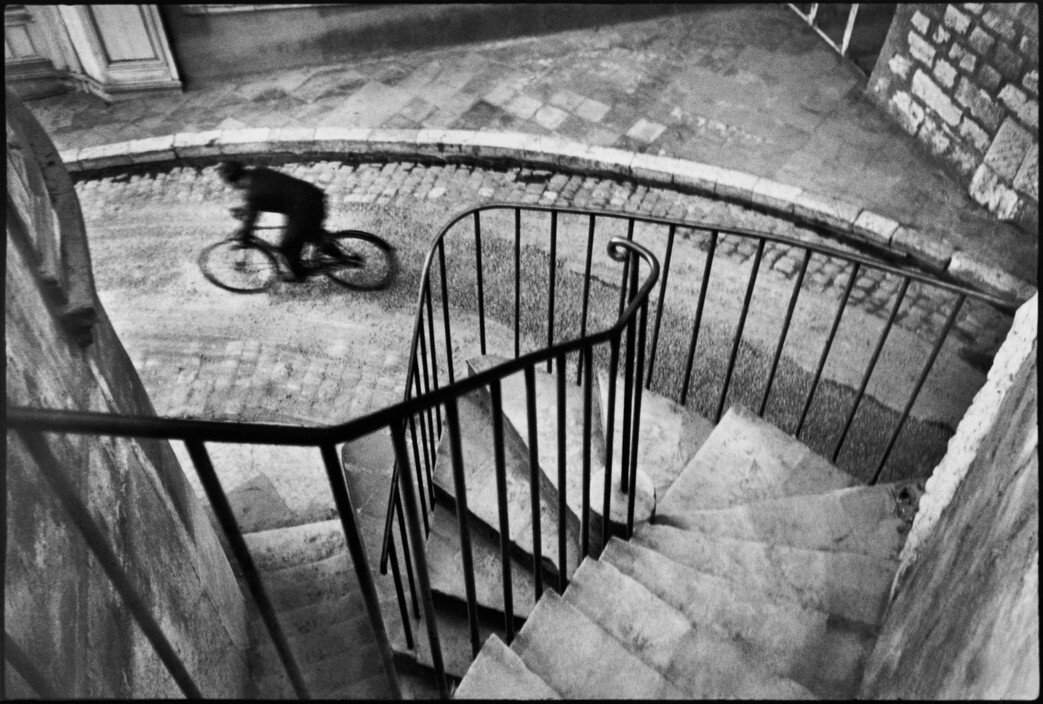
Henri Cartier-Bresson, born on August 22, 1908, in Chanteloup-en-Brie, France, is widely regarded as one of the most influential photographers of the 20th century. Known as the “father of modern photojournalism,” Cartier-Bresson pioneered the concept of “the decisive moment,” a philosophy that defined his approach to capturing images. His work spans nearly a century of global events, personal moments, and cultural shifts, all of which he documented with an unparalleled eye for detail and composition. This article explores the life, career, and lasting impact of Henri Cartier-Bresson, providing a comprehensive overview of his contributions to photography and art.
Early Life and Artistic Influences
Henri Cartier-Bresson was born into a wealthy bourgeois family in Chanteloup-en-Brie, a small town about 30 kilometers east of Paris. His early life was marked by privilege and exposure to the arts, which would later influence his career as a photographer. Cartier-Bresson’s uncle, an established painter, played a pivotal role in his artistic development, serving as a mentor and inspiring him to explore the world of visual art.
Initially, Cartier-Bresson pursued painting, studying under Jacques-Émile Blanche and André Lhote, two prominent French artists. He also became involved with the Surrealist movement, which profoundly influenced his approach to both painting and photography. The Surrealists’ emphasis on spontaneity, intuition, and the unconscious mind would later inform Cartier-Bresson’s photographic style, particularly his focus on capturing fleeting moments of human experience.
The Shift to Photography
Cartier-Bresson’s transition from painting to photography began in the early 1930s, following a transformative trip to the Ivory Coast. Upon returning to France in 1931, he purchased his first Leica camera, a small, portable 35mm camera that would become his tool of choice for the rest of his career. The Leica allowed Cartier-Bresson to blend into his surroundings, capturing candid moments without drawing attention to himself or his subjects.
With his newfound passion for photography, Cartier-Bresson embarked on a series of travels across Europe, visiting Spain, Italy, and Mexico. During these journeys, he began to develop his signature style, characterized by a deep curiosity about the world and an ability to capture the essence of a moment in a single frame. His early work quickly gained attention for its spontaneity and composition, marking him as a rising talent in the field of photography.
The Decisive Moment: A Philosophy of Photography
One of the key concepts that Henri Cartier-Bresson introduced to the world of photography is that of “the decisive moment” (le moment décisif), a term that would come to define his entire body of work. Cartier-Bresson believed that the essence of photography lay in capturing a fleeting moment that encapsulated the whole scene’s meaning, emotion, and narrative. This idea was rooted in his training as a painter and his engagement with Surrealism, where the emphasis was on capturing the spontaneous and the unexpected.
For Cartier-Bresson, photography was not just about documenting reality; it was about seeing and interpreting the world in a way that revealed deeper truths. He likened the act of taking a photograph to that of drawing or painting, where the artist must anticipate the movement and composition before it occurs. This anticipation required a combination of patience, intuition, and a deep understanding of human nature—qualities that Cartier-Bresson possessed in abundance.
His philosophy of the decisive moment is perhaps best exemplified in his book Images à la Sauvette, published in 1952. The book, which translates to “Images on the Run” but was titled The Decisive Moment in English, is a collection of Cartier-Bresson’s photographs that highlight his ability to capture these ephemeral, yet profoundly meaningful, moments. The book’s cover was designed by Henri Matisse, further solidifying the connection between Cartier-Bresson’s photography and the broader world of visual arts.
Wartime Experiences and Post-War Career
Henri Cartier-Bresson’s career was interrupted by World War II, during which he served as a soldier in the French Army. In 1940, he was captured by the Germans and spent 35 months in a prisoner-of-war camp. After two unsuccessful escape attempts, he finally managed to escape on his third try and returned to Paris in 1943. There, he joined the French Resistance, documenting the liberation of Paris and the aftermath of the war.
These wartime experiences had a profound impact on Cartier-Bresson, deepening his commitment to documenting human experience through photography. After the war, he co-directed the documentary film Le Retour (The Return), which chronicled the return of French prisoners of war and deportees. This work marked a brief return to filmmaking, a medium Cartier-Bresson had explored in the 1930s while working with notable directors like Jean Renoir and Jacques Becker.
Founding Magnum Photos and Global Impact
In 1947, Henri Cartier-Bresson, along with fellow photographers Robert Capa, David “Chim” Seymour, George Rodger, and William Vandivert, founded Magnum Photos, a cooperative photography agency. Magnum was established with the aim of giving photographers greater control over their work and the rights to their images. The agency quickly became one of the most respected and influential organizations in the world of photography, known for its commitment to documenting global events with integrity and artistry.
Through Magnum, Cartier-Bresson traveled extensively, capturing iconic images from around the world. From the partition of India and Pakistan to the civil rights movement in the United States, from the early days of Communist China to the Soviet Union during the Cold War, Cartier-Bresson’s lens documented some of the most significant events of the 20th century. His ability to be in the right place at the right time, combined with his keen eye for composition, resulted in a body of work that is both historically important and artistically unparalleled.
Cartier-Bresson’s work during this period also included portraits of some of the most prominent figures of the time, including Mahatma Gandhi, Pablo Picasso, and Albert Camus. His portraits, like his reportage, were characterized by a naturalness and intimacy that revealed the character and essence of his subjects.
Later Years and Return to Drawing
As the 1960s progressed, Cartier-Bresson began to shift his focus away from photography and returned to his first love: drawing. By the mid-1970s, he had largely retired from active photography, choosing instead to spend his time sketching and painting. Despite this shift, his influence on photography remained strong, and his earlier work continued to be celebrated and exhibited around the world.
In 1979, the International Center of Photography in New York awarded Cartier-Bresson the Cornell Capa Award for distinguished achievement in photography. Throughout the 1980s and 1990s, his work was the subject of numerous retrospectives, and he continued to receive accolades for his contributions to the field.
In 2003, just a year before his death, the Fondation Henri Cartier-Bresson was established in Paris. The foundation was created to preserve and promote his work, as well as to support other photographers through grants and exhibitions. Today, the foundation continues to play a vital role in keeping Cartier-Bresson’s legacy alive, ensuring that future generations can learn from and be inspired by his approach to photography.
Legacy and Influence
Henri Cartier-Bresson’s impact on photography cannot be overstated. He not only changed the way photographers approach their craft but also how the world views photography as an art form. His emphasis on capturing the decisive moment has influenced countless photographers, from photojournalists to street photographers, and his work remains a benchmark for excellence in the field.
Cartier-Bresson’s approach to photography was grounded in a deep respect for his subjects and a commitment to capturing the truth of the moment. He believed that photography should be unobtrusive, that the photographer should blend into the background and let the scene unfold naturally. This philosophy has become a guiding principle for many photographers who seek to document life as it is, without interference or manipulation.
His contributions to photojournalism, in particular, have had a lasting impact on the field. By co-founding Magnum Photos, Cartier-Bresson helped to establish a model of independent photojournalism that prioritizes the rights and artistic vision of the photographer. This model has allowed photographers to maintain control over their work and has led to the creation of some of the most powerful and enduring images of the modern era.
Conclusion
Henri Cartier-Bresson’s life and work are a testament to the power of photography as a means of capturing the world around us. His ability to see and capture the decisive moment has left us with a visual history of the 20th century that is both intimate and universal. Through his lens, we see the beauty, the struggle, and the humanity of the world, distilled into moments that speak to the essence of the human experience.
As we continue to navigate the complexities of the modern world, Cartier-Bresson’s work serves as a reminder of the importance of seeing clearly, of being present in the moment, and of using our creative talents to document and share the world as we experience it. His legacy as a master photographer, an innovator, and a visionary continues to inspire and challenge photographers and artists around the globe.
Henri Cartier-Bresson passed away on August 3, 2004, just shy of his 96th birthday. Yet, his work remains as vibrant and relevant today as it was during his lifetime, a true testament to his genius and his unwavering dedication to the art of photography.


