
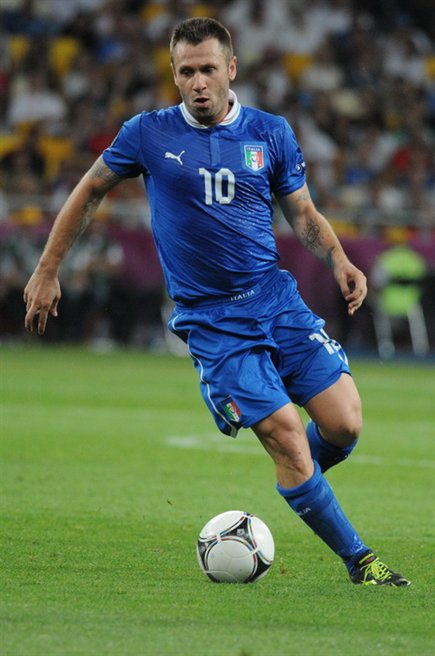
Antonio Cassano is a name that resonates deeply within the world of football, not only in Italy but across the globe. Known for his exceptional talent on the pitch and his equally notorious off-field antics, Cassano’s career has been a rollercoaster of highs and lows. Born on July 12, 1982, in Bari, Italy, the day after Italy’s historic World Cup victory, Cassano seemed destined for football greatness from the very start. This article provides an in-depth look into the life of Antonio Cassano, exploring his age, the fame he garnered, and the pivotal moments that have defined his career.
Early Life and Humble Beginnings
Antonio Cassano was born and raised in the tough, working-class neighborhood of Bari Vecchia in southern Italy. Growing up in an area where football was not just a sport but a way of life, Cassano’s early exposure to the game was inevitable. From a young age, he displayed a natural aptitude for football, dazzling his peers with his dribbling skills and flair in tight spaces, often in the narrow streets and small courtyards of his neighborhood.
Despite his early promise on the football pitch, Cassano’s childhood was marked by significant challenges. He was raised in a single-parent household after his father abandoned the family when Antonio was just a child. This absence left a lasting impact on Cassano, contributing to the chip on his shoulder that would characterize much of his career. His mother, who worked tirelessly to provide for the family, played a crucial role in his upbringing, instilling in him a determination to succeed despite the odds.
The Rise to Stardom: Early Career at Bari
Cassano’s footballing journey began in earnest when he joined ProInter, a local youth team in Bari. His performances quickly caught the eye of scouts from Bari’s professional club, and he soon joined their youth ranks. His rise through the ranks was swift, and it became clear that Cassano was a special talent. His ability to score goals and create chances set him apart from his peers, and it wasn’t long before he was knocking on the door of the first team.
Cassano made his Serie A debut on December 11, 1999, at the tender age of 17, in a match against Lecce. It was a game that would change his life forever. Just a week later, Cassano scored a sensational goal against Inter Milan, dribbling past several defenders before coolly slotting the ball into the net. This goal not only announced his arrival on the big stage but also marked the beginning of a career filled with both brilliance and controversy.
The Move to AS Roma: A Star on the Rise
Cassano’s performances at Bari soon attracted the attention of Italy’s top clubs. In March 2001, at just 18 years old, he made a high-profile move to AS Roma for a reported fee of 60 billion lire (around $30 million), making him one of the most expensive teenagers in football history at the time. The move to Roma was seen as a major step up, and Cassano was expected to become one of the leading lights in Italian football.
At Roma, Cassano quickly struck up a strong on-field partnership with the club’s captain, Francesco Totti. The two players complemented each other perfectly, with Totti’s vision and passing ability providing the perfect platform for Cassano’s flair and finishing. Their partnership was instrumental in Roma’s success during the early 2000s, and Cassano’s stock continued to rise.
However, it wasn’t all smooth sailing for Cassano in the Italian capital. His time at Roma was marked by flashes of brilliance on the pitch, interspersed with moments of petulance and indiscipline. He often clashed with his coaches, most notably Fabio Capello, who struggled to manage the young prodigy’s fiery temperament. Despite these challenges, Cassano’s talent was undeniable, and he continued to deliver match-winning performances for Roma.
International Recognition and the 2004 European Championship
Cassano’s rise at Roma inevitably led to international recognition, and he made his debut for the Italian national team in November 2003. His inclusion in the squad for the 2004 European Championship in Portugal was seen as a major milestone in his career. Although Italy’s campaign ended in disappointment, with the team failing to progress beyond the group stage, Cassano was one of the few bright spots.
He scored two goals during the tournament, including a memorable last-minute winner against Bulgaria. However, the joy of that goal quickly turned to despair as news filtered through that Denmark and Sweden had drawn 2-2 in the other group match, a result that eliminated Italy. The image of Cassano’s face, switching from euphoria to heartbreak within seconds, remains one of the defining moments of that tournament.
The “Cassanate” and Departure from Roma
Despite his undeniable talent, Cassano’s career was often overshadowed by his erratic behavior and frequent outbursts, which became so infamous that they were dubbed “cassanate” by the Italian press. These “cassanate” ranged from clashes with coaches and teammates to off-field antics that often grabbed headlines for the wrong reasons.
Cassano’s relationship with Roma began to deteriorate in 2005, largely due to contract disputes and his strained relationship with Capello. After months of speculation and a series of public fallouts, Cassano’s time at Roma came to an end in January 2006 when he signed with Spanish giants Real Madrid. The move was supposed to be the next big step in his career, but it turned out to be one of the most challenging periods of his life.
The Real Madrid Experience: A Lesson in Humility
Cassano’s move to Real Madrid was seen as a golden opportunity for him to showcase his talent on one of the biggest stages in world football. However, his time in Spain was fraught with difficulties from the start. Struggling with fitness issues and failing to adapt to the Spanish lifestyle, Cassano found himself on the fringes of the first team. His performances were inconsistent, and he soon fell out of favor with the coaching staff.
His time at Real Madrid was further marred by disciplinary issues. Cassano’s clashes with the management and his failure to maintain a professional attitude led to him being sidelined for much of his tenure at the club. Despite winning a La Liga title with Madrid, Cassano’s time in Spain is largely remembered as a missed opportunity—a period where his off-field behavior overshadowed his on-field abilities.
Return to Italy: The Sampdoria Revival
In 2007, after a largely disappointing spell in Spain, Cassano returned to Italy, joining Sampdoria on loan. The move was seen as a chance for Cassano to revive his career and recapture the form that had once made him one of the most promising talents in European football. At Sampdoria, Cassano found a club that believed in him, and in return, he delivered some of the best performances of his career.
Cassano’s time at Sampdoria was marked by a renewed sense of purpose. He became the focal point of the team, helping them achieve a fourth-place finish in Serie A and securing qualification for the UEFA Champions League. His partnership with striker Giampaolo Pazzini was particularly fruitful, and together, they formed one of the most potent attacking duos in Italian football.
In 2010, Cassano married Carolina Marcialis, a former water polo player, in Portofino. The couple’s relationship brought stability to Cassano’s often turbulent life, and their first child, Christopher, was born in April 2011.
The Milan Years and Health Scare
In January 2011, Cassano made a high-profile move to AC Milan. The transfer was seen as a homecoming of sorts, as Cassano had long been linked with a move to one of Italy’s top clubs. At Milan, Cassano continued to display his undeniable talent, contributing to the team’s success as they won the Serie A title in his first season with the club.
However, Cassano’s career took an unexpected turn in October 2011 when he suffered a stroke after returning from a match against Roma. The incident was a major scare for the footballing world, and Cassano underwent heart surgery to correct a congenital heart defect. Despite the severity of the situation, Cassano made a remarkable recovery and returned to action in April 2012.
Later Career: Inter, Parma, and the Final Years
After his recovery, Cassano’s career continued with stints at Inter Milan, Parma, and a return to Sampdoria. While his performances remained impressive, the latter years of his career were marked by the same inconsistency and flashes of brilliance that had defined much of his playing days.
In July 2017, Cassano signed with Verona but made headlines when he announced his retirement just days after joining the club, only to reverse his decision shortly afterward. However, his time at Verona was short-lived, and he eventually left the club without playing a competitive match, effectively ending his professional career.
Legacy and Post-Retirement Life
Antonio Cassano’s career is a story of immense talent intertwined with controversy. His “cassanate” became a part of his legacy as much as his moments of genius on the pitch. Despite the challenges, Cassano remains one of the most naturally gifted players of his generation, capable of moments of brilliance that few could match.
Since retiring from professional football, Cassano has remained in the public eye, often appearing as a pundit on Italian sports television. His insights, often delivered with the same candidness that defined his playing career, continue to make him a popular figure in Italian football.
Cassano’s life and career serve as a reminder of the fine line between genius and madness. While his career may not have reached the heights that many predicted, his impact on Italian football is undeniable. Antonio Cassano will always be remembered as a player who played the game with passion, flair, and a touch of unpredictability—qualities that made him one of the most captivating players of his era.


