
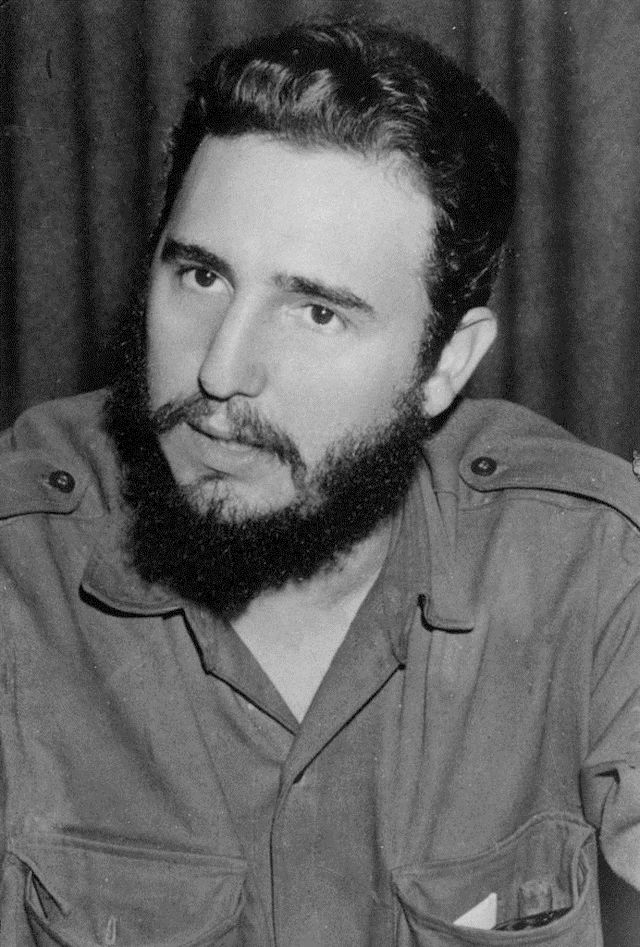
Fidel Castro is a name that resonates with both reverence and controversy. Born on August 13, 1926, in Birán, Cuba, Castro’s life journey from a landowner’s son to one of the most significant figures in global politics is as tumultuous as the history of the island he came to dominate. For decades, Castro’s name has been synonymous with the Cuban Revolution, communism, and the Cold War. His role as a leader, revolutionary, and, to many, a dictator, has left an indelible mark on both Cuban history and the broader global landscape.
Early Life and Education
Fidel Alejandro Castro Ruz was born into a prosperous family. His father, Ángel Castro, was an immigrant from Spain who became a successful landowner in Cuba. This privileged background provided Castro with opportunities for education, which he pursued with vigor. He enrolled at the University of Havana in 1945, where he studied law. It was here that Castro’s political inclinations began to take shape.
The University of Havana was a hotbed of political activity, particularly among students. Castro was drawn to the more radical elements of the Cuban People’s Party (Partido Ortodoxo). The atmosphere was charged with tension, often resulting in violent clashes between opposing factions. These early experiences were formative for Castro, shaping his ideological beliefs and his approach to political struggle.
The Revolutionary Path
Castro graduated with a law degree in 1950, but his true passion lay in political activism. The political climate in Cuba was increasingly unstable, particularly after the coup d’état led by Fulgencio Batista in 1952. Batista’s authoritarian regime became the primary target of Castro’s revolutionary fervor. In response, Castro joined a movement intent on overthrowing Batista, culminating in the attack on the Moncada Barracks in Santiago de Cuba on July 26, 1953.
The assault on Moncada was a failure. Poor coordination among the various groups involved led to a disastrous outcome. Many of Castro’s comrades were killed in the fighting, and others were executed after being captured. Castro himself was arrested and put on trial. However, this trial became a turning point in his life.
“History Will Absolve Me”
During his trial, Castro represented himself, using the courtroom as a platform to denounce the Batista regime. His speech, later published under the title “History Will Absolve Me,” outlined the grievances of the Cuban people and set forth a revolutionary program that included land reforms, the nationalization of public utilities, and measures to address economic inequality. This speech not only saved Castro from a harsher sentence but also transformed him from a failed revolutionary into a national figure.
After serving a relatively short prison sentence, Castro was released in 1955 as part of a general amnesty granted by Batista. This was partly due to pressure from various factions, including the Catholic Church. Upon his release, Castro went into exile in Mexico, where he continued to plot the overthrow of the Batista regime.
The Cuban Revolution
In Mexico, Castro met Ernesto “Che” Guevara, an Argentine Marxist revolutionary who would become his closest ally. Together, they planned an armed revolution. On December 2, 1956, Castro and a small group of 82 men, including Guevara, landed in Cuba aboard the yacht Granma. Despite being vastly outnumbered and poorly equipped, they waged a guerrilla war against Batista’s forces.
By January 1, 1959, the Cuban Revolution had succeeded. Batista fled the country, and Castro’s forces entered Havana to a hero’s welcome. The initial decisions of the new government, such as closing casinos and brothels, cracking down on drug trafficking, and opening up previously exclusive hotels and beaches to the general population, garnered widespread support. However, the deeper structural changes that Castro sought to implement would soon bring him into conflict with powerful domestic and international interests.
The Establishment of a Communist State
One of the first major policies implemented by Castro’s government was the Agrarian Reform Law of May 1959. This law limited the size of landholdings to 402 hectares (about 1,000 acres) and redistributed land to peasant cooperatives and individual farmers. While this was a popular move among the rural poor, it sparked significant opposition from the landowning class and urban middle classes. The redistribution of land also drew the ire of the United States, where many of the affected landowners had business ties.
The tensions between Cuba and the United States escalated rapidly. In response to Castro’s policies, including the nationalization of American-owned oil refineries and other assets, the U.S. imposed an economic embargo on Cuba. This embargo, which would last for decades, isolated Cuba economically but also solidified Castro’s relationship with the Soviet Union. The alliance with the Soviets was formalized in 1961 when Cuba declared itself a socialist state, aligning with the communist bloc during the Cold War.
The Bay of Pigs Invasion and the Cuban Missile Crisis
In April 1961, the United States attempted to overthrow Castro through a covert operation known as the Bay of Pigs Invasion. The CIA-trained force of Cuban exiles landed at the Bay of Pigs on the southern coast of Cuba, hoping to spark a popular uprising against Castro. However, the invasion was a catastrophic failure, and the exiles were quickly defeated by Castro’s forces. This event not only humiliated the U.S. government but also strengthened Castro’s position in Cuba and abroad.
The following year, the world teetered on the brink of nuclear war during the Cuban Missile Crisis. After discovering that the Soviet Union was installing nuclear missiles in Cuba, the U.S. imposed a naval blockade around the island. For 13 days, the world watched as the two superpowers faced off. Ultimately, the crisis was defused when the Soviet Union agreed to remove the missiles in exchange for a U.S. pledge not to invade Cuba and the secret removal of U.S. missiles from Turkey.
The Legacy of Castro’s Rule
Fidel Castro’s rule over Cuba lasted nearly 50 years. During this time, he transformed Cuba into a one-party communist state, with all political and economic power centralized in the hands of the government. The achievements of Castro’s government are a topic of heated debate. On the one hand, Castro’s policies resulted in significant improvements in healthcare and education. Cuba boasts some of the best health indicators in the developing world, and its literacy rate is among the highest globally.
On the other hand, Castro’s government was also marked by repression and human rights abuses. Political dissent was not tolerated, and opponents of the regime were often imprisoned or exiled. The economy, heavily reliant on Soviet subsidies, stagnated after the collapse of the Soviet Union in 1991. The economic hardship faced by ordinary Cubans led to a mass exodus of refugees, many of whom risked their lives to reach the United States.
The End of an Era
Fidel Castro’s health began to deteriorate in the early 2000s. In 2006, he temporarily transferred power to his younger brother, Raúl Castro, due to illness. Two years later, in February 2008, Fidel Castro officially stepped down as president of Cuba. Raúl Castro succeeded him, continuing the communist regime but with some economic reforms.
Fidel Castro passed away on November 25, 2016, at the age of 90. His death marked the end of an era for Cuba and the world. While his legacy remains divisive, there is no denying that Fidel Castro was one of the most influential figures of the 20th century. He was a man who, through sheer force of will and unwavering belief in his cause, altered the course of history.
Conclusion
The story of Fidel Castro is one of revolution, power, and controversy. From his early days as a student activist to his role as the leader of the Cuban Revolution, Castro’s life was a testament to his unyielding determination. His impact on Cuba and the world is undeniable, as he played a central role in the global Cold War struggle. Whether viewed as a hero of the oppressed or a dictator who curtailed freedoms, Fidel Castro’s life and legacy continue to provoke debate and reflection.


