
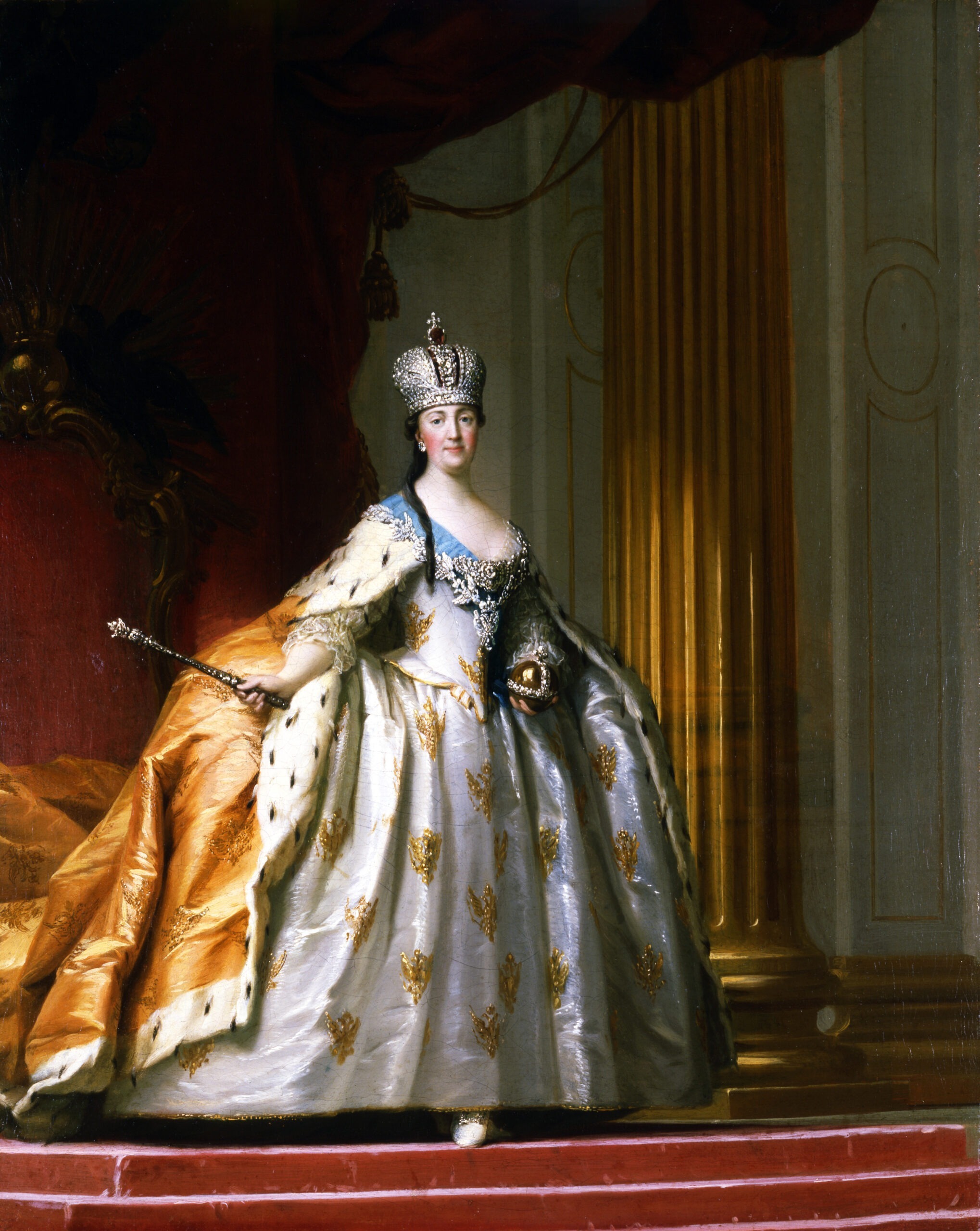
Caterina II, more famously known as Catherine the Great, is one of history’s most remarkable figures. Born on May 2, 1729, in Stettin, Prussia (now Szczecin, Poland), she would ascend to become the Empress of Russia and one of the most influential monarchs in European history. Her reign from 1762 until her death in 1796 is often described as the golden age of the Russian Empire, marked by significant territorial expansion, internal reform, and the promotion of Enlightenment ideals.
Early Life: The Path to Power
Catherine was born as Sophie Friederike Auguste von Anhalt-Zerbst-Dornburg, the daughter of a minor German prince, Christian August of Anhalt-Zerbst, and Johanna Elisabeth of Holstein-Gottorp. Despite her relatively obscure origins, Sophie was well-educated and demonstrated an early interest in literature, philosophy, and politics—an intellectual curiosity that would later define her reign.
At the age of 15, Sophie was chosen to marry Peter of Holstein-Gottorp, the heir to the Russian throne and nephew of the reigning Empress Elizabeth of Russia. Upon her arrival in Russia in 1744, Sophie converted to the Russian Orthodox Church, taking the name Catherine Alexeievna. Her marriage to Peter, who would later become Peter III, was politically motivated and largely unhappy, marked by Peter’s erratic behavior and Catherine’s increasing alienation.
The Coup of 1762: Catherine’s Rise to Power
Catherine’s ascent to the throne is a dramatic tale of political intrigue, ambition, and decisive action. When Peter III became emperor in January 1762, his unpopular policies and erratic leadership alienated the Russian nobility and military. Among his most controversial actions was withdrawing Russian forces from the Seven Years’ War and seeking peace with Prussia, a move that many saw as a betrayal of Russia’s interests.
Catherine, who had by this time cultivated strong alliances within the Russian court, particularly with influential military leaders like the Orlov brothers, saw an opportunity. In July 1762, just six months after Peter’s ascension, Catherine staged a coup d’état with the support of the imperial guard. Peter III was deposed and later died under mysterious circumstances, likely assassinated, although Catherine’s direct involvement remains a topic of historical debate.
On June 28, 1762, Catherine was crowned as Empress of Russia, marking the beginning of her 34-year reign. Her accession was not just a change in leadership but a profound shift in Russian governance and culture, aligning the country more closely with the intellectual currents of the Enlightenment.
Catherine the Enlightened Monarch
Catherine the Great is often celebrated as an Enlightened despot, a ruler who embraced the ideas of the Enlightenment—reason, science, and progress—while maintaining absolute authority. She corresponded with some of the greatest thinkers of her time, including Voltaire, Denis Diderot, and Jean-Baptiste d’Alembert. These intellectual exchanges were not just superficial; Catherine was genuinely interested in reforming Russian society along Enlightenment principles.
One of Catherine’s most ambitious projects was the Nakaz, or Instruction, which she issued in 1767. This document was intended to serve as a guide for a new legal code and was heavily influenced by the works of Montesquieu and Cesare Beccaria. The Nakaz advocated for legal equality, the abolition of torture, and the rule of law. Although many of its recommendations were never fully implemented, the Nakaz was a clear demonstration of Catherine’s commitment to Enlightenment ideals.
Catherine also sought to modernize the Russian economy and administration. She restructured the provincial government, introduced new administrative divisions, and sought to increase the efficiency of the bureaucracy. She encouraged the establishment of new towns and industries, and under her rule, Russia experienced significant economic growth.
Territorial Expansion: The Expansion of the Russian Empire
Catherine’s reign is also marked by significant territorial expansion, which greatly increased Russia’s power and influence in Europe. One of her first major conquests was the annexation of Crimea in 1783, a region that had been under Ottoman control. This acquisition not only secured Russia’s southern borders but also provided a valuable warm-water port on the Black Sea, which would be crucial for Russia’s naval ambitions.
Catherine’s expansionist policies extended beyond Crimea. Through a series of wars and diplomatic maneuvers, she extended Russian influence over large parts of Eastern Europe. Most notably, she played a key role in the Partitions of Poland, a series of three divisions of Polish territory among Russia, Prussia, and Austria between 1772 and 1795. By the end of her reign, Russia had gained vast new territories, including most of modern-day Belarus and Ukraine, further solidifying its status as a European superpower.
Internal Challenges: Pugachev’s Rebellion and Serfdom
Despite her many successes, Catherine’s reign was not without its challenges. One of the most significant domestic threats she faced was Pugachev’s Rebellion (1773-1775), a massive peasant uprising led by Yemelyan Pugachev, who claimed to be the deceased Peter III. The rebellion, which spread across much of southern Russia, was fueled by widespread discontent among the serfs, who made up the vast majority of Russia’s population and lived in conditions of severe oppression.
Catherine’s response to the rebellion was ruthless. She mobilized the imperial army, which eventually crushed the revolt, and Pugachev was captured and executed. The rebellion highlighted the deep social divisions within Russian society and the limitations of Catherine’s reformist ambitions. Although she had initially expressed sympathy for the plight of the serfs, Pugachev’s Rebellion convinced her to strengthen the institution of serfdom, fearing that any attempt to improve the serfs’ condition would lead to further unrest.
Cultural Patronage: The Arts and Education
Catherine’s influence extended far beyond politics and territorial expansion. She was a great patron of the arts, education, and culture, and she played a pivotal role in transforming St. Petersburg into a cultural capital of Europe. Catherine founded the Hermitage Museum in 1764, which began as her personal collection of art and has since grown into one of the largest and most prestigious art museums in the world.
Catherine was also deeply involved in education reform. She established the Smolny Institute for Noble Maidens in 1764, the first state-funded educational institution for women in Russia. This initiative reflected her belief in the importance of education, particularly for the nobility, who she saw as the future leaders of the empire.
In addition to her support for formal education, Catherine was an accomplished writer herself. She authored numerous plays, comedies, and satirical works, often using them to comment on the political and social issues of her time. Her literary works, while not as widely known today, were an important aspect of her efforts to promote Enlightenment values in Russia.
Personal Life and Legacy
Catherine the Great’s personal life has been the subject of much speculation and intrigue, particularly her numerous romantic relationships. She had a series of well-known lovers, many of whom were influential figures in her court, including Grigory Orlov, who played a key role in the coup that brought her to power, and Grigory Potemkin, who was instrumental in her military and territorial policies. These relationships, while often scandalous by the standards of the time, were also politically significant, as Catherine used them to build alliances and consolidate her power.
Catherine’s legacy is complex. She is remembered as a brilliant ruler who transformed Russia into a major European power, but her reign also had its darker aspects, particularly her policies towards the serfs and the ruthless suppression of dissent. Her commitment to Enlightenment ideals was genuine, but it was often tempered by the realities of ruling a vast and diverse empire.
Catherine died on November 17, 1796, at the age of 67, after suffering a stroke. She was succeeded by her son Paul I, who had a strained relationship with his mother and sought to undo many of her policies. Despite this, Catherine’s reign is often seen as one of the most successful in Russian history, and she remains a towering figure in the history of European monarchy.
Conclusion: The Lasting Impact of Catherine the Great
Catherine the Great’s reign was a turning point in Russian history. Under her leadership, Russia became one of the most powerful and culturally vibrant nations in Europe. Her efforts to modernize the country, expand its borders, and promote the arts and education left a lasting legacy that continues to be felt in Russia and beyond.
Catherine’s life and reign are a testament to her extraordinary ambition, intelligence, and political acumen. She navigated the complexities of court politics, international diplomacy, and domestic unrest with a skill that few monarchs have matched. Her ability to blend Enlightenment ideals with the realities of autocratic rule made her one of the most fascinating and influential figures of her time.
In the annals of history, Catherine the Great is remembered not just as a powerful ruler, but as a cultural icon and a symbol of the possibilities and contradictions of enlightened absolutism. Her legacy continues to inspire and challenge our understanding of leadership, power, and the role of women in history.


