
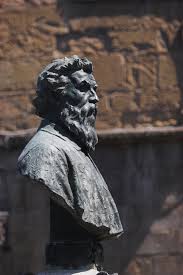
Benvenuto Cellini is a name that echoes through the annals of Renaissance art, embodying the quintessential spirit of the Italian Renaissance. His life, marked by extraordinary artistic achievements, personal controversies, and a relentless pursuit of excellence, is a story that intertwines creativity with the turbulent dynamics of 16th-century Italy. This article delves into the life, career, and legacy of Benvenuto Cellini, exploring his journey from a Florentine craftsman to one of the most celebrated figures in the history of art.
Early Life and Artistic Beginnings
Born on November 3, 1500, in Florence, Benvenuto Cellini was the second son of Maria Lisabetta Granacci and Giovanni Cellini, a craftsman who made musical instruments. From a young age, Benvenuto showed a remarkable aptitude for music, particularly in singing and playing the flute, a talent his father encouraged. However, despite his musical abilities, Cellini’s true calling lay in the visual arts.
At the age of fourteen, Cellini began his formal training in the workshop of Michelangelo Brandini, the father of the renowned sculptor Baccio Bandinelli. This early exposure to the artistic world of Florence was pivotal in shaping Cellini’s future. The following year, he transitioned to the workshop of an esteemed goldsmith, where he honed his skills in metalwork—an art form that would later define his career.
However, Cellini’s early life was not without its troubles. At sixteen, he was forced to flee Florence after being involved in a violent altercation with his brother, Cecchino. This incident set the tone for much of Cellini’s tumultuous life, which was characterized by both artistic brilliance and personal strife.
The Rise of a Renaissance Master
Cellini’s travels took him to various cities, including Bologna and Pisa, where he continued his training under different masters, such as the goldsmith Ulivieri Della Chiostra. However, his fiery temperament soon got him into trouble again, leading him to seek refuge in Siena and later in Rome. It was in Rome, at the tender age of twenty, that Cellini began to make a name for himself in the workshop of Giovanni de’ Georgis.
By 1524, Cellini had established his own workshop in Rome, gaining recognition for his skill in goldsmithing and metalwork. His talent soon caught the attention of the papal court, and in 1527, during the Sack of Rome, Cellini played a significant role in the defense of Pope Clement VII and Castel Sant’Angelo. His involvement in this historic event included the killing of Charles III, Duke of Bourbon, with a single arquebus shot, an act that further cemented his reputation as a man of both skill and courage.
A Master Goldsmith and Sculptor
Cellini’s career flourished under the patronage of the powerful families of the time. In Mantua, he created works for the Gonzaga family, including the renowned “Sigillo del Cardinale Ercole Gonzaga,” a silver seal crafted in 1528. His return to Rome saw him appointed as the official stamp designer of the papal mint by Clement VII, a prestigious position that underscored his growing influence in the art world.
However, Cellini’s life was never free from controversy. After the death of Clement VII, he faced the enmity of Pompeo de’ Capitaneis, a fellow goldsmith in Rome. Fearing for his life, Cellini murdered Pompeo in what he claimed was self-defense. Despite the gravity of the crime, the new pope, Paul III, absolved him, a testament to Cellini’s importance and connections.
Amidst these turbulent events, Cellini continued to produce exceptional works of art. His notable creations from this period include the “Medaglia di Clemente VII,” a golden medallion, and the “Testone da quaranta soldi di Alessandro de’ Medici,” a coin featuring the likeness of Alessandro de’ Medici.
Exile and Triumph in France
In 1537, amid growing tensions with the papal authorities and fearing for his safety, Cellini fled to Padua and later to France, where he entered the service of King Francis I. This move marked a new chapter in Cellini’s life, as he sought to establish himself in the French court. During this time, he created several bronze medals for the king, although he found himself largely inactive and without significant commissions.
Despite these challenges, Cellini’s time in France was not without its triumphs. He crafted one of his most famous works, the Salt Cellar of Francis I, an exquisite piece of goldsmithing that symbolizes the union of the sea and the earth, represented through figures of Neptune and Tellus. This masterpiece, made of ebony, gold, and enamel, is a testament to Cellini’s unparalleled skill and creativity.
Return to Italy and Imprisonment
Cellini’s return to Italy was fraught with difficulties. Accused of theft during the Sack of Rome, he was imprisoned in Castel Sant’Angelo. His imprisonment was lengthy and arduous, but Cellini’s indomitable spirit saw him through this dark period. After his release, he returned to France, where he resumed work at the court of Francis I.
It was during his second stint in France that Cellini completed other significant works, including the Bronze Greyhound and began work on the Bust of Cosimo I de’ Medici. Despite his success in France, personal animosities and health issues prompted his return to Florence.
The Florentine Masterpieces
Back in Florence, Cellini entered one of the most productive phases of his career. His most famous work from this period is the “Perseus with the Head of Medusa,” a bronze statue that stands in the Loggia dei Lanzi in Florence. Commissioned by Cosimo I de’ Medici, this sculpture is a masterpiece of Mannerist art, capturing both the horror and beauty of the mythological subject. The intricate detailing and dynamic composition of the statue showcase Cellini’s genius and mastery of bronze casting.
In addition to “Perseus,” Cellini created several other notable works, including the “Bust of Cosimo I” in marble and bronze, the “Narcissus,” and the “Apollo and Hyacinth” sculptures. His work during this period solidified his reputation as one of the leading artists of the Renaissance.
Literary Contributions and Final Years
Cellini’s contributions to the Renaissance were not limited to visual arts. In 1563, he was elected a member of the Accademia delle Arti del Disegno in Florence, an institution founded by Cosimo I de’ Medici. This recognition was not only for his artistic achievements but also for his literary works.
Between 1558 and 1566, Cellini penned his autobiography, “Vita di Benvenuto di Maestro Giovanni Cellini Fiorentino, scritta per lui medesimo in Firenze.” This work is considered a literary masterpiece, offering a vivid and detailed account of Cellini’s life, his artistic endeavors, and the various escapades that marked his tumultuous existence. The autobiography is notable for its candidness and the colorful, often exaggerated, storytelling that provides insight into the mind of one of the Renaissance’s most complex figures.
In addition to his autobiography, Cellini wrote two important treatises: the “Trattato dell’Oreficeria” (Treatise on Goldsmithing) and the “Trattato della Scultura” (Treatise on Sculpture). These works not only reflect his deep understanding of his craft but also serve as instructional texts that influenced subsequent generations of artists.
Death and Legacy
Benvenuto Cellini passed away on February 13, 1571, in Florence. His death marked the end of an era, but his legacy lived on through his works and writings. He is remembered as one of the most prominent figures of the Mannerist movement, a style characterized by exaggerated forms and a heightened sense of drama, which departed from the harmonious ideals of the High Renaissance.
Cellini’s life and work have been the subject of numerous studies, operas, and artistic interpretations. His influence on the art of goldsmithing and sculpture cannot be overstated, and his autobiography remains a crucial document for understanding the Renaissance period.
In 1838, the French composer Hector Berlioz immortalized Cellini in the opera “Benvenuto Cellini,” a work that reflects the drama and vibrancy of the artist’s life. This opera, though initially not successful, has since been recognized for its innovative composition and remains a testament to Cellini’s enduring impact on the arts.
Conclusion
Benvenuto Cellini was more than just an artist; he was a Renaissance man in the truest sense. His life, marked by artistic triumphs, personal controversies, and a relentless pursuit of excellence, reflects the dynamic and often tumultuous nature of the Renaissance itself. From his early days as a goldsmith in Florence to his later years as a sculptor and writer, Cellini’s contributions to the world of art and literature have left an indelible mark on history.
Cellini’s legacy is one of brilliance and complexity. His works, whether in gold, bronze, or marble, continue to inspire awe and admiration. His autobiography provides a window into the life of a man who was as much a product of his time as he was a shaper of it. As we look back on the life of Benvenuto Cellini, we see a figure who embodied the spirit of the Renaissance—a time of rebirth, creativity, and endless possibilities.


