
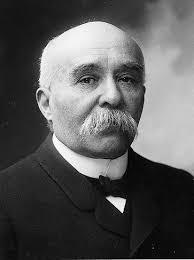
Georges Clémenceau, a towering figure in French history, was born on September 28, 1841, in Mouilleron-en-Pareds, a conservative region in the Vendée department of France. His life spanned nearly nine decades, with his death occurring on November 24, 1929, in Paris at the age of 88. Clémenceau’s life and career were marked by his fierce republicanism, staunch anti-clericalism, and an unwavering commitment to French nationalism. His influence on both French and global politics during the late 19th and early 20th centuries cannot be overstated.
Early Life and Education
Georges Benjamin Clémenceau was born into a republican and anti-clerical family. His father had actively participated in the revolutionary events of 1848, a background that deeply influenced Clémenceau’s political orientation. As a young man, Clémenceau was already politically active, publishing two radical newspapers during his student years. His early activism caught the attention of the ultraconservative government of Napoleon III, leading to his imprisonment for several weeks.
In 1865, Clémenceau earned a degree in medicine, but his passion for politics led him to pursue a different path. After completing his studies, he traveled to the United States, where he spent four years. During his time in America, Clémenceau was profoundly influenced by the organization of U.S. institutions, which reinforced and revitalized his republican ideals.
The American Influence and Personal Life
While in the United States, Clémenceau taught at a school where he met Mary Plummer, one of his students. They married on June 20, 1869, but their union was far from ideal. The couple eventually separated, and Clémenceau lived alone for many years, dedicating himself entirely to his political career, which was his true passion.
Clémenceau’s experiences in America were pivotal in shaping his political views. He admired the U.S. system of governance and saw in it a model for the republican values he cherished. This admiration would later influence his political strategies and his vision for France.
Political Ascent and the Radical Leader
Upon returning to France, Clémenceau quickly established himself as a formidable political figure. In 1870, he was elected mayor of Montmartre, marking the beginning of his long and influential political career. Shortly thereafter, he joined the National Assembly, where he became a vocal opponent of the peace terms imposed on France by Germany following the Franco-Prussian War.
Clémenceau’s fierce opposition to Germany earned him the nickname “The Tiger,” and he soon became the leader of the Radical Party, which was aligned with the extreme left. His reputation as a hard-hitting journalist and a relentless political critic was solidified in 1880 when he founded the newspaper La Justice. This platform allowed him to defend himself against accusations of corruption in the infamous Panama Affair of 1893 and to campaign vigorously against anti-Semitism, notably in support of Alfred Dreyfus during the Dreyfus Affair in 1898.
Ministerial Roles and the Path to Prime Minister
In 1906, Clémenceau was appointed Minister of the Interior, a role in which he demonstrated his uncompromising approach to governance. He ordered the violent suppression of a miners’ strike in Pas de Calais and a winegrowers’ uprising in Languedoc-Roussillon, actions that distanced him from the socialist faction led by Jean Jaurès. Despite this, Clémenceau’s political career continued to ascend, and he soon became Prime Minister of France.
As Prime Minister, Clémenceau implemented a decisive shift toward nationalism and state centralism, positioning himself in constant opposition to socialists and trade unions. His tenure saw a strengthening of Franco-British relations, but also an increase in tensions with Germany, a frequent target of his attacks. However, his first term as Prime Minister was short-lived, ending in 1909 when he was succeeded by Aristide Briand.
World War I and Clémenceau’s Return to Power
The outbreak of World War I in 1914 brought Clémenceau back to the forefront of French politics. A fervent militarist, he vehemently opposed any notion of diplomatic mediation and clashed with the French military leadership, particularly Joseph Joffre. Clémenceau was a strong supporter of Ferdinand Foch, whom he believed was better suited to lead the French military efforts.
In 1917, Clémenceau was once again appointed Prime Minister, as well as Minister of War. His return to power marked a turning point in the war. He took decisive actions, including the arrest of Interior Minister Louis Malvy for treason and the appointment of Ferdinand Foch as the Supreme Allied Commander. Under Clémenceau’s leadership, France maintained its resolve and eventually emerged victorious in 1918.
The Treaty of Versailles and Clémenceau’s Legacy
The end of World War I did not soften Clémenceau’s stance towards Germany. At the 1919 Paris Peace Conference, he was a leading voice in the negotiations, advocating for harsh terms against Germany. He demanded significant reparations and the military occupation of the Rhineland, measures intended to cripple Germany both politically and economically. His rigid position brought him into conflict with the American delegation, particularly with President Woodrow Wilson, who favored a more conciliatory approach.
Clémenceau’s unyielding attitude at the Treaty of Versailles has been a subject of historical debate. While some view his actions as necessary to prevent future German aggression, others argue that the punitive measures imposed on Germany sowed the seeds for World War II. Regardless of the controversy, Clémenceau’s influence on the post-war order was undeniable.
Retirement and Final Years
In 1920, Clémenceau ran for the presidency of the French Republic but was defeated. Following this setback, he retired from political life, spending his remaining years writing and reflecting on his career. His memoirs, Grandeur and Misery of Victory, published in 1929, offered a sobering assessment of the post-war situation in Europe. In this work, Clémenceau predicted that another conflict with Germany was inevitable, a prediction that tragically came true a decade later with the outbreak of World War II.
Clémenceau’s final work, In the Evening of My Thought, was published in 1929, the year of his death. This introspective book provided insights into the mind of a man who had shaped the course of French and European history.
Conclusion: The Legacy of Georges Clémenceau
Georges Clémenceau’s life was one of unwavering dedication to his country and his principles. Known as “The Tiger,” he was a fierce defender of republican values, a relentless critic of his political opponents, and a key architect of France’s victory in World War I. His legacy is complex; while he is celebrated as a patriot and a stalwart leader, his role in the Treaty of Versailles and his uncompromising nationalism have been subjects of criticism and debate.
Clémenceau’s influence extended beyond his lifetime, shaping the course of 20th-century European history. His predictions about the future of Europe, particularly regarding the dangers posed by a resurgent Germany, were tragically prescient. Today, Clémenceau is remembered as one of France’s greatest statesmen, a man whose life and career left an indelible mark on the world.


