
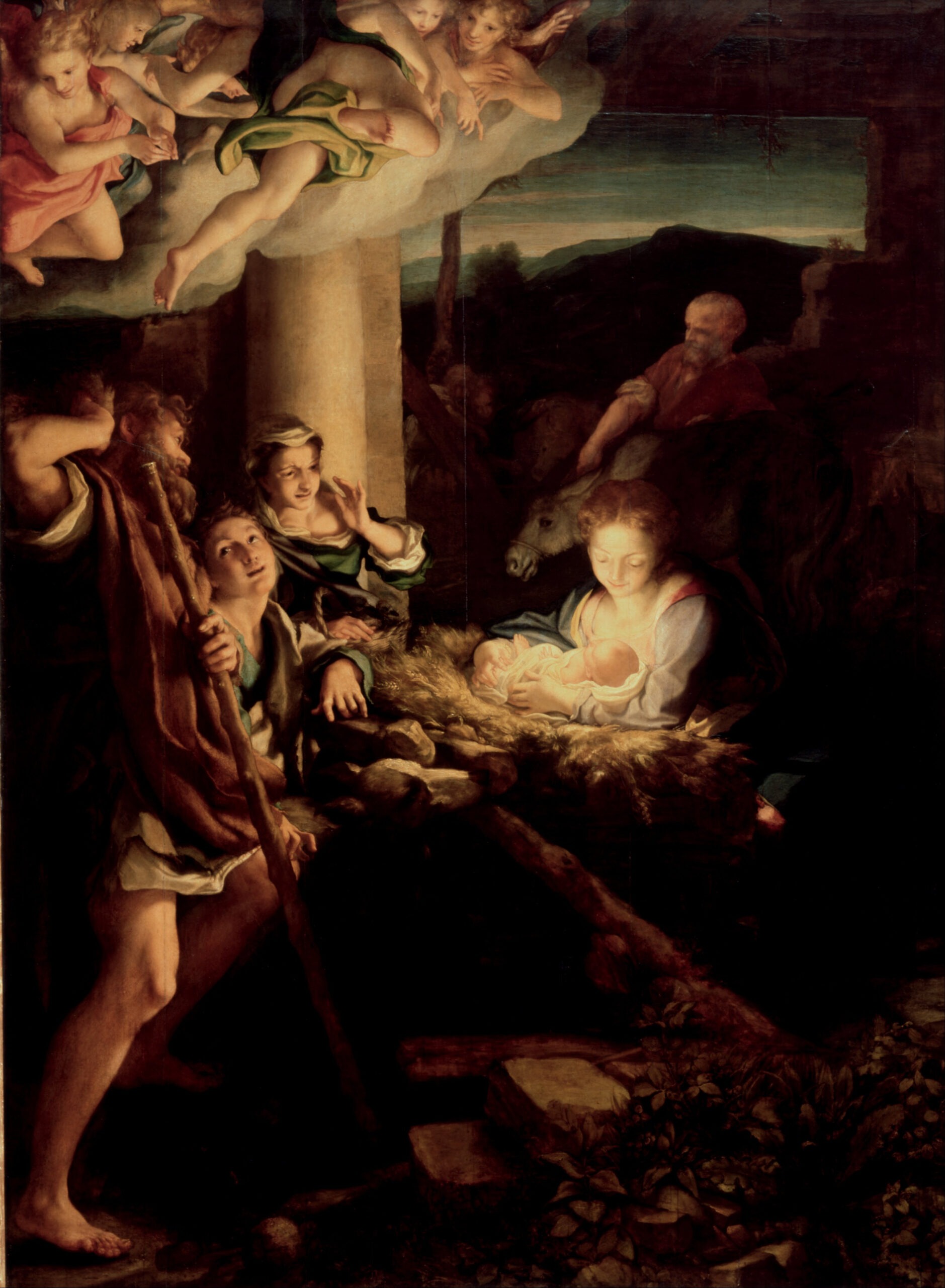
Antonio Allegri, better known as Correggio, was a master painter of the Italian Renaissance whose works are celebrated for their innovative use of perspective, lighting, and emotive expression. Born in the small town of Correggio, near Parma, Italy, around 1489, Correggio’s life and career are shrouded in mystery, with much of his biography pieced together from limited historical records. Despite this, his contributions to the world of art are undeniable, and his influence can be seen in the works of later artists, including the Baroque masters.
This article explores the life of Correggio, delving into the key events and artistic achievements that have cemented his place in art history.
Early Life and Training
Antonio Allegri was born in the town of Correggio, which would later provide his famous moniker. The exact date of his birth is uncertain, with most historians placing it around 1489 based on the timeline of his earliest known works. Some accounts, like those of the art historian Giorgio Vasari, suggest a later birth year of 1494, though this is less widely accepted.
Correggio’s early life and training are not well-documented, leading to much speculation about his artistic influences and mentors. It is believed that he initially studied under his uncle, Lorenzo Allegri, and Antonio Bartolotti, who were both modest local artists. However, it is clear that Correggio’s talents soon outstripped the abilities of these early teachers, and he likely sought further training in the larger artistic centers of northern Italy.
Correggio is thought to have encountered the works of Andrea Mantegna, a leading figure in the Renaissance art of the region, and may have studied under Francesco Bianchi Ferrari in Modena. These early influences are evident in Correggio’s meticulous attention to detail and his mastery of perspective, traits that would come to define his later works.
There is also speculation that Correggio traveled to Rome between 1513 and 1518, where he would have been exposed to the groundbreaking works of Michelangelo, Raphael, and Leonardo da Vinci. Although there is no concrete evidence to confirm this trip, the stylistic evolution in Correggio’s work suggests a deep familiarity with the innovations of these Renaissance giants.
Rise to Prominence
By the early 1510s, Correggio had begun to establish himself as a talented artist in his own right. Between 1514 and 1518, he completed several important commissions, including The Adoration of the Magi (Brera), The Madonna Campori (Modena), and The Zingarella (Capodimonte). These works demonstrate his growing command of spatial depth, chiaroscuro (the use of light and shadow), and a soft, almost ethereal expressiveness in his figures.
Around 1518, Correggio moved to Parma, where he would create some of his most celebrated works. It was in Parma that he decorated the “Camera della Badessa” (The Abbess’s Chamber) in the Monastery of San Paolo. This fresco cycle, completed around 1520, is a testament to Correggio’s innovative approach to ceiling decoration, eschewing traditional architectural frameworks in favor of a more dynamic and illusionistic style. The work features playful cherubs and mythological figures, set against a sky filled with soft, billowing clouds, creating a sense of infinite space that was revolutionary for its time.
Marriage and Family Life
During his time in Parma, Correggio married Girolama Merlini, with whom he had four children—one son and three daughters. Despite his growing fame, Correggio remained closely tied to his family and his hometown, returning to Correggio later in life. His marriage to Girolama provided him with stability, but little is known about his personal life beyond his professional achievements.
Major Works and Artistic Legacy
Correggio’s move to Parma marked the most productive period of his career. He received several major commissions, including the decoration of the dome of San Giovanni Evangelista (St. John the Evangelist) and later the dome of the Parma Cathedral. These projects are considered masterpieces of illusionistic ceiling painting, and they cemented Correggio’s reputation as one of the most innovative artists of his time.
In the dome of San Giovanni Evangelista, completed around 1521-1524, Correggio depicted the vision of St. John on Patmos. The composition is remarkable for its use of perspective, with figures ascending towards the viewer as if the dome itself is opening up into the heavens. This dynamic, upward motion would become a hallmark of Baroque art, but Correggio’s work predates this movement by several decades, showcasing his pioneering approach.
The decoration of the dome of Parma Cathedral, completed between 1526 and 1530, is perhaps Correggio’s most famous work. Here, he created a stunning depiction of the Assumption of the Virgin, with a swirling mass of apostles, angels, and clouds, all spiraling upwards towards the figure of the Virgin Mary. The composition is a tour de force of foreshortening and perspective, creating an illusion of depth and movement that was unparalleled at the time. This work had a profound influence on later artists, particularly those of the Baroque period, who sought to emulate Correggio’s dramatic use of space and light.
In addition to his monumental frescoes, Correggio also completed several important altarpieces and smaller devotional works during this period. His Mystic Marriage of St. Catherine and Ecce Homo are celebrated for their delicate handling of human emotion and their masterful use of light to create a sense of intimacy and immediacy.
Later in his career, Correggio was commissioned by Federico Gonzaga, Duke of Mantua, to create a series of mythological paintings known as The Loves of Jupiter. These works, including Leda and the Swan and Danaë, explore themes of love and transformation, rendered with a sensuality and grace that would influence later artists, including Peter Paul Rubens and Annibale Carracci.
Death and Posthumous Recognition
Correggio’s life was cut short by illness in 1534. According to Giorgio Vasari, the artist died on March 5, possibly after a journey from Parma to Correggio while carrying a heavy sack of coins—a detail that adds a touch of drama to his final days. While this account may be more legend than fact, it underscores the enigmatic nature of Correggio’s life.
Following his death, Correggio’s work continued to be highly regarded, though his fame never reached the heights of contemporaries like Michelangelo or Raphael during his lifetime. It was only in the 17th century that his contributions to art were fully recognized, particularly as the Baroque movement began to take hold in Europe. Artists and critics alike began to appreciate Correggio’s innovative use of perspective, his mastery of light and shadow, and his ability to convey deep emotion through his figures.
Correggio’s influence is evident in the works of many Baroque artists, including Caravaggio, Rubens, and Bernini, who drew inspiration from his dramatic compositions and his skillful use of chiaroscuro. Today, Correggio is celebrated as one of the leading figures of the Italian Renaissance, and his works are housed in major museums and collections around the world, including the Louvre, the Uffizi Gallery, and the National Gallery in London.
Artistic Style and Influence
Correggio’s style is characterized by a softness and fluidity that set him apart from his contemporaries. His figures are often bathed in a gentle, diffused light that enhances their naturalism and emotional expressiveness. Unlike the more rigid and formal compositions of the High Renaissance, Correggio’s works are imbued with a sense of movement and dynamism, achieved through his innovative use of perspective and foreshortening.
One of Correggio’s most significant contributions to art is his development of a more intimate and humanized depiction of religious and mythological subjects. His Madonnas, for example, are often portrayed with a tender, maternal warmth that contrasts with the more distant and idealized representations common in earlier Renaissance art. This approach to depicting the divine in human terms would have a lasting impact on the development of Western art, influencing not only the Baroque artists but also later movements such as Rococo.
Correggio’s mastery of illusionistic techniques, particularly in his frescoes, also set a new standard for ceiling decoration. His ability to create the illusion of open skies, vast architectural spaces, and figures that appear to hover above the viewer was groundbreaking and would inspire generations of artists to push the boundaries of what was possible in painting.
Conclusion
Antonio Allegri, known as Correggio, remains one of the most enigmatic and innovative artists of the Italian Renaissance. Despite the relative scarcity of biographical information, his works speak volumes about his artistic genius and his ability to convey emotion, movement, and light in ways that were ahead of his time. From his early days in Correggio to his monumental frescoes in Parma, Correggio’s contributions to art have left an indelible mark on the history of painting.
His influence can be seen in the works of the great Baroque masters and beyond, and his legacy continues to be celebrated in the world’s most prestigious art institutions. Correggio’s life and art remind us of the power of creativity and the enduring impact of an artist who, despite the mysteries surrounding his life, managed to capture the essence of the human experience in his work.


