
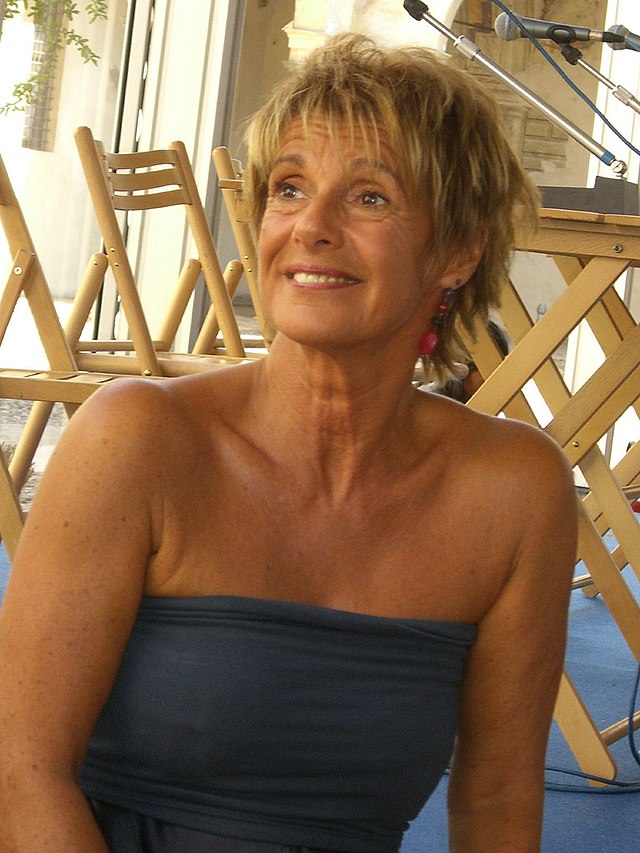
Lella Costa, born Gabriella Costa on September 30, 1952, in Milan, Italy, is one of the most prominent figures in the Italian theater scene. Known primarily for her monologues, she has made significant contributions to Italian culture through her work in theater, television, radio, and cinema. Her career is marked by a dedication to social issues, particularly civil rights, and she has been a vocal advocate for various humanitarian causes. Costa’s influence extends beyond the stage, as she has become a beloved public figure in Italy, known for her wit, intelligence, and commitment to the arts.
Early Life and Education
Growing up in Milan, Lella Costa showed an early passion for literature and the arts. She attended the prestigious Giosuè Carducci Classical High School, where her love for literature blossomed. This passion led her to enroll in the Faculty of Letters at the University of Milan. However, her deep interest in theater soon took precedence over her academic pursuits. She decided to leave her studies and pursue a career in acting, enrolling in the Accademia dei Filodrammatici, one of Italy’s most esteemed drama schools. Her dedication to her craft paid off when she graduated with honors, earning a prestigious gold medal.
The Early Career: The Birth of a Monologue Artist
Lella Costa’s theatrical career began in earnest in 1980 with her debut monologue, Repertorio, cioè l’orfana e il reggicalze, written by Stella Leonetti. This early work showcased her talent for delivering powerful and engaging monologues, a genre that would come to define her career. The monologue format allowed Costa to explore complex themes and ideas, often with a blend of humor and pathos that resonated deeply with audiences.
Throughout the 1980s, Costa continued to develop her unique style, collaborating with renowned writers and directors such as Renzo Rosso and Slawomir Mrozek. Her work in radio also began during this period, where she honed her skills in a medium that allowed her to reach a broader audience. Radio became another platform for Costa to explore her love of storytelling, and she quickly became known for her innovative and engaging broadcasts.
In 1985, she co-wrote another monologue with Patrizia Balzanelli, which led to her first solo show, Adlib, in 1987. This marked the beginning of Costa’s long and successful career as a solo performer, where her ability to connect with audiences through personal and socially relevant narratives became her trademark.
Breakthrough and Popularity
Costa’s breakthrough came in the late 1980s and early 1990s with a series of successful monologues that cemented her reputation as a leading figure in Italian theater. In 1988, she performed Coincidenze, which was followed by her first foray into cinema with a role in Ladri di saponette (1989), directed by Maurizio Nichetti. The film, a satirical homage to Italian neorealism, showcased Costa’s versatility as an actress and her ability to transition seamlessly between stage and screen.
During this period, Costa also became a familiar face on Italian television. She appeared on the cult show La TV delle ragazze and other popular programs such as Fate il vostro gioco, Ottantanonpiùottanta, and Il gioco dei nove. Her frequent appearances on the Maurizio Costanzo Show, one of Italy’s most-watched talk shows, further increased her visibility and popularity.
In 1990, Costa released her third monologue, Malsottile, a poignant and ironic reflection on memory, a theme that would recur throughout her work. This performance solidified her status as a master of the monologue, and she continued to build on this success with subsequent works.
Literary and Theatrical Contributions
In 1992, Lella Costa expanded her creative output by publishing her first book, La daga nel loden, a collection of her theatrical works up to that point. The book was well-received, offering readers insight into Costa’s creative process and the themes that dominated her work. That same year, she ventured into a new theatrical form with Due, her only non-monologue production, demonstrating her versatility and willingness to explore different formats.
The mid-1990s saw Costa return to monologues with Magoni (1994) and La daga nel loden (1995). The former featured original music by the acclaimed musician Ivano Fossati, adding a new dimension to Costa’s performances. These works were critically acclaimed and enjoyed successful runs at prestigious venues such as the Teatro Studio in Milan.
In 1996, Costa collaborated with renowned Italian author Alessandro Baricco on Stanca di guerra, which premiered at the Piccolo Teatro in Milan. This collaboration marked a significant moment in Costa’s career, as it brought together two of Italy’s most respected creative minds. The following year, Costa worked with director Gabriele Vacis on Un’altra storia (1998), further establishing her reputation as a leading figure in Italian theater.
In 1998, Costa published Che faccia fare, another collection of her theatrical works, which was followed by her participation in the popular television program Comici in 1999. This period also saw Costa achieve great success in radio, where she read and interpreted Daniel Pennac’s Il Paradiso degli Orchi on Radio 3. Her ability to bring literature to life through her voice captivated listeners and demonstrated her skill as a performer across multiple mediums.
The 2000s: Continued Success and Advocacy
The new millennium brought continued success for Lella Costa, both on stage and off. In 2000, she returned to the Piccolo Teatro with Precise parole, a stage adaptation of Shakespeare’s Othello directed by Gabriele Vacis. This performance was followed by her participation in the Italian production of The Vagina Monologues in 2001, which brought her into the international spotlight as part of a global movement promoting women’s rights.
In 2002, Costa published In Tournée, a collection of her theatrical works, and continued to push boundaries with her performances. She starred in Occhi Scritti, written and directed by Francesco Cavalli and Pasquale D’Alessio, and toured Italy with her version of La Traviata, again under the direction of Gabriele Vacis. This production was notable for its innovative approach and was even broadcast on Rai 2, reaching a wide television audience.
In 2004, Costa participated in Nobel tra letteratura e teatro, a theatrical project based on the works of Nobel laureate Gabriel García Márquez. Her performance in La incredibile e triste storia della Candida Eréndira e della sua nonna snaturata was praised for its emotional depth and sensitivity. Later that year, she shared the stage with Arnoldo Foà in the recital Le mille e una notte. Sherazade, further showcasing her versatility as a performer.
One of Costa’s most celebrated works came in 2005 with Alice, una meraviglia di Paese, directed by Giorgio Gallione and featuring original music by Stefano Bollani. This production was a critical and commercial success, highlighting Costa’s ability to reinterpret classic stories with a contemporary and feminist perspective.
Media Appearances and Public Advocacy
In addition to her work in theater, Lella Costa has been an active participant in the Italian media landscape. In 2006, she co-hosted Mitiko on LA7 alongside journalist Marco Travaglio. This four-episode series explored iconic figures in Italian culture and was well-received by both audiences and critics.
Costa has also used her platform to advocate for social justice and civil rights. She has been a vocal supporter of Emergency, the humanitarian organization founded by Gino Strada, and has served as a spokesperson for various campaigns promoting peace and human rights. Her involvement in these causes reflects her deep commitment to using her art as a means of effecting positive change in society.
Recent Years and Ongoing Influence
Between 2010 and 2012, Lella Costa made several appearances on the popular Italian television show Zelig, hosted by Claudio Bisio. These appearances introduced her to a new generation of viewers and reaffirmed her status as one of Italy’s most beloved performers.
Throughout her career, Lella Costa has remained dedicated to the art of monologue, continually pushing the boundaries of the genre and exploring new themes and ideas. Her work is characterized by its intellectual rigor, emotional depth, and sharp wit, making her a unique voice in Italian theater.
Costa’s influence extends beyond her performances, as she has inspired a new generation of artists and activists with her commitment to social justice and her belief in the power of storytelling. Her legacy as a performer, writer, and advocate for civil rights continues to resonate in Italy and beyond.
Conclusion
Lella Costa’s life and career are a testament to the power of art to inspire, provoke, and bring about change. From her early days as a student in Milan to her rise as one of Italy’s most respected theater artists, Costa has consistently used her voice to challenge societal norms and advocate for a more just and equitable world. Her monologues have not only entertained audiences but have also encouraged them to think critically about the world around them.
As Costa continues to explore new projects and ideas, her work remains as relevant and impactful as ever. Her contributions to Italian culture and her unwavering commitment to social causes have earned her a place among the most influential figures in contemporary Italian theater. Lella Costa is not just an artist; she is a force for change, a voice for the voiceless, and a beacon of hope in a world that often needs it most.


