
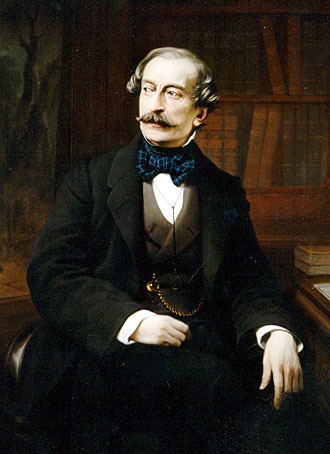
Massimo d’Azeglio, born Massimo Taparelli, was a pivotal figure in 19th-century Italy, known for his contributions to art, literature, and politics during a transformative period in Italian history. Born on October 24, 1798, in Turin, d’Azeglio’s life was marked by his commitment to the cultural and political unification of Italy. His journey from an artist to a statesman provides a fascinating glimpse into the complexities of the Italian Risorgimento—a movement that sought to consolidate the various states of the Italian Peninsula into a single nation.
Early Life and Education
Massimo d’Azeglio was born into a noble family with a strong military tradition. His father, Cesare Taparelli, was a respected figure in Piedmontese society, and his upbringing was steeped in the values of honor, duty, and patriotism. However, d’Azeglio’s early life was also shaped by the turbulence of the Napoleonic Wars, which forced his family into exile in Florence during the French occupation of Piedmont.
In Florence, the young d’Azeglio was exposed to the rich cultural and artistic heritage of the Renaissance, which would profoundly influence his later pursuits. After the fall of Napoleon, the family returned to Turin, where d’Azeglio enrolled at the university. Initially, he followed in his family’s footsteps by embarking on a military career, but his true passion lay elsewhere.
A Shift to the Arts
In 1820, Massimo d’Azeglio made a bold decision to abandon his military career and pursue his interest in the arts. He moved to Rome, where he studied painting under the guidance of the Flemish artist Martin Verstappen. D’Azeglio quickly established himself as a talented painter, specializing in landscapes and historical scenes that often reflected his burgeoning nationalist sentiments.
By 1825, d’Azeglio had begun to incorporate themes of patriotism into his work, signaling a shift towards a more politically engaged form of art. His paintings from this period often depicted historical events and figures from Italy’s past, resonating with the growing nationalist movement that sought to revive Italy’s cultural heritage as a means of fostering a sense of national identity.
Literary Contributions
D’Azeglio’s artistic endeavors soon extended into the realm of literature. In 1831, following the death of his father, he moved to Milan, where he became closely associated with the influential writer and nationalist Alessandro Manzoni. This connection proved to be a turning point in d’Azeglio’s life, as he married Manzoni’s daughter, Giulia, and began to devote more time to writing.
D’Azeglio’s first novel, “La Sagra di San Michele”, was a reflection of his dual interests in art and history. The novel, which he had already depicted in a painting, was well-received and marked the beginning of his literary career. Over the next decade, d’Azeglio would write several more novels, each infused with the themes of patriotism and the struggle for Italian independence.
His most famous work, “Ettore Fieramosca o La disfida di Barletta”, published in 1833, is a historical novel set during the Italian Wars of the early 16th century. The book recounts the tale of Ettore Fieramosca, a knight who defends Italy’s honor in a duel against French soldiers. The novel became a symbol of Italian resistance against foreign domination and was widely read by those involved in the Risorgimento.
In 1841, d’Azeglio published “Niccolò de’ Lapi, ovvero i Palleschi e i Piagnoni”, another historical novel that delves into the political and religious conflicts of Renaissance Florence. Although he never completed his planned work “La Lega Lombarda”, these novels cemented d’Azeglio’s reputation as one of the leading literary figures of his time, blending historical narrative with a passionate call for Italian unity.
Political Engagement and Leadership
Massimo d’Azeglio’s foray into literature was paralleled by an increasing involvement in political activism. The 1840s were a period of significant political upheaval across Europe, and Italy was no exception. The desire for national unification was gaining momentum, and d’Azeglio, inspired by his nationalist convictions, began to play a more active role in the movement.
In 1845, d’Azeglio published a series of pamphlets, the most notable of which was “Gli Ultimi Casi di Romagna”. These writings were fiercely anti-Austrian, condemning the foreign domination of Italian territories and advocating for the liberation and unification of Italy. D’Azeglio’s rhetoric resonated with many Italians who were disillusioned with the existing political order, and his pamphlets helped to galvanize support for the Risorgimento.
The revolutionary wave of 1848, which swept through Europe, provided d’Azeglio with the opportunity to put his ideas into action. He actively participated in the uprisings that erupted across Italy, and following the defeat of the Italian forces at the Battle of Novara in 1849, King Victor Emmanuel II appointed d’Azeglio as the Prime Minister of the Kingdom of Sardinia.
As Prime Minister, d’Azeglio faced the daunting task of steering the kingdom through a period of intense political instability. Despite the challenges, he succeeded in implementing a series of reforms aimed at modernizing the state and laying the groundwork for the eventual unification of Italy. His tenure, which lasted until 1852, was marked by efforts to strengthen the constitutional monarchy and reduce the influence of the Church in state affairs.
D’Azeglio’s pragmatic approach to governance and his ability to navigate the complex political landscape of the time earned him respect from both his allies and his opponents. However, recognizing that the unification of Italy required a more dynamic leader, d’Azeglio voluntarily stepped down in favor of Count Camillo Benso di Cavour, who would go on to play a central role in the unification process.
Later Years and Legacy
After resigning as Prime Minister, Massimo d’Azeglio gradually withdrew from active politics, although he continued to influence the course of events through his writings and public statements. He remained a staunch supporter of Italian unification and backed the Kingdom of Sardinia’s involvement in the Crimean War, which helped to raise Italy’s international profile.
In 1860, d’Azeglio was appointed as the governor of Milan, a position he held during a crucial period in the lead-up to Italy’s unification. His governance was marked by efforts to integrate the newly annexed territories into the Kingdom of Sardinia and to promote the cause of Italian unity.
During his later years, d’Azeglio turned his attention to writing his memoirs, which were published posthumously as “I miei ricordi” (My Memories). This autobiographical work provides valuable insights into the personal experiences and political beliefs of one of Italy’s most important 19th-century figures. In it, d’Azeglio reflects on his life, the challenges he faced, and his enduring commitment to the cause of Italian unity.
Massimo d’Azeglio passed away on January 15, 1866, in his hometown of Turin. His death marked the end of an era, but his legacy as a champion of Italian nationalism and a key figure in the Risorgimento lives on. D’Azeglio’s contributions to art, literature, and politics were instrumental in shaping the cultural and political landscape of modern Italy.
Historical Context and Significance
Understanding Massimo d’Azeglio’s life and work requires an appreciation of the broader historical context in which he lived. The late 18th and early 19th centuries were a time of significant political and social upheaval in Europe. The French Revolution, the Napoleonic Wars, and the subsequent Congress of Vienna had redrawn the map of Europe, and Italy, divided into several states under foreign domination, was at the center of these changes.
The Risorgimento, or the Italian unification movement, emerged as a response to these conditions. It was a complex and multifaceted movement that sought to unite the various Italian states into a single nation. Figures like Massimo d’Azeglio played a crucial role in articulating the intellectual and cultural foundations of this movement, using art, literature, and political activism to inspire a sense of national identity among Italians.
D’Azeglio’s emphasis on the importance of cultural unity as a precursor to political unification was particularly significant. He believed that fostering a shared sense of Italian identity through art and literature was essential to overcoming the regionalism and foreign domination that had long divided the Italian Peninsula. This belief was reflected in his novels, paintings, and political writings, all of which sought to evoke a sense of pride in Italy’s historical and cultural heritage.
Moreover, d’Azeglio’s political career exemplifies the challenges and opportunities of the Risorgimento. As Prime Minister of the Kingdom of Sardinia, he navigated a complex and often hostile political environment, balancing the demands of liberal reformers, conservative monarchists, and foreign powers. His willingness to step aside for the greater good of the unification movement demonstrated his commitment to the cause and his understanding of the need for strong, visionary leadership.
Conclusion
Massimo d’Azeglio was a man of many talents and deep convictions, whose life and work left an indelible mark on the history of Italy. From his early days as a painter and writer to his later role as a statesman and political leader, d’Azeglio consistently pursued the ideals of patriotism, cultural renewal, and national unity.
His legacy is one of artistic and literary achievement, political acumen, and a tireless dedication to the cause of Italian unification. As a figure who straddled the worlds of art and politics, d’Azeglio serves as a reminder of the power of culture to shape political change and the importance of visionary leadership in times of national crisis.
Today, Massimo d’Azeglio is remembered as one of the key architects of modern Italy, a country whose unity and independence he helped to bring about through his words, his art, and his actions. His life is a testament to the enduring power of the human spirit to overcome adversity and achieve greatness in the pursuit of a noble cause.


