
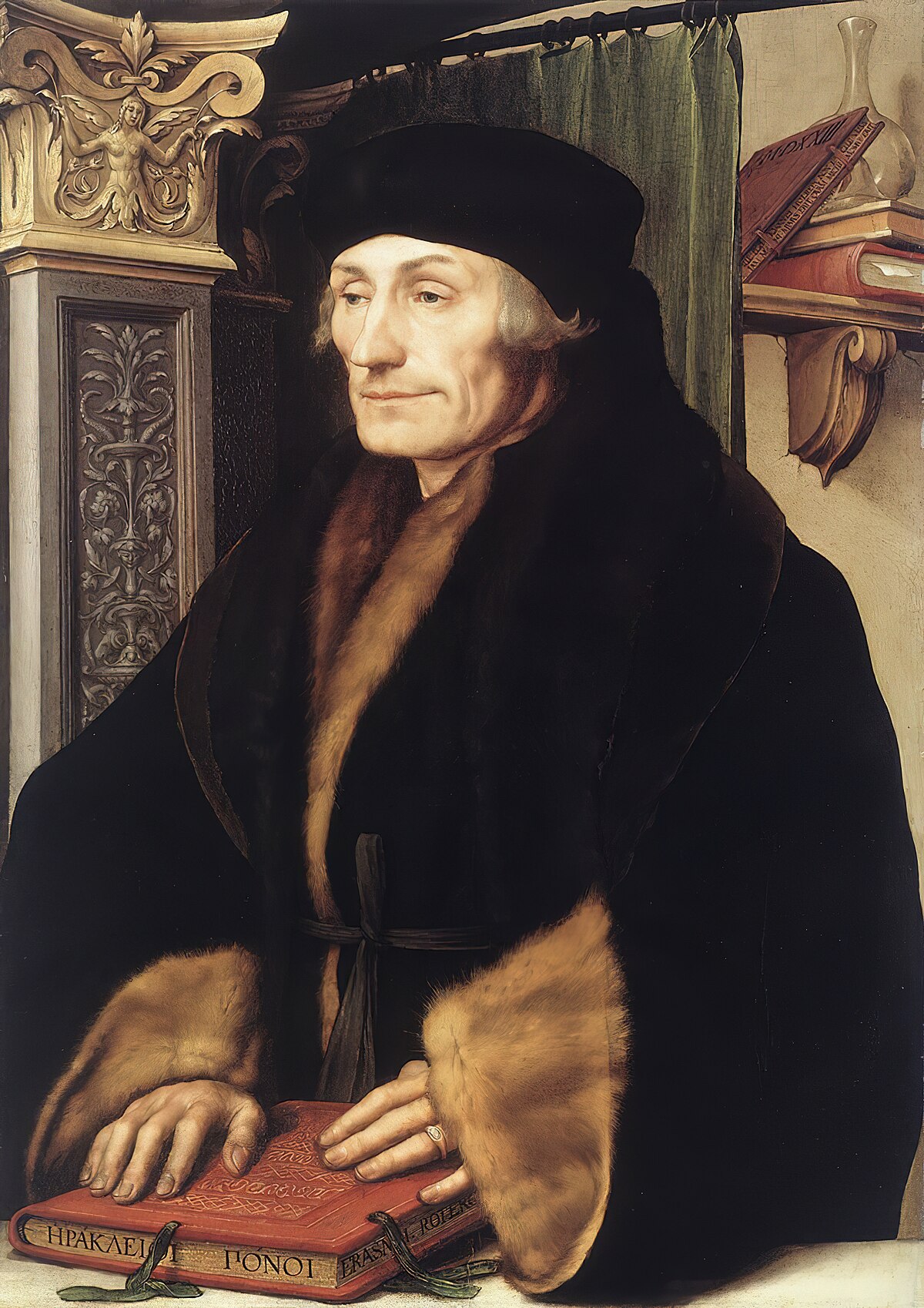
Erasmus of Rotterdam, born on October 27, 1469, in the city of Rotterdam (or perhaps in 1466 in Gouda), is widely regarded as one of the most significant figures of the Northern Renaissance. His contributions to theology, philosophy, and humanism have left an indelible mark on European intellectual history. Erasmus, whose birth name was Geert Geertsz, is most famous for his works such as The Praise of Folly and his critical editions of the New Testament, which challenged the religious orthodoxy of his time and laid the groundwork for the Protestant Reformation.
Early Life and Education
Erasmus was born the illegitimate son of a priest, Roger Gerard, and his mother, Margaret, the daughter of a physician. Despite the challenges of his birth status, Erasmus received an exceptional education, attending monastic schools in Deventer and ‘s-Hertogenbosch. His early education was steeped in the classical tradition, and it was during these formative years that he developed a lifelong passion for Latin and Greek literature, which would become central to his intellectual endeavors.
Orphaned at a young age, Erasmus entered the priesthood in 1492, although he never fully embraced the monastic life. Instead, he sought to further his studies, traveling to the University of Paris in 1495. There, he immersed himself in the study of theology, philosophy, and the classics, but it was his desire for intellectual freedom that ultimately defined his career. Erasmus’s pursuit of knowledge led him across Europe, where he engaged with the leading scholars of his time and became a central figure in the intellectual movement known as humanism.
Intellectual Freedom and Early Works
Erasmus’s commitment to intellectual freedom was a defining characteristic of his life. Unlike many of his contemporaries, he refused to align himself with any particular religious or political faction, preferring instead to maintain his independence. This decision allowed him to critique the Catholic Church from within while avoiding direct involvement in the emerging Protestant Reformation.
One of Erasmus’s most enduring contributions to literature is The Praise of Folly (Moriae Encomium), written in 1509 during a visit to the home of his friend Sir Thomas More. The work is a satirical critique of the Church and society, using the voice of Folly, personified as a woman, to mock the vanity, corruption, and hypocrisy that Erasmus observed in the world around him. The Praise of Folly quickly became one of the most popular and controversial books of the Renaissance, cementing Erasmus’s reputation as a sharp-witted critic of the status quo.
In addition to his satirical works, Erasmus was deeply engaged in scholarly pursuits. His work on the New Testament, including the publication of a critical Greek edition in 1516, was groundbreaking. By returning to the original Greek texts, Erasmus sought to correct the errors and inconsistencies that had crept into the Latin Vulgate over the centuries. His scholarly rigor and emphasis on the original languages of scripture were influential in shaping the theological debates of the Reformation.
Erasmus and the Reformation
While Erasmus shared many of the concerns of the Protestant reformers, particularly regarding the corruption and excesses of the Catholic Church, he chose not to align himself with the movement led by Martin Luther. Instead, Erasmus maintained a cautious distance, advocating for reform within the Church rather than a break from it. He believed that true reform could only come through education, reason, and a return to the original sources of Christian teaching, rather than through radical change or violence.
This position put Erasmus in a difficult position. On one hand, he was admired by reformers like Luther for his scholarship and critique of the Church. On the other hand, his refusal to break with the Church led to accusations of cowardice and indecision. Luther, who initially hoped for Erasmus’s support, eventually criticized him for what he saw as a lack of commitment to the cause of reform.
Erasmus’s desire to remain neutral and independent is best illustrated by his response to the growing religious tensions of the time. He famously declined an invitation from Luther to join the Reformation, stating that he preferred to “remain a free scholar and to serve the cause of letters and learning.” Erasmus’s position reflected his belief that intellectual inquiry and scholarship should remain above the fray of religious conflict, a stance that both endeared him to his contemporaries and left him isolated.
Later Years and Final Works
As the Reformation gained momentum, Erasmus found himself increasingly caught between the opposing forces of Catholicism and Protestantism. His criticisms of the Church were seen by some as fueling the reformers’ cause, while others accused him of being too conservative and unwilling to take a stand. The social and religious upheavals of the period, including the Peasants’ War and the rise of radical Protestant sects, troubled Erasmus deeply. He feared that the Reformation would lead to chaos and violence, and he was particularly dismayed by the iconoclasm and radicalism that accompanied the movement in some regions.
In 1529, as the Reformation spread to Basel, where Erasmus was residing, the city adopted Protestant doctrines, prompting him to move to the nearby Catholic city of Freiburg. Despite the religious turmoil around him, Erasmus continued his scholarly work, producing one of his most important later works, Ecclesiastes, a treatise on preaching and the central role of the Word in Christian life.
Ecclesiastes reflects Erasmus’s deep commitment to the idea that true Christianity is rooted in the teachings of Christ, rather than in the rituals and dogmas of the Church. In this work, he emphasized the importance of scripture and the need for preachers to focus on the moral and spiritual education of their congregations. This emphasis on the ethical and educational aspects of religion was a consistent theme in Erasmus’s work and highlights his belief that reform should come through personal piety and education rather than through doctrinal changes or schism.
Erasmus died on July 12, 1536, in Basel, where he had returned to oversee the publication of Ecclesiastes. Although he remained a Catholic throughout his life, his works were later condemned by the Church, and in 1543, his books were burned in Milan alongside those of Luther. Erasmus’s death marked the end of an era, but his influence on European thought and culture continued to resonate long after his passing.
Historical Context and Influence
To fully appreciate Erasmus’s life and work, it is essential to understand the broader historical context in which he lived. The late 15th and early 16th centuries were a time of profound change in Europe. The Renaissance, with its emphasis on the rediscovery of classical knowledge and the potential of human achievement, was in full swing. At the same time, the Catholic Church, which had dominated European life for centuries, was facing increasing criticism for its corruption and worldliness.
Erasmus was a product of the Renaissance, deeply influenced by its values of humanism, education, and the study of classical antiquity. His scholarship was characterized by a return to the original texts of the Bible and the Church Fathers, a method known as ad fontes (to the sources). This approach was revolutionary in its insistence on the importance of studying the Bible in its original languages, rather than relying on the Latin Vulgate, which had become the standard text of the Church.
The rise of humanism also played a crucial role in shaping Erasmus’s thought. Humanists like Erasmus believed in the potential of human reason and education to improve society. They emphasized the importance of studying the humanities—literature, history, philosophy, and the arts—as a means of cultivating moral and intellectual virtues. Erasmus’s works reflect this belief in the transformative power of education and his commitment to the idea that knowledge should be accessible to all.
Legacy and Enduring Significance
Erasmus’s legacy is complex and multifaceted. He is remembered as one of the greatest scholars of the Renaissance, a brilliant writer, and a tireless advocate for intellectual freedom. His works, particularly The Praise of Folly and his editions of the New Testament, continue to be studied and admired for their wit, erudition, and moral insight.
However, Erasmus is also remembered for his cautious approach to the Reformation. His refusal to fully align himself with either the Catholic Church or the Protestant reformers left him in a difficult position, criticized by both sides for his perceived indecision. Yet this very caution also allowed him to maintain his independence and continue his scholarly work without being drawn into the bitter conflicts that characterized the period.
Today, Erasmus is often seen as a symbol of the intellectual and cultural currents of the Northern Renaissance. His emphasis on education, moral reform, and the study of the original texts of Christianity had a profound impact on the development of European thought. His ideas helped lay the groundwork for the Reformation, even as he remained committed to the idea of reform within the Church rather than through schism.
Erasmus’s influence extended far beyond his own time. His works were widely read and admired throughout Europe, and his ideas about education, religion, and society continued to resonate with later generations of thinkers. The humanist tradition that he helped to shape played a crucial role in the development of modern European thought, and his commitment to intellectual freedom and the pursuit of knowledge remains an enduring legacy.
In conclusion, Erasmus of Rotterdam was a towering figure of the Northern Renaissance, whose life and work had a profound impact on the intellectual and religious landscape of Europe. His commitment to education, moral reform, and intellectual freedom continues to inspire scholars and thinkers today, and his legacy as one of the great humanists of the Renaissance is secure.


