
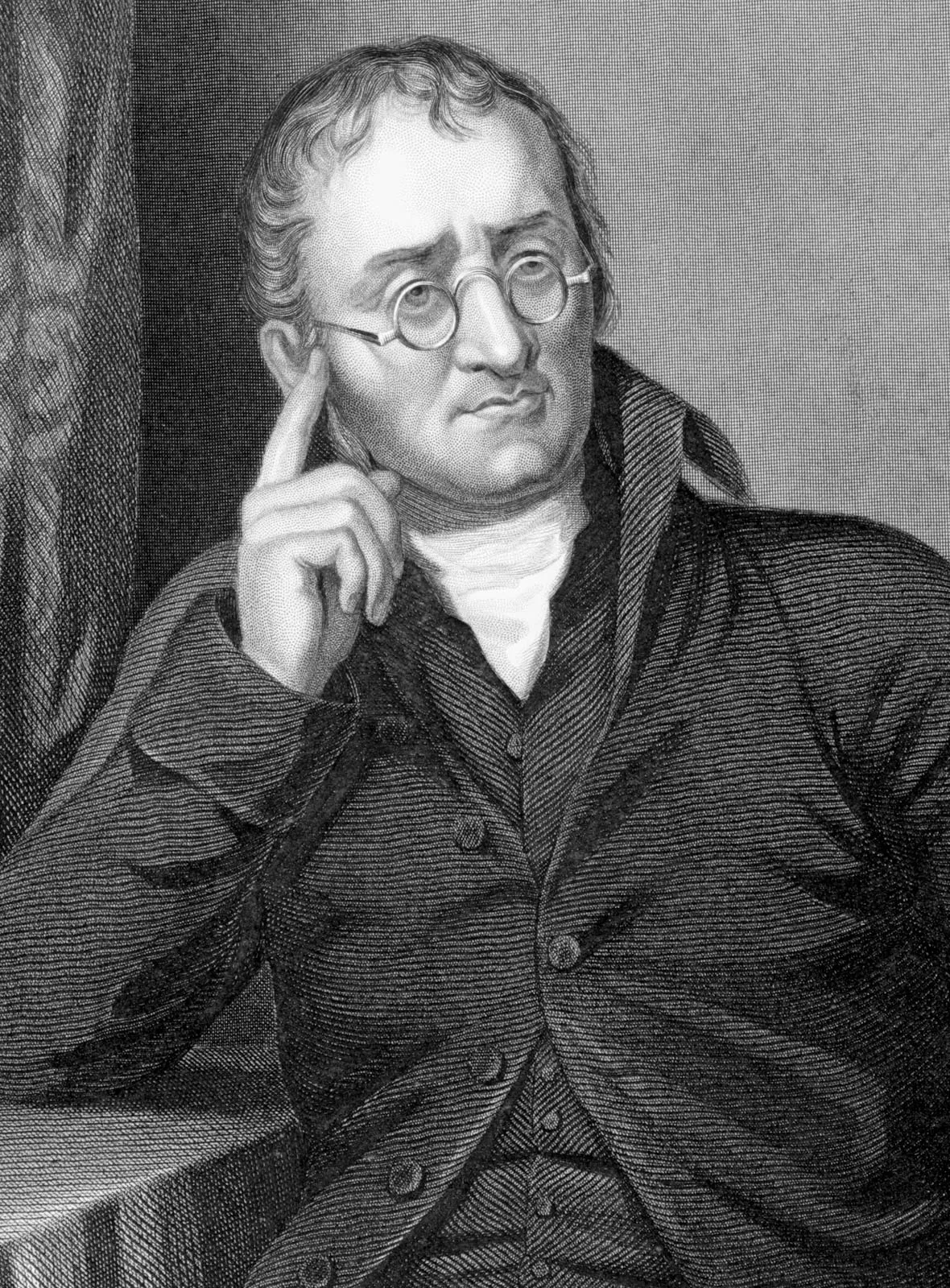
John Dalton, born on September 6, 1766, in Eaglesfield, near Cockermouth, England, is a name that resonates profoundly within the realms of chemistry and meteorology. Renowned for his pioneering work in atomic theory, Dalton’s contributions laid the foundational bedrock for modern chemistry. His life, however, is not just a tale of scientific discovery; it is a journey through the evolving landscape of 18th and 19th-century science, marked by intellectual curiosity, perseverance, and a steadfast commitment to knowledge.
Early Life and Education
John Dalton was born into a Quaker family, a religious group known for its emphasis on simplicity, integrity, and education. These values profoundly influenced Dalton’s upbringing. His early life was marked by an environment of intellectual stimulation, largely due to the influence of Elihu Robinson, a prominent Quaker and meteorologist in Dalton’s community. Robinson’s mentorship kindled Dalton’s interest in meteorology and mathematics, shaping the trajectory of his future endeavors.
Dalton’s formal education began in Kendal, where he quickly distinguished himself as a promising scholar. He actively participated in solving complex problems published in the “Gentlemen’s and Ladies’ Diaries,” showcasing his early aptitude for critical thinking and problem-solving. At the age of 21, Dalton considered pursuing a career in medicine or law. However, his parents did not support this direction, leading him to remain in his hometown until 1793, when he relocated to Manchester.
The Manchester Years and Early Scientific Contributions
The move to Manchester was a pivotal moment in Dalton’s life. In 1793, he published his first major work, Meteorological Observations and Essays. Although the treatise did not receive immediate recognition, it contained the seeds of many of Dalton’s later discoveries. The book laid the groundwork for his future contributions to meteorology, a field he remained deeply invested in throughout his life.
Shortly after arriving in Manchester, Dalton was appointed as a teacher of natural philosophy and mathematics at the New College. His appointment was partly facilitated by John Gough, a blind philosopher who recognized Dalton’s potential. In 1794, Dalton was elected to the Manchester Literary and Philosophical Society, known as “Lit & Phil.” This membership connected him with like-minded scholars and provided a platform for sharing and refining his ideas.
Daltonism: The Study of Color Perception
One of Dalton’s early contributions to science was his research on color perception, particularly color blindness, a condition he personally experienced. In 1794, he published Extraordinary Facts Relating to the Vision of Colours, where he proposed that color blindness was caused by discoloration of the fluid in the eyeball. His hypothesis was based on his own experience, as both he and his brother were affected by this condition, leading him to believe it was hereditary.
Although Dalton’s theory about the cause of color blindness was later disproven, his work laid the foundation for further studies in this area. The condition of color blindness became widely known as “Daltonism,” highlighting his influence on the field. Dalton’s methodical approach to studying color perception set a standard for scientific inquiry, demonstrating the importance of observation and hypothesis testing in advancing knowledge.
Dalton’s work in this area, while flawed, underscored his broader commitment to understanding the natural world. His meticulous observations and willingness to explore new ideas, even when they challenged established beliefs, exemplify the spirit of scientific exploration that characterized his career.
The Development of Atomic Theory
John Dalton’s most significant and enduring contribution to science is his atomic theory. In 1803, Dalton began formulating his ideas about atoms, building upon two of the fundamental laws of chemistry and eventually leading to the enunciation of his famous “law of multiple proportions.” According to this law, when two elements combine to form different compounds, the ratios of the quantities of one element that combine with a fixed quantity of the other are simple whole numbers.
Dalton’s atomic theory posited that all matter is composed of tiny, indivisible particles called atoms. He described these atoms as solid, indestructible spheres, each corresponding to a specific chemical element. While Dalton’s model of the atom was later refined with the discovery of subatomic particles like electrons and protons, his work marked a monumental shift in scientific understanding.
Dalton’s atomic theory was groundbreaking because it provided a unifying explanation for a wide range of chemical phenomena. It allowed scientists to predict the outcomes of chemical reactions and offered a new way to classify elements and compounds. The idea that matter was composed of discrete units challenged the prevailing notions of the time, which often viewed matter as continuous and infinitely divisible.
One of the key components of Dalton’s atomic theory was the assertion that atoms of different elements have different weights, which he quantified based on their combining weights in chemical reactions. This concept paved the way for the development of the periodic table and the study of chemical stoichiometry. Dalton’s work was instrumental in establishing chemistry as a quantitative science, where measurements and calculations became integral to understanding chemical processes.
Despite some inaccuracies in his theory, such as the belief that pure elements were composed of single atoms (which is true only for noble gases), Dalton’s ideas were revolutionary. His atomic theory laid the foundation for modern chemistry and influenced countless scientists who followed in his footsteps.
Later Life and Recognition
Dalton’s scientific achievements earned him a significant reputation in the early 19th century. In 1804, he was invited to lecture on natural philosophy at the Royal Institution in London, a testament to his growing influence in the scientific community. However, Dalton remained humble and focused on his work, largely eschewing the limelight.
In 1810, the renowned chemist Sir Humphry Davy proposed that Dalton apply for membership in the Royal Society, the prestigious scientific institution. Dalton, known for his modesty and likely concerned about the financial implications, initially declined the invitation. However, in 1822, he was elected to the Royal Society without his knowledge, a recognition of his significant contributions to science.
Dalton never married and lived a simple, dedicated life focused on his research. In 1833, the British government awarded him a pension of 150 pounds per year in recognition of his scientific achievements. This pension was later increased to 300 pounds, reflecting the high regard in which he was held.
Dalton spent over 25 years living in George Street, Manchester, with his friend Reverend Johns. His daily routine was a mix of laboratory work, teaching, and annual excursions to the Lake District, a region he loved for its natural beauty. Despite his fame, Dalton remained deeply connected to his Quaker roots, leading a life marked by simplicity and intellectual rigor.
The Final Years and Legacy
In 1837, Dalton suffered a stroke, the first of several that would mark the decline of his health. Although the stroke affected his ability to speak, it did not diminish his passion for science. He continued his experiments and observations, a testament to his unwavering dedication to his work.
Dalton experienced another stroke in 1838, which further impaired his physical abilities but did not deter his scientific endeavors. His final stroke occurred in May 1844, marking the end of his long and illustrious career. On July 26, 1844, Dalton recorded his last meteorological observation, and he passed away the following day after a fall from his bed.
The news of Dalton’s death sent shockwaves through the scientific community. His body was laid in state at the Manchester Town Hall, where over 40,000 people paid their respects. This public outpouring of grief and admiration highlighted the profound impact Dalton had on science and society.
Dalton was buried in the Ardwick Cemetery in Manchester, and his legacy was further commemorated with a bust at the entrance of the Royal Manchester Institution. His contributions to science, particularly his atomic theory and research on gases, continue to influence scientific thought and education to this day.
Dalton’s Contributions to Gas Laws
One of Dalton’s significant contributions to chemistry was his work on gas mixtures. His research led to the formulation of what is now known as Dalton’s Law of Partial Pressures. This law states that the total pressure exerted by a mixture of non-reactive gases is equal to the sum of the partial pressures of each individual gas. The partial pressure of a gas is the pressure that it would exert if it occupied the entire volume alone.
Dalton’s Law of Partial Pressures is applicable in various scientific fields, from atmospheric science to respiratory physiology. For example, the law explains the behavior of gases in the Earth’s atmosphere, where different gases contribute to the total atmospheric pressure. In medical science, Dalton’s law is crucial for understanding the partial pressures of oxygen and carbon dioxide in the lungs, which are vital for respiration.
The law also plays a significant role in industrial processes, such as the distillation of essential oils. In these processes, the combined vapor pressures of water and the oil allow for distillation at temperatures lower than the boiling point of water alone, making it possible to extract volatile compounds without decomposition.
Conclusion
John Dalton’s life and work represent a cornerstone in the history of science. His atomic theory revolutionized the field of chemistry, providing a framework that continues to underpin modern scientific research. Dalton’s contributions to the understanding of gas behavior, color blindness, and meteorology demonstrate his versatility and depth as a scientist.
Dalton’s legacy extends beyond his scientific achievements. His dedication to knowledge, humility, and perseverance in the face of challenges offer valuable lessons for future generations of scientists. As we continue to explore the complexities of the natural world, Dalton’s work serves as a reminder of the importance of curiosity, critical thinking, and the relentless pursuit of truth.
In summary, John Dalton was not just a scientist but a visionary whose ideas transformed our understanding of the physical world. His work laid the foundation for the chemical sciences and set the stage for future discoveries that would shape the modern world. The impact of his contributions is still felt today, making him one of the most influential figures in the history of science.


