
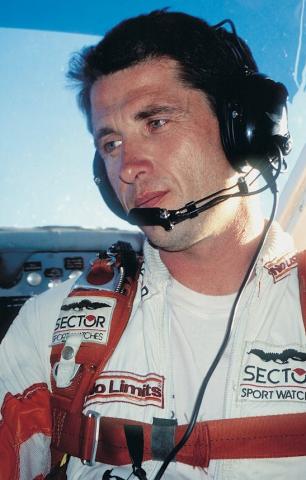
Patrick De Gayardon, born on January 23, 1960, in Oullins, near Paris, France, was a legendary figure in the world of extreme sports. Known as a pioneer of skydiving and wingsuit flying, De Gayardon pushed the boundaries of human flight, blending audacity with scientific precision. His life and career were marked by incredible achievements and a relentless pursuit of the dream to fly like a bird. This article delves into the life of Patrick De Gayardon, exploring his early years, rise to fame, and the legacy he left behind in the world of extreme sports.
Early Life and Introduction to Extreme Sports
Patrick De Gayardon’s childhood was spent in the quiet surroundings of his grandparents’ home. He received his early education at the Marist Fathers’ convent in Lyon, where he studied for eleven years. After completing his high school education, De Gayardon initially pursued a degree in law, but his passion for adventure soon led him down a different path.
Before discovering skydiving, De Gayardon was an avid sports enthusiast, participating in various disciplines, including windsurfing, golf, tennis, and skiing. These early experiences honed his physical abilities and developed his appetite for pushing the limits of human potential.
In 1980, at the age of 20, De Gayardon made his debut in the world of skydiving, a decision that would change the course of his life. The thrill of freefall and the freedom it offered captivated him, and he quickly became immersed in the sport. His natural talent and dedication soon set him apart from his peers.
Mastery of Skydiving and Base Jumping
By 1984, Patrick De Gayardon had expanded his skydiving repertoire to include base jumping, a discipline that involves jumping from fixed objects such as buildings, bridges, and cliffs. Base jumping was still in its infancy at the time, and De Gayardon was one of its early pioneers. His jumps from skyscrapers, power lines, and other fixed structures showcased his daring nature and his ability to master the most challenging aspects of skydiving.
De Gayardon’s passion for skydiving was particularly evident in his pursuit of freestyle skydiving, where he performed intricate, three-dimensional maneuvers during freefall. His creativity and precision in the air earned him recognition in the competitive skydiving community. He became the French national champion in freefall in 1985 and 1988, and in 1986, he was named vice-champion of the world in the same discipline.
The Birth of Skysurfing
In May 1989, Patrick De Gayardon helped pioneer a new extreme sport that would bring him international fame: skysurfing. Skysurfing involved performing acrobatic maneuvers during freefall while strapped to a specially designed board, similar to a snowboard. The combination of freefall and surfing techniques allowed skydivers to execute a wide range of dynamic and visually stunning moves.
De Gayardon was one of the first practitioners of skysurfing, and his innovative approach quickly made him a leading figure in the sport. His ability to blend the grace of surfing with the adrenaline rush of skydiving captivated audiences around the world. De Gayardon’s skysurfing performances were not only technically impressive but also visually mesmerizing, as he seemed to dance with the wind in the sky.
In 1991, De Gayardon secured a second-place finish in the French championships for team flight, further solidifying his reputation as a versatile and skilled skydiver. The following year, he became a member of the “No Limits Sector Team,” a group of elite skydivers known for pushing the boundaries of the sport. In the spring of 1992, De Gayardon made a historic base jump from Angel Falls in Venezuela, the world’s highest waterfall, with a drop of 979 meters.
Record-Breaking Feats and Pioneering Achievements
Throughout the early 1990s, Patrick De Gayardon continued to break new ground in the world of skydiving. In October 1992, he performed a high-altitude jump over Bordeaux, France, from an astonishing height of 11,700 meters (38,385 feet). This jump was notable not only for its altitude but also for the technical skill required to execute it successfully.
In 1993, De Gayardon embarked on another daring adventure by leaping from a helicopter into the Sótano de las Golondrinas, a massive natural cave in Mexico. The cave, with a depth of 376 meters and varying widths of 63 to 49 meters, posed significant challenges. De Gayardon’s feat involved opening his parachute only after descending into the vast chasm, showcasing his mastery of precise timing and control.
One of De Gayardon’s most iconic achievements came in April 1994, when he performed a skysurfing jump over the North Pole. Leaping from 3,200 meters, De Gayardon became the first person to skysurf in such extreme conditions, demonstrating his ability to push the sport’s boundaries even in the most unforgiving environments.
On November 14, 1995, De Gayardon set a new record by jumping from an altitude of 12,700 meters (41,667 feet) over Moscow without using an oxygen mask. This feat underscored his physical endurance and mental toughness, as well as his willingness to challenge the limits of human capability.
In 1996, Patrick De Gayardon’s contributions to skysurfing were recognized when he won the first-ever World Skysurfing Championship organized by the Fédération Aéronautique Internationale (FAI). This victory solidified his status as one of the greatest skydivers of his generation.
The Wingsuit Project: Realizing the Dream of Human Flight
In 1997, Patrick De Gayardon shifted his focus to a new and ambitious project that would revolutionize the world of skydiving: the development of a wingsuit. Inspired by the flying capabilities of certain animals, such as the flying squirrels of Madagascar, De Gayardon sought to create a suit that would allow humans to glide through the air with control and precision.
The concept of the wingsuit was not entirely new, but De Gayardon’s innovative design took the idea to new heights. His wingsuit featured three fabric surfaces sewn directly into the suit, filling the space between the arms, body, and legs when spread out. The suit was constructed with a double-layered membrane that inflated during freefall, creating a lifting effect that allowed for controlled horizontal movement.
De Gayardon’s wingsuit enabled him to achieve a horizontal speed of 140-150 kilometers per hour (87-93 miles per hour), with a maximum speed of 180 kilometers per hour (112 miles per hour). The vertical speed was reduced to just 90 kilometers per hour (56 miles per hour). By adjusting his body position and the angle of descent, De Gayardon could achieve a flight path with a 35-degree descent angle, allowing for greater horizontal distance than vertical drop.
During tests, De Gayardon’s wingsuit proved capable of covering horizontal distances of up to six kilometers (3.7 miles) in just over two minutes from an altitude of 4,000 meters (13,123 feet). This achievement represented a major leap forward in human flight, as it allowed for a more sustained and controlled glide, bringing De Gayardon closer to realizing the dream of flying like a bird.
In one of his most famous stunts, De Gayardon demonstrated the effectiveness of his wingsuit by jumping from an aircraft without a parachute and then re-entering the plane mid-flight. This incredible feat showcased the precision and control that his wingsuit provided, as well as his extraordinary skill as a skydiver.
Tragic End and Lasting Legacy
Tragically, Patrick De Gayardon’s life was cut short on April 13, 1998, during a routine training jump in Hawaii. While testing improvements to his wingsuit, a malfunction occurred with the suit’s integrated parachute system, leading to a fatal accident. De Gayardon’s death was a devastating loss to the extreme sports community and to all who admired his courage and innovation.
The day after his passing, Italy’s Gazzetta dello Sport paid tribute to De Gayardon with a poignant message: “There are men who, with their inventions, have changed our way of living. Others, our way of dreaming.” This sentiment captured the essence of De Gayardon’s impact on the world—he was not just a skydiver or an athlete; he was a visionary who inspired others to push the boundaries of what was possible.
Conclusion
Patrick De Gayardon’s life was a testament to the human spirit’s desire to soar beyond limits and explore the unknown. His contributions to skydiving, skysurfing, and wingsuit flying have left an indelible mark on the world of extreme sports. Through his innovative designs and daring feats, De Gayardon brought the dream of human flight closer to reality, inspiring future generations of skydivers and adventurers to continue exploring the skies.
De Gayardon’s legacy lives on in the wingsuit flying community, where his pioneering work continues to influence the development of new technologies and techniques. His story is one of passion, perseverance, and an unyielding belief in the power of dreams. As long as there are those who look to the sky with wonder and a desire to fly, Patrick De Gayardon’s name will be remembered as a true pioneer of human flight.


