
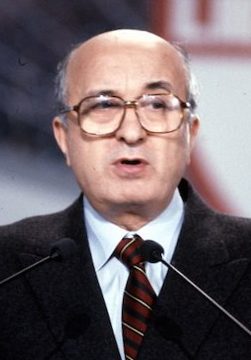
Ciriaco De Mita (February 2, 1928 – May 26, 2022) was a towering figure in Italian politics, known for his long and impactful career within the Christian Democracy (Democrazia Cristiana) party, his role as Prime Minister of Italy, and his influence on Italian political life spanning several decades. His life journey from a small town in southern Italy to the heights of political power is a story of resilience, strategic acumen, and dedication to public service. This article provides a comprehensive overview of De Mita’s life, his rise to fame, and the significant milestones that defined his political career.
Early Life and Education
Ciriaco De Mita was born on February 2, 1928, in Nusco, a small town in the province of Avellino, Italy. His family background was modest; his father was a tailor, and his mother was a homemaker. Growing up in a rural environment during a period of significant social and economic challenges in Italy, De Mita was driven by a desire to pursue education as a means of improving his circumstances.
He attended high school in Sant’Angelo dei Lombardi, where he distinguished himself academically. His intellectual capabilities earned him a scholarship to the prestigious Catholic University of Milan, where he studied law. This opportunity marked the beginning of De Mita’s journey into the world of politics and public life.
At university, De Mita was exposed to the political ideas and philosophies that would shape his career. He became involved in student politics and developed a deep interest in the workings of the state and governance. After graduating with a degree in law, De Mita briefly worked as a legal consultant at the energy giant ENI. However, his true calling was politics, and it wasn’t long before he began to make his mark.
Entry into Politics and Early Career
Ciriaco De Mita’s formal entry into politics came in 1956 during the congress of the Christian Democracy (DC) party in Trento. At the age of 28, De Mita was elected as a national councilor of the party. His election was notable not only because of his youth but also because of his willingness to critique the party’s organizational structure and its leadership, particularly that of Amintore Fanfani, a dominant figure in the DC at the time.
De Mita’s early political career was characterized by his association with the left-wing faction of the Christian Democracy party, known as the “Sinistra di Base.” This faction, which he helped to found, was the most progressive wing of the DC and advocated for social reforms and closer cooperation with Italy’s burgeoning leftist movements. De Mita’s involvement with this group placed him at the forefront of the party’s internal debates and positioned him as a rising star within the DC.
In 1963, De Mita was elected to the Italian Parliament for the first time, representing the constituency of Salerno, Avellino, and Benevento. His election to Parliament marked the beginning of a long and influential legislative career. Three years later, he suggested the possibility of a political alliance with the Italian Communist Party (PCI) to implement regional governance, a bold and controversial idea that showcased his forward-thinking approach.
Rise to Leadership in Christian Democracy
Throughout the 1970s and 1980s, De Mita continued to rise through the ranks of the Christian Democracy party. His strategic acumen and ability to navigate the complex internal dynamics of the party allowed him to consolidate power gradually. In 1968, he was appointed Undersecretary of the Interior, a role that further cemented his position within the party and gave him valuable experience in government administration.
De Mita’s real breakthrough came in 1982 when he was elected as the national secretary of the Christian Democracy party. This position was one of the most powerful in Italian politics, as the DC was the dominant party in Italy for much of the post-war period. As secretary, De Mita wielded significant influence over the direction of the party and the formation of government policy.
During his tenure as party secretary, De Mita focused on revitalizing the DC by promoting younger members and encouraging a more dynamic and responsive party structure. He was also instrumental in appointing Romano Prodi, his economic advisor, to a key position at the head of IRI, a major Italian state-owned holding company, demonstrating his ability to place allies in strategic positions.
Despite facing internal party conflicts and a decline in the DC’s popularity in the 1983 elections, De Mita’s leadership was strong enough to keep him at the helm of the party. His efforts to modernize and adapt the party to the changing political landscape were widely recognized, and in 1985, he was named one of the most powerful men in Italy by the weekly magazine Il Mondo, ranking just behind industrial magnate Gianni Agnelli and socialist leader Bettino Craxi.
Prime Minister of Italy
Ciriaco De Mita’s most prominent role came in April 1988 when he was appointed Prime Minister of Italy by President Francesco Cossiga. His appointment came during a turbulent period in Italian politics, characterized by the fragmentation of traditional political alliances and the rise of new political forces.
As Prime Minister, De Mita led a coalition government known as the Pentapartito, which included the Christian Democrats, Socialists, Social Democrats, Republicans, and Liberals. His government was marked by efforts to address Italy’s economic challenges, including high inflation and public debt, as well as attempts to push through institutional reforms.
However, De Mita’s tenure as Prime Minister was also marred by tragedy. Shortly after taking office, his advisor on institutional reforms, Senator Roberto Ruffilli, was assassinated by the Red Brigades, a far-left terrorist organization. Ruffilli’s murder was a significant blow to De Mita personally and politically, as it underscored the persistent threat of political violence in Italy during the 1970s and 1980s.
Despite these challenges, De Mita’s government implemented several important initiatives, including efforts to reform the Italian state’s administrative structure. However, his time as Prime Minister was short-lived. In February 1989, he stepped down as the leader of the Christian Democracy party, and a few months later, he resigned as Prime Minister, making way for his successor, Giulio Andreotti.
Later Political Career and Legacy
After leaving the office of Prime Minister, Ciriaco De Mita continued to play an active role in Italian politics. He remained involved in the Christian Democracy party, serving as its president until 1992. During this period, he focused on guiding the party through a time of significant change as Italy’s political landscape shifted dramatically.
In 1992, De Mita was appointed chairman of the bicameral commission for institutional reforms, a role that allowed him to influence the direction of constitutional and political reforms in Italy. However, the early 1990s were a time of upheaval for the Christian Democracy party, which was weakened by corruption scandals and the collapse of the First Republic political system.
In 1993, De Mita left the Christian Democracy party and joined the Italian People’s Party (Partito Popolare Italiano), aligning himself with the left-wing faction of the party led by Gerardo Bianco. De Mita’s decision to join the PPI marked his continued commitment to center-left politics and his belief in the need for a strong progressive voice in Italian politics.
Throughout the 1990s and 2000s, De Mita remained active in politics, supporting the formation of new political coalitions, including the Olive Tree coalition and later the Democratic Party (Partito Democratico). In 2002, he played a key role in the merger of the Italian People’s Party and the Daisy Party (La Margherita), contributing to the creation of a unified center-left political force.
De Mita’s political career took a surprising turn in 2008 when he left the Democratic Party due to disagreements over term limits for parliamentary candidates. He subsequently founded the Populars for the Constituent Assembly of the Center (Popolari per la Costituente di Centro), which aligned with centrist and Catholic political traditions.
In 2014, at the age of 86, De Mita was elected mayor of his hometown, Nusco, demonstrating his enduring commitment to public service. Remarkably, he was re-elected as mayor in 2019 at the age of 91, making him one of the oldest active politicians in Italy.
Personal Life and Death
Ciriaco De Mita was known for his intellectual rigor, strategic mind, and deep commitment to the Catholic faith. He was married to Annamaria Scarinzi, with whom he had four children. Despite his long and often intense political career, De Mita maintained a close connection to his family and his hometown of Nusco, where he spent his final years.
De Mita passed away on May 26, 2022, at the age of 94, in his beloved Nusco. His death marked the end of an era in Italian politics, as he was one of the last surviving figures from the post-war generation of Christian Democrats who had shaped Italy’s political landscape for decades.
Conclusion
Ciriaco De Mita’s life and career spanned one of the most dynamic periods in Italian history, from the post-war reconstruction to the political transformations of the 21st century. As a key figure in the Christian Democracy party, De Mita played a pivotal role in shaping Italy’s political institutions and navigating the country through times of both prosperity and crisis.
His legacy is one of dedication to public service, a commitment to political and social reform, and a deep belief in the power of democracy to effect positive change. De Mita’s influence on Italian politics will be remembered as that of a strategist, reformer, and statesman who, despite the many challenges he faced, remained steadfast in his commitment to his country and its people.


