
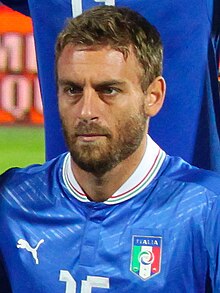
Daniele De Rossi, born on July 24, 1983, in Ostia, a coastal district of Rome, Italy, is a name synonymous with passion, loyalty, and unparalleled dedication in the world of football. As one of the most iconic midfielders in Italian football history, De Rossi’s career has been marked by his fierce commitment on the pitch, tactical intelligence, and an undying loyalty to his beloved club, AS Roma. This article delves into the life and career of Daniele De Rossi, exploring his journey from a young football enthusiast to a world champion and a revered figure in the sport.
Early Life and Football Beginnings
Daniele De Rossi was born into a footballing family, with his father, Alberto De Rossi, being deeply involved in AS Roma’s youth academy. Growing up in Ostia, De Rossi was immersed in the culture of football from a young age. His early passion for the sport led him to join the youth ranks of Ostiamare, a local club, where he initially played as a forward. His talent was evident early on, and it wasn’t long before he caught the attention of AS Roma, the club that would become his second home.
De Rossi’s transition to AS Roma’s youth academy was a significant step in his footballing journey. Under the guidance of his father and other experienced coaches, De Rossi honed his skills and gradually moved from an attacking role to a more defensive position in the midfield. This shift would later define his career, as he became known for his ability to break up opposition plays, distribute the ball effectively, and lead by example with his combative style of play.
Rise to Prominence in the 2000s
De Rossi’s professional debut came on October 30, 2001, at the age of 18, during a UEFA Champions League match against Anderlecht. This marked the beginning of a long and illustrious career with AS Roma. The following season, 2002-2003, saw De Rossi become a regular member of the first team under the management of Fabio Capello. He made his Serie A debut on January 25, 2003, in a match against Como, and scored his first goal for the club on May 10, 2003, against Torino.
The 2003-2004 season was pivotal for De Rossi as he established himself as a key player for Roma. His performances in midfield, characterized by his tactical awareness and defensive capabilities, drew praise from both fans and pundits. His partnership with the experienced Brazilian midfielder Emerson was particularly noteworthy, as the duo formed a formidable midfield unit. De Rossi’s growing influence on the pitch also earned him a place in Italy’s Under-21 national team, with whom he won the UEFA European Under-21 Championship in 2004.
Establishing Himself as a Leader
By the 2004-2005 season, De Rossi had firmly established himself as a vital cog in AS Roma’s midfield. His consistency and reliability on the pitch did not go unnoticed, and he earned his first call-up to the senior Italian national team. On September 4, 2004, De Rossi made his debut for Italy in a World Cup qualifier against Norway, scoring a goal in his first appearance. His immediate impact at the international level was a testament to his growing stature in the footballing world.
De Rossi’s leadership qualities began to shine through during this period. In a UEFA Cup match against Middlesbrough FC on March 15, 2006, Roma’s manager Luciano Spalletti handed De Rossi the captain’s armband for the first time, marking the beginning of his journey as a leader both on and off the pitch. His integrity was further demonstrated just four days later in a Serie A match against Messina, where he admitted to the referee that he had handled the ball before scoring, leading to the goal being disallowed. This act of sportsmanship endeared him even more to fans and earned him widespread respect.
World Cup Glory and Continued Success
De Rossi’s career reached new heights in 2006 when he was selected to represent Italy in the FIFA World Cup held in Germany. Although his tournament started on a sour note—he received a four-match suspension for a red card offense in Italy’s group stage match against the United States—De Rossi’s story would have a much happier ending. After serving his suspension, he returned for the final against France, where Italy emerged victorious in a penalty shootout. De Rossi scored one of the penalties that secured Italy’s fourth World Cup title, forever etching his name into the annals of football history.
Following the World Cup, De Rossi’s status as one of Roma’s most important players was solidified. He continued to deliver consistent performances, becoming a central figure in the team’s midfield. The 2006-2007 season saw De Rossi win his first major club trophy as Roma defeated Inter Milan to win the Coppa Italia. Roma would go on to win the Coppa Italia again the following year, further cementing De Rossi’s legacy as a key contributor to the club’s success.
The 2010s: A Decade of Leadership and Challenges
As the 2010s began, Daniele De Rossi’s role at both Roma and the Italian national team evolved. Following the retirement of Francesco Totti from international football, De Rossi was handed the coveted number 10 jersey for the 2010 FIFA World Cup in South Africa. Despite Italy’s disappointing performance in the tournament, De Rossi’s leadership on the field was evident. He scored Italy’s first goal of the tournament in their opening match against Paraguay, showcasing his knack for stepping up in crucial moments.
De Rossi’s contributions to Roma remained invaluable as he continued to be the heartbeat of the team’s midfield. His versatility allowed him to adapt to various roles, whether as a defensive midfielder, a central midfielder, or even as a makeshift defender when required. His ability to read the game, combined with his physicality and passing accuracy, made him an indispensable asset to the team.
In 2012, De Rossi played a significant role in Italy’s journey to the UEFA Euro 2012 final. Throughout the tournament, he was utilized in various positions, including as a central defender in a three-man defense, a testament to his tactical flexibility. Italy ultimately finished as runners-up, losing to Spain in the final, but De Rossi’s performances earned him a place in the Team of the Tournament.
The End of an Era at Roma
As De Rossi entered the latter stages of his career, he continued to be a leader and a role model for younger players. However, his time at Roma was not without its challenges. Injuries and changes in management led to periods of inconsistency for both De Rossi and the team. Despite these difficulties, De Rossi’s commitment to Roma never wavered. He continued to give his all for the club, earning the nickname “Capitan Futuro” (Captain Future) from fans who saw him as the natural successor to Francesco Totti as the club’s captain.
In 2019, after 18 years of dedicated service to AS Roma, De Rossi announced that he would be leaving the club at the end of the season. His departure marked the end of an era for Roma, as De Rossi was one of the last remaining links to the club’s golden generation. His farewell was an emotional moment for both the player and the fans, who had witnessed his growth from a promising young talent to a club legend.
A Brief Stint in Argentina and Retirement
Following his departure from Roma, De Rossi made the surprising decision to continue his playing career in Argentina with Boca Juniors. This move was motivated by his desire to experience a different footballing culture and to fulfill a lifelong dream of playing at La Bombonera, Boca Juniors’ iconic stadium. De Rossi’s time in Argentina was brief but memorable. He made his debut for Boca in August 2019 and quickly became a fan favorite. However, injuries and personal reasons led him to announce his retirement from professional football in January 2020, just a few months after joining the club.
Transition to Coaching and Life After Football
After hanging up his boots, De Rossi transitioned into coaching, a natural progression for someone with his deep understanding of the game. In March 2021, he joined the coaching staff of the Italian national team under Roberto Mancini. His experience and leadership qualities were invaluable as Italy embarked on their successful UEFA Euro 2020 campaign, where they were crowned European champions. However, in August 2021, De Rossi announced his decision to leave the national team’s coaching staff to focus on pursuing a career as a head coach.
De Rossi’s post-playing career reflects his continued passion for football and his desire to contribute to the sport in a new capacity. His time with the national team’s coaching staff has been an important stepping stone in his development as a coach, and it’s likely that we will see him take on more prominent coaching roles in the future.
Legacy and Impact
Daniele De Rossi’s legacy in football is defined by his loyalty, leadership, and tenacity. He is remembered not only for his contributions on the pitch but also for the values he embodied throughout his career. De Rossi was a player who always put the team first, who led by example, and who played with a level of intensity and passion that resonated with fans around the world.
At AS Roma, De Rossi’s legacy is particularly profound. He is one of the most beloved figures in the club’s history, having spent nearly two decades representing the Giallorossi with distinction. His departure from Roma marked the end of an era, but his influence continues to be felt at the club. Young players look up to him as a role model, and his story serves as a reminder of the importance of loyalty and dedication in football.
On the international stage, De Rossi’s achievements with the Italian national team, including winning the 2006 FIFA World Cup and reaching the final of UEFA Euro 2012, have solidified his place among the greats of Italian football. His ability to perform at the highest level for so many years is a testament to his talent, work ethic, and determination.
Conclusion
Daniele De Rossi’s journey from a young footballer in Ostia to a world-renowned midfielder is a story of passion, perseverance, and loyalty. His career is a testament to what can be achieved through hard work and a deep love for the game. As he embarks on the next chapter of his footballing journey as a coach, there is no doubt that De Rossi will continue to make a significant impact on the sport he loves.
De Rossi’s legacy as a player is secure, and his contributions to both AS Roma and the Italian national team will be remembered for generations to come. His story serves as an inspiration to aspiring footballers and a reminder of the values that make the sport so special.


