
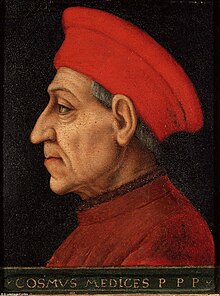
Cosimo de’ Medici, often referred to as “Cosimo the Elder” or “Pater Patriae” (Father of the Fatherland), was a prominent figure in Renaissance Florence. Born on September 27, 1389, in Florence, Italy, Cosimo played a pivotal role in shaping the political, economic, and cultural landscape of his city and beyond. His legacy as a shrewd politician, a successful banker, and a patron of the arts has cemented his place in history as one of the most influential figures of the Italian Renaissance.
Early Life and Education
Cosimo di Giovanni de’ Medici was born into a wealthy and influential family in Florence. His father, Giovanni di Bicci de’ Medici, was the founder of the Medici Bank, which would become one of the most powerful financial institutions in Europe. Giovanni’s business acumen and strategic alliances laid the foundation for the Medici family’s rise to prominence.
Cosimo received a well-rounded education, reflecting the Renaissance ideals of humanism. He was educated under the guidance of Roberto de’ Rossi at the Camaldolese Monastery, where he was exposed to the intellectual currents of the time. Cosimo studied Latin, Greek, and Arabic, and developed a deep appreciation for philosophy, theology, and the arts. This education not only equipped him with the knowledge necessary to navigate the complex world of Renaissance politics but also fostered his lifelong passion for the arts and culture.
The Medici Bank and Financial Expansion
In 1420, following his father’s retirement, Cosimo and his younger brother, Lorenzo, took over the management of the Medici Bank. Under Cosimo’s leadership, the bank expanded its operations significantly, establishing branches in major European cities such as London, Paris, and Bruges. The bank’s success was not only due to its financial expertise but also to Cosimo’s ability to forge strategic alliances with powerful figures across Europe.
Cosimo’s financial acumen and the wealth generated by the Medici Bank allowed him to exert considerable influence over Florentine politics. He used his resources to support his allies and weaken his enemies, effectively consolidating his family’s power in Florence. The Medici family, though technically private citizens, became the de facto rulers of Florence, with Cosimo at the helm.
Political Ascendancy and the Struggle for Power
The early 15th century was a period of intense political rivalry in Florence. The city was divided between various factions, with the Medici family emerging as one of the most powerful. However, their rise to power was not without challenges. The Medici faced stiff opposition from other prominent families, particularly the Albizzi and the Strozzi, who viewed the Medici as upstarts and a threat to the established order.
In 1433, Cosimo’s political opponents, led by Rinaldo degli Albizzi, managed to have him arrested on charges of attempting to overthrow the government. Cosimo was imprisoned in the Palazzo dei Priori and faced the possibility of execution. However, his immense wealth and the influence of his allies across Italy saved him. Instead of being executed, Cosimo was exiled to Venice, where he continued to manage the affairs of the Medici Bank and maintain his influence over Florentine politics from afar.
Exile and Triumphant Return
Cosimo’s exile in Venice was relatively comfortable, thanks to the vast resources at his disposal and the strong network of allies he had cultivated. He continued to exert influence over Florence’s political scene, even from a distance. His opponents in Florence, meanwhile, struggled to maintain control of the city. The oligarchic government led by the Albizzi became increasingly unpopular, and pressure from other Italian states forced them to reconsider Cosimo’s exile.
In 1434, after just a year in exile, Cosimo was recalled to Florence. His return was nothing short of triumphant. The people of Florence, weary of the oligarchic rule and disillusioned with the Albizzi, welcomed Cosimo back with open arms. Upon his return, Cosimo wasted no time in consolidating his power. He had his political enemies exiled and established a “signoria de facto,” effectively becoming the ruler of Florence without holding any official title.
Patronage of the Arts and Cultural Flourishing
Cosimo de’ Medici’s influence extended far beyond politics and finance. He was also a great patron of the arts, using his vast wealth to support artists, architects, and scholars. Cosimo believed that the arts were a reflection of a city’s greatness, and he was determined to make Florence the cultural capital of Europe.
One of Cosimo’s most significant contributions to Florence was his support for the construction of public and religious buildings. He commissioned the construction of the Basilica of San Lorenzo, one of Florence’s most important churches, and funded the completion of the Duomo, Florence’s iconic cathedral. Cosimo also played a key role in the creation of the Uffizi, which would later become one of the world’s most famous art galleries.
In addition to his support for architecture, Cosimo was a patron of some of the greatest artists of the Renaissance. He supported the work of Filippo Brunelleschi, the architect behind the dome of the Florence Cathedral, and Donatello, one of the most influential sculptors of the period. Cosimo’s patronage extended to the world of literature as well; he was a supporter of scholars like Marsilio Ficino, who played a crucial role in the revival of Platonic philosophy.
Diplomatic Alliances and Foreign Policy
Cosimo’s influence was not limited to Florence; he was also a key player in the broader political landscape of Italy. He skillfully navigated the complex web of alliances and rivalries that characterized Italian politics during the Renaissance. Cosimo forged alliances with powerful states like Venice and the Papal States, using diplomacy to protect Florence’s interests and secure its position as a leading power in Italy.
One of Cosimo’s most significant diplomatic achievements was the alliance with Francesco Sforza, a powerful condottiero (mercenary leader) who would later become the Duke of Milan. This alliance helped to strengthen Florence’s position in its ongoing conflict with Milan, which was ruled by the Visconti family. The alliance with Sforza culminated in the Battle of Anghiari in 1440, where the Florentine forces, supported by Sforza, secured a decisive victory against Milan.
Cosimo’s diplomatic efforts also played a crucial role in the signing of the Peace of Lodi in 1454. This treaty brought an end to the wars that had plagued Italy for decades and established a balance of power among the major Italian states. The peace that followed allowed Florence to flourish economically and culturally, further solidifying Cosimo’s legacy as a statesman.
Decline and Legacy
As Cosimo aged, he began to withdraw from public life, passing on the responsibilities of governance to trusted allies like Luca Pitti. However, his influence over Florence remained strong until his death. In his later years, Cosimo faced personal tragedy with the death of his son Giovanni, whom he had hoped would succeed him. This loss deeply affected Cosimo, leading him to arrange for his other son, Piero, to be assisted by capable advisors like Diotisalvi Neroni.
Cosimo de’ Medici passed away on August 1, 1464, at his villa in Careggi, where he had spent his final years surrounded by scholars and members of the Neoplatonic Academy, including the philosopher Marsilio Ficino. His death marked the end of an era in Florence, but his legacy lived on through his descendants, particularly his grandson, Lorenzo the Magnificent, who would continue the Medici family’s tradition of patronage and political leadership.
Cosimo’s contributions to Florence were profound and far-reaching. His financial acumen and political savvy allowed him to establish the Medici family as one of the most powerful dynasties in Europe. His patronage of the arts and support for humanist scholarship helped to usher in the Renaissance, a period of unprecedented cultural and intellectual growth. Cosimo’s legacy as a statesman, banker, and patron of the arts continues to be celebrated to this day.
Historical Context and the Medici Legacy
To fully appreciate Cosimo de’ Medici’s impact, it’s essential to understand the historical context in which he lived. The 15th century was a time of great change in Europe, marked by the decline of feudalism, the rise of powerful city-states, and the beginning of the Renaissance. Florence, under Cosimo’s leadership, became a model of Renaissance culture and governance.
The Medici family’s rise to power was not an overnight success but the result of decades of strategic planning, alliances, and careful management of both political and financial resources. Cosimo’s ability to navigate the complex political landscape of Italy, while simultaneously fostering a cultural renaissance in Florence, is a testament to his skill as a leader.
The legacy of Cosimo de’ Medici is also reflected in the enduring influence of the Medici family. The Medici would continue to play a central role in Florentine and Italian politics for generations. Lorenzo the Magnificent, Cosimo’s grandson, would carry on his legacy, further solidifying the Medici’s place in history as patrons of the arts and leaders of the Renaissance.
Cosimo’s establishment of the Medici Bank and his political acumen set the stage for the family’s dominance in Florence for nearly three centuries. The Medici would produce popes, queens, and grand dukes, all of whom contributed to the shaping of European history. The family’s support of the arts and sciences during the Renaissance had a lasting impact, leading to some of the most significant cultural achievements in Western history.
In conclusion, Cosimo de’ Medici was not only the founder of the Medici dynasty but also a central figure in the cultural and political history of Florence. His legacy as a statesman, banker, and patron of the arts continues to be felt today, more than five centuries after his death. Cosimo’s ability to blend financial expertise with political strategy, along with his deep commitment to the arts, made him a key figure in the development of the Renaissance and one of the most influential men of his time.


