
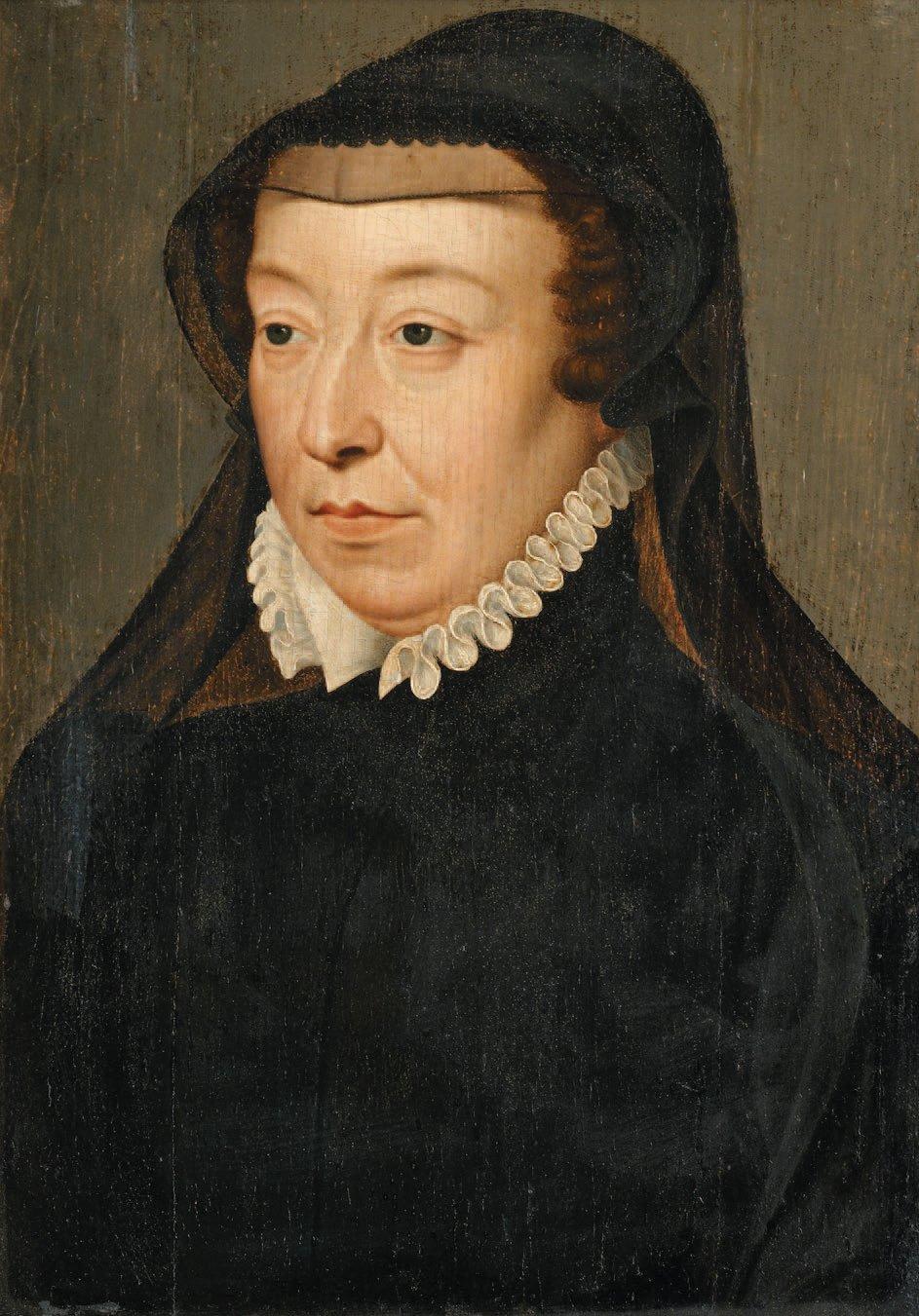
Caterina de’ Medici, born on April 13, 1519, in Florence, Italy, is one of the most intriguing and controversial figures of the late Renaissance. As a queen consort of France, her influence extended beyond the political realm into the cultural and social fabric of the time. Her life, marked by both great achievements and infamous deeds, has been the subject of countless stories, from the writings of Alexandre Dumas to modern television dramas. This article delves into the life of Caterina de’ Medici, exploring her journey from the courts of Florence to the heights of French royalty, and examining the complexities and contradictions that defined her legacy.
Early Life: From Florence to the French Court
Caterina Maria Romula di Lorenzo de’ Medici was born into the illustrious Medici family, a dynasty that had risen to power in Florence through banking and commerce. Her father, Lorenzo de’ Medici, Duke of Urbino, and her mother, Maddalena de la Tour d’Auvergne, both died shortly after her birth, leaving Caterina an orphan at a young age. Despite this, she was raised in the lap of luxury under the care of her grandmother, Alfonsina Orsini, and later, under the guardianship of Pope Leo X, a member of the Medici family.
Caterina’s education was typical of a noblewoman of her time, emphasizing both intellectual and cultural pursuits. She was well-versed in Italian, French, and Latin, and received a thorough education in the arts, philosophy, and theology. This early exposure to the Renaissance ideals of humanism would later influence her patronage of the arts and her role in shaping French culture.
The Marriage Alliance: Caterina’s Entry into French Royalty
The political landscape of early 16th-century Europe was dominated by complex alliances and power struggles. As the sole heir to the Medici legacy, Caterina was seen as a valuable asset in these diplomatic games. In 1533, at the tender age of 14, she was married to Henry, Duke of Orléans, the second son of King Francis I of France. The marriage was part of a broader alliance between the Medici family and the French crown, orchestrated by Pope Clement VII, a distant relative of Caterina.
Despite the sudden death of Pope Clement VII shortly after the wedding, which rendered the alliance politically less advantageous, Caterina was welcomed into the French court. Her intelligence and cultural refinement quickly won the favor of King Francis I, and she became a beloved member of the royal family. However, her position was complicated by the presence of Henry’s longtime mistress, Diane de Poitiers, who wielded considerable influence over him.
Life as Queen Consort: Challenges and Triumphs
Caterina’s life at the French court was marked by a delicate balancing act. As queen consort following Henry’s ascension to the throne in 1547, she was expected to produce heirs and maintain the stability of the Valois dynasty. However, the early years of her marriage were marred by difficulties in conceiving, leading to rumors and suspicions about her ability to bear children. These doubts were amplified by her Florentine origins, which were often viewed with suspicion and prejudice by the French nobility.
It wasn’t until 1544, more than a decade after her marriage, that Caterina gave birth to her first child, a son named Francis. This was followed by the birth of nine more children, several of whom would go on to play significant roles in European history. Despite the challenges, Caterina’s perseverance in securing the future of the Valois line cemented her status as a key figure in the French monarchy.
Caterina’s influence as queen consort extended beyond the production of heirs. She was a patron of the arts and is credited with introducing several innovations to the French court. Among these were the adoption of the fork as a dining utensil and the introduction of Florentine culinary practices, which laid the foundations for what would become known as French haute cuisine. Her love for the arts and culture also led her to commission numerous architectural projects, including the expansion of the Louvre and the construction of the Tuileries Palace.
The Wars of Religion: A Queen’s Struggle for Unity
Caterina de’ Medici’s reign was defined by the turbulent period of the French Wars of Religion, a series of conflicts between Catholics and Protestants (Huguenots) that tore the country apart during the latter half of the 16th century. As a Catholic herself, Caterina was deeply concerned with maintaining the unity of France, and she sought to navigate the religious tensions through a policy of conciliation.
Her efforts to mediate between the two factions were epitomized by the marriage of her daughter, Margaret of Valois, to Henry of Navarre, a prominent Huguenot leader, in 1572. The marriage was intended as a gesture of goodwill and a means to bring peace to the warring factions. However, the wedding festivities were overshadowed by one of the most infamous events in French history: the St. Bartholomew’s Day Massacre.
The massacre, which began on the night of August 23-24, 1572, saw the brutal killing of thousands of Huguenots in Paris and across France. Although the exact role Caterina played in the events leading up to the massacre remains a subject of historical debate, her reputation was irrevocably tarnished. The massacre solidified her image as a Machiavellian figure, willing to use any means necessary to protect her family’s interests.
Legacy and Historical Reassessment
Caterina de’ Medici’s legacy is one of complexity and contradiction. For centuries, she was portrayed as a villainous figure, a reputation fueled by the writings of her contemporaries and later dramatized in literature and film. She was depicted as a scheming and ruthless queen, associated with poisonings, dark magic, and political intrigue. The influence of works like Alexandre Dumas’ “La Reine Margot” only served to reinforce this negative image.
However, modern historians have begun to reassess Caterina’s life and reign, offering a more nuanced understanding of her actions and motivations. Far from being a mere villain, Caterina is now recognized as a pragmatic and intelligent ruler who was faced with extraordinarily difficult circumstances. Her efforts to maintain the stability of the French crown during one of the most tumultuous periods in its history are seen as evidence of her political acumen and determination.
Caterina’s patronage of the arts and her role in shaping French culture are also increasingly acknowledged. She was a key figure in the development of the Renaissance in France, bringing with her the artistic and intellectual traditions of her native Florence. Her influence can be seen in the architecture, cuisine, and cultural practices that flourished during her time at the French court.
The Final Years: A Legacy of Power and Influence
As the matriarch of the Valois dynasty, Caterina de’ Medici’s influence persisted until her death. She continued to play a central role in the French court during the reigns of her sons, particularly Charles IX and Henry III. Her relationship with her children was often strained, particularly with her son Francis II, who was heavily influenced by his wife, Mary, Queen of Scots.
Despite these challenges, Caterina remained a formidable presence in the court, working tirelessly to maintain the power and influence of the Valois family. Her efforts were not always successful, as the Wars of Religion continued to devastate France, and the power of the monarchy began to wane.
Caterina’s final years were marked by a series of personal and political challenges. The death of her favorite son, Henry, Duke of Anjou, in 1584 was a significant blow, and the ongoing conflict between Catholics and Protestants showed no signs of abating. The rise of the Catholic League, led by the powerful Guise family, further complicated the political landscape, and Caterina found herself increasingly isolated.
Caterina de’ Medici died on January 5, 1589, at the age of 69, in the Château de Blois. Her death marked the end of an era in French history, as the Valois dynasty would soon be replaced by the Bourbons with the ascension of Henry IV, the former Huguenot leader. Although she was buried temporarily in Blois, her remains were later transferred to the Basilica of Saint-Denis, the traditional burial place of French royalty.
Conclusion: A Queen’s Enduring Legacy
Caterina de’ Medici’s life and reign have left an indelible mark on French history. As a queen consort and later as queen mother, she navigated a period of unprecedented turmoil, using her intelligence, political skill, and determination to maintain the stability of the French crown. Her legacy, though marred by events like the St. Bartholomew’s Day Massacre, is also one of cultural patronage and influence, as she helped to shape the artistic and intellectual landscape of Renaissance France.
Today, Caterina de’ Medici is remembered not only for her controversial actions but also for her contributions to French culture and her efforts to navigate the treacherous waters of 16th-century politics. Her story is a testament to the complexities of power and the enduring impact of a queen who, despite the many challenges she faced, left a lasting legacy in both France and the wider world.


