
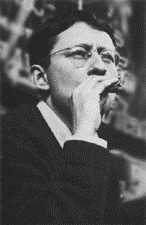
Guy Debord, born on December 28, 1931, in Paris, was a French philosopher, filmmaker, and writer whose ideas and work profoundly influenced the intellectual landscape of the 20th century. As a co-founder of the Situationist International (SI), Debord became a leading figure in the critique of modern consumer society and its cultural manifestations. His most famous work, The Society of the Spectacle (1967), remains a seminal text in critical theory, offering a prescient analysis of the media-driven world that has only become more relevant with time.
Early Life and Intellectual Formation
Guy Ernest Debord was born into a bourgeois family in Paris but spent much of his early life in the south of France. His upbringing was marked by a sense of detachment from conventional society, which would later inform his radical critique of everyday life. Debord was a voracious reader from a young age, immersing himself in literature, philosophy, and avant-garde art. This intellectual curiosity led him to Paris in the late 1940s, where he became involved with the bohemian circles of the city.
In 1951, Debord joined the Lettrist International, a group of young artists and intellectuals led by Isidore Isou. The Lettrists sought to revolutionize art and culture by breaking away from traditional forms and exploring new ways of expression. Debord quickly distinguished himself within the group for his sharp intellect and radical ideas, and by 1952, he was one of its leading members. His early writings and films from this period reflect a deepening commitment to a critique of modern life and a desire to transcend the limitations of art as it was traditionally understood.
The Birth of the Situationist International
In 1957, Debord co-founded the Situationist International (SI), a collective of artists, writers, and intellectuals dedicated to revolutionizing society by challenging the dominant cultural and political structures. The SI’s core idea was that modern life had become a “spectacle”—a society in which authentic social relations had been replaced by mere representations. This concept, which would become central to Debord’s later work, critiqued how capitalist society commodified all aspects of life, reducing human experience to images and superficial interactions.
The Situationists advocated for the creation of “situations”—moments of life deliberately constructed to break through the alienation and passivity imposed by the spectacle. These situations were intended to disrupt the everyday routines that kept people trapped in a cycle of consumption and conformity. The SI’s activities ranged from artistic experiments and political writings to direct action and radical interventions in public spaces.
Debord’s leadership within the SI was marked by his uncompromising vision and intellectual rigor. He was deeply influenced by Marxist theory but sought to extend its critique to the cultural and psychological dimensions of life under capitalism. The SI’s publications, particularly their journal Internationale Situationniste, were critical in disseminating these ideas and inspiring a generation of activists and thinkers.
The Society of the Spectacle: A Radical Critique
In 1967, Guy Debord published his most famous work, The Society of the Spectacle (La Société du Spectacle). The book was a profound critique of contemporary society, arguing that the spectacle had become the central organizing principle of modern life. According to Debord, the spectacle is not just a collection of images but a social relationship mediated by images. It represents the domination of appearances over reality, where the real world is replaced by a world of mere representations.
Debord’s analysis in The Society of the Spectacle anticipated many of the developments that would characterize late 20th and early 21st-century society. He argued that in the spectacle, everything is commodified, including human relationships, culture, and even dissent. The result is a society where people are passive spectators of their own lives, disconnected from genuine experience and agency.
The book was not just a theoretical treatise but also a call to action. Debord saw the critique of the spectacle as essential to any revolutionary project, as it laid bare the mechanisms through which capitalism maintained its control. The influence of The Society of the Spectacle extended far beyond the SI, shaping the thinking of countless scholars, activists, and artists in the decades that followed.
The May 1968 Uprising: Debord’s Influence
One of the most significant moments in Guy Debord’s life was the May 1968 uprising in France. The massive student and worker protests that shook the country were deeply influenced by Situationist ideas, particularly their critique of consumer society and the spectacle. Slogans such as “All Power to the Imagination” and “Beneath the Pavement, the Beach” echoed the Situationist call for the creation of situations and the subversion of everyday life.
Although Debord was not directly involved in organizing the protests, his ideas were widely circulated among the student movement, and the SI played a crucial role in articulating the demands for a radical transformation of society. The events of May 1968 represented, in many ways, a practical realization of the Situationist project, as thousands of people took to the streets to challenge the established order and imagine new possibilities for living.
The aftermath of May 1968, however, was marked by disillusionment for Debord. He saw the eventual co-optation and decline of the revolutionary energy that had driven the protests as evidence of the spectacle’s ability to absorb and neutralize dissent. In the years that followed, Debord became increasingly withdrawn from public life, focusing on his writing and filmmaking while maintaining a critical distance from the political movements that had once inspired him.
Debord’s Cinematic Work: A Radical Experimentation
In addition to his philosophical writings, Guy Debord was also a filmmaker, using cinema as a medium to further explore his critique of the spectacle. Between 1952 and 1978, Debord created several films that challenged traditional cinematic forms and sought to deconstruct the visual language of the spectacle.
His first film, Hurlements en faveur de Sade (1952), was a radical experiment that consisted of a series of black and white screens with intermittent spoken text, devoid of any imagery or narrative structure. The film was a direct attack on the conventions of cinema, stripping it down to its most basic elements and forcing the audience to confront the emptiness of the spectacle.
Debord’s most famous film, La Société du Spectacle (1973), was an adaptation of his book. The film combined footage from advertisements, newsreels, and other media with Debord’s voiceover narration, creating a montage that illustrated the central thesis of the spectacle. The film was a powerful visual and auditory representation of Debord’s critique, reinforcing the idea that in the spectacle, reality is constructed through images.
Debord’s films were not widely distributed, and he maintained strict control over their availability. For many years, his films were almost impossible to see, contributing to their mystique and the perception of Debord as a reclusive and enigmatic figure. It was only in the years after his death that his cinematic work began to be more widely recognized and appreciated as an integral part of his intellectual legacy.
Later Years and Legacy
In the 1970s and 1980s, Guy Debord withdrew further from public life, disillusioned with the political developments of the time and the co-optation of Situationist ideas by mainstream culture. He continued to write, producing works such as Comments on the Society of the Spectacle (1988), in which he revisited and expanded upon his earlier ideas in light of the changes in global capitalism and the rise of new forms of media.
Debord’s later works reflected a growing pessimism about the prospects for revolutionary change. He argued that the spectacle had become even more pervasive and insidious, with the development of new technologies and the increasing commodification of all aspects of life. Despite this bleak outlook, Debord remained committed to the idea that the critique of the spectacle was essential for understanding and resisting the forces of domination in modern society.
On November 30, 1994, Guy Debord took his own life at his home in Champot, near Bellevue-la-Montagne in France. His suicide was a tragic end to a life dedicated to the relentless critique of society and the pursuit of radical freedom. In his final years, Debord had been suffering from various health issues, including alcoholism, which had taken a toll on his physical and mental well-being.
Debord’s death marked the end of an era, but his ideas and work have continued to resonate in the years since. His critique of the spectacle has only become more relevant in the age of the internet, social media, and the pervasive influence of mass media. Debord’s work remains a touchstone for those seeking to understand and challenge the conditions of life in a world dominated by images and representations.
Guy Debord’s Enduring Influence
The influence of Guy Debord extends far beyond the confines of academic philosophy and critical theory. His ideas have permeated various fields, including art, politics, media studies, and cultural criticism. The concept of the spectacle has become a key framework for analyzing the ways in which media and consumer culture shape our perceptions of reality and our interactions with the world.
Debord’s work has inspired countless artists, filmmakers, and writers who have sought to challenge the conventions of their respective mediums and explore the possibilities of creating new forms of expression. His emphasis on the need to break free from the constraints of the spectacle and to create situations that allow for genuine human interaction continues to resonate with those who seek to push the boundaries of creativity and social engagement.
In the realm of politics, Debord’s ideas have been taken up by various movements that seek to challenge the dominant cultural and economic order. The critique of the spectacle has been a central theme in anti-globalization movements, as well as in the work of activists and theorists who aim to expose the ways in which power operates through the manipulation of images and narratives.
Debord’s legacy is also evident in the continued relevance of the Situationist International, which remains a reference point for radical political and cultural movements. The SI’s ideas about the relationship between art and politics, the critique of consumer society, and the possibilities for revolutionary change continue to inspire new generations of activists and thinkers.
Conclusion: The Radical Legacy of Guy Debord
Guy Debord’s life and work represent a relentless pursuit of truth in a world increasingly dominated by illusion and superficiality. His critique of the spectacle remains one of the most important contributions to our understanding of modern society, offering a powerful analysis of how power operates through images and representations.
Debord’s ideas challenge us to question the reality that is presented to us and to seek out new ways of living and interacting that go beyond the constraints of the spectacle. His work is a reminder that true freedom and authenticity can only be achieved by confronting and dismantling the structures of domination that shape our lives.
As we continue to navigate a world in which the spectacle has become even more pervasive, the insights of Guy Debord remain as relevant and urgent as ever. His legacy endures as a testament to the power of critical thought and the potential for radical change in the face of a society that seeks to reduce us to passive spectators of our own existence.


