
Introduction
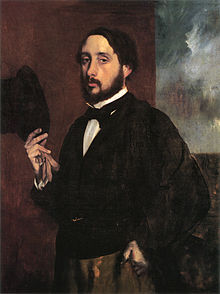
Edgar Degas, born Hilaire Germain Edgar De Gas on July 19, 1834, in Paris, France, is one of the most celebrated artists in the history of Western art. Renowned for his innovative techniques and unique perspectives, Degas is often associated with the Impressionist movement, although he preferred to be identified as a realist. His works, which include paintings, sculptures, prints, and drawings, capture the human figure in motion, with a particular focus on dancers, bathers, and horse riders. Degas’ life and career were marked by a relentless pursuit of artistic excellence, a commitment to innovation, and a deep understanding of the human condition.
Early Life and Education
Edgar Degas was born into a well-to-do family in Paris. His father, Auguste De Gas, was a banker, and his mother, Célestine Musson De Gas, came from a wealthy Creole family in New Orleans. From an early age, Degas showed an inclination towards the arts, particularly drawing, which his father encouraged by providing him with access to literature and art. This early exposure to the humanities laid the foundation for Degas’ lifelong commitment to art.
Degas attended the Lycée Louis-le-Grand, where his interest in painting began to overshadow his academic pursuits. Despite his father’s wishes for him to pursue a career in law, Degas enrolled at the École des Beaux-Arts in Paris in 1855, where he studied under the guidance of Louis Lamothe, a disciple of the neoclassical painter Jean-Auguste-Dominique Ingres. Ingres’ influence on Degas was profound, particularly in his emphasis on line drawing and classical form, which would become central to Degas’ artistic style.
Italian Influence and Early Artistic Development
Like many artists of his time, Degas undertook a study trip to Italy between 1856 and 1859. This journey was pivotal in his artistic development, as it allowed him to study the works of the Renaissance masters up close. Degas spent time in Florence, Rome, Naples, and Venice, copying works by artists such as Andrea Mantegna, Michelangelo, and Raphael. The influence of these masters is evident in Degas’ early works, which often depicted historical and mythological subjects.
During his time in Italy, Degas developed a keen interest in the human form, which would become a central theme in his work. His early paintings, such as “The Bellelli Family” (1858-1867), demonstrate his growing skill in capturing the nuances of human expression and the complexity of social interactions. This painting, which portrays his aunt, uncle, and cousins, is notable for its psychological depth and meticulous attention to detail, qualities that would define Degas’ later works.
The Move Towards Modernism: Embracing Contemporary Life
Upon returning to Paris, Degas began to shift his focus from historical and mythological subjects to contemporary life. Influenced by the burgeoning Realist movement and the works of artists like Gustave Courbet, Degas sought to depict the realities of modern life with a new level of honesty and immediacy. This shift in focus is evident in works such as “The Orchestra of the Opera” (1869), which captures the musicians of the Paris Opera in the midst of a performance, and “Women Ironing” (1873), which portrays the laborious work of laundresses.
One of the most significant developments in Degas’ career during this period was his interest in capturing movement. Inspired by the new technology of photography, which allowed for the freezing of motion in a way that had never been possible before, Degas began to experiment with unconventional compositions and angles. This is particularly evident in his depictions of ballet dancers, which would become one of his most famous and enduring subjects.
The Impressionist Movement: A Reluctant Participant
Although Edgar Degas is often associated with the Impressionist movement, he was somewhat ambivalent about being labeled as such. Unlike many of his contemporaries, Degas was less interested in capturing the effects of light and color and more focused on the depiction of movement, form, and the inner lives of his subjects. Nonetheless, he became an integral part of the group of artists who would later be known as the Impressionists, participating in seven of the eight Impressionist exhibitions held between 1874 and 1886.
Degas’ contributions to the Impressionist exhibitions included a wide range of works, from his iconic ballet scenes to portraits, nudes, and studies of everyday life. His approach to these subjects was often characterized by a sense of detachment and objectivity, which set him apart from the more emotionally expressive works of artists like Claude Monet and Pierre-Auguste Renoir. Despite this, Degas’ work was highly influential within the group, particularly in his use of unusual compositions and his exploration of the human form.
Focus on Ballet: The Dancer as a Central Figure
Perhaps no other subject is more closely associated with Edgar Degas than that of the ballet dancer. Beginning in the early 1870s, Degas devoted much of his artistic energy to capturing the world of the ballet, both on stage and behind the scenes. His interest in this subject was not limited to the performances themselves but extended to the rigorous training, rehearsals, and private moments of the dancers.
Degas’ ballet works are notable for their innovative compositions and their focus on the physicality of the dancers. In paintings such as “The Dance Class” (1874) and “The Rehearsal” (1878-1879), Degas often depicted his subjects from unexpected angles, sometimes cropping the figures in ways that suggested the influence of photography and Japanese prints. These works are also characterized by their attention to the textures of the dancers’ costumes, the interplay of light and shadow, and the depiction of movement, both graceful and strenuous.
In addition to his paintings, Degas also produced a series of sculptures of dancers, the most famous of which is “Little Dancer Aged Fourteen” (1881). This sculpture, which depicts a young ballet student in a naturalistic pose, caused a sensation when it was first exhibited due to its unconventional use of materials, including real fabric for the tutu and a wig made of human hair. Today, it remains one of Degas’ most iconic works.
Degas’ Exploration of Other Subjects
While ballet dancers are perhaps the most famous of Degas’ subjects, his oeuvre is incredibly diverse. He explored a wide range of themes, including horse racing, portraits, and nudes. Degas was fascinated by the movement of horses, and he created numerous works depicting the races at Longchamp, focusing on the dynamism and energy of the sport. His studies of horses in motion, influenced by the photographic studies of Eadweard Muybridge, are particularly notable for their sense of realism and vitality.
Degas also produced a significant body of work focused on the female nude. However, unlike the idealized nudes of many of his contemporaries, Degas’ women are often depicted in intimate, unguarded moments, such as bathing, drying themselves, or combing their hair. These works, including “The Bath” (1886) and “After the Bath, Woman Drying Herself” (1890-1895), are notable for their candidness and for Degas’ interest in capturing the naturalism of the human body.
Later Years and Declining Health
As Edgar Degas aged, he became increasingly reclusive. The death of his close friend Édouard Manet in 1883 marked the beginning of a difficult period for Degas, during which he withdrew from many of his social circles. His eyesight, which had always been somewhat weak, began to deteriorate rapidly in the 1890s, eventually leading to near-total blindness. Despite this, Degas continued to work, focusing increasingly on sculpture as his vision failed.
The last decades of Degas’ life were marked by a growing sense of isolation. He never married and had no children, and his relationships with his friends and family became increasingly strained. Nevertheless, he remained committed to his art, producing some of his most experimental and abstract works during this time.
In 1912, Degas was forced to leave his longtime studio due to redevelopment in the area, and he spent the remaining years of his life moving between various residences in Paris. He died on September 27, 1917, at the age of 83, leaving behind a legacy as one of the most innovative and influential artists of his time.
Legacy and Influence
Edgar Degas’ impact on the world of art is immeasurable. His innovative compositions, his exploration of movement, and his focus on the human figure have had a profound influence on countless artists, both during his lifetime and in the years since his death. Degas’ work anticipated many of the developments of 20th-century art, particularly in the areas of abstraction, expressionism, and modernist sculpture.
Degas’ approach to capturing everyday life, his use of unconventional perspectives, and his interest in the fleeting moments of human experience have made him a central figure in the history of modern art. His works continue to be celebrated for their technical mastery, their emotional depth, and their unique vision of the world.
Today, Degas’ works are housed in major museums around the world, including the Louvre in Paris, the Metropolitan Museum of Art in New York, and the Musée d’Orsay in Paris. His influence can be seen in the works of later artists such as Pablo Picasso, Henri Matisse, and Jackson Pollock, who drew inspiration from Degas’ innovative techniques and his commitment to pushing the boundaries of art.
Conclusion
Edgar Degas’ life and work represent a significant chapter in the history of art. His relentless pursuit of artistic excellence, his commitment to innovation, and his deep understanding of the human condition have earned him a place among the greatest artists of all time. Whether capturing the grace of a ballet dancer, the energy of a horse race, or the quiet intimacy of a woman at her toilette, Degas’ works continue to captivate and inspire audiences around the world.
As an artist, Degas was both a traditionalist and a revolutionary, drawing on the techniques of the old masters while simultaneously challenging the conventions of his time. His legacy is one of innovation, exploration, and a profound appreciation for the beauty and complexity of everyday life. Edgar Degas remains a towering figure in the history of art, and his contributions to the world of painting, sculpture, and beyond continue to be celebrated more than a century after his death.


