
Introduction
Eugène Delacroix stands as one of the most influential and celebrated figures in the history of art, particularly within the Romantic movement. Born in an era of profound cultural and political shifts, Delacroix’s work embodies the spirit of the 19th century—a time when emotion, color, and drama in art were given new importance. His life and career are marked by significant achievements and contributions that not only defined his legacy but also influenced generations of artists to come.
Early Life and Education
Ferdinand Victor Eugène Delacroix was born on April 26, 1798, in Charenton-Saint-Maurice, France, not far from Paris. His early education was at the prestigious Lycée Louis-le-Grand, where he developed a deep love for classical literature. This classical foundation would later be evident in his artistic choices, as he often drew inspiration from literary sources.
In 1815, Delacroix began his formal training under the tutelage of Pierre-Narcisse Guérin, a respected artist of the time. Guérin’s influence, combined with Delacroix’s admiration for the neoclassical style of Jacques-Louis David, helped shape the young artist’s approach to his craft. However, Delacroix would soon diverge from the rigid neoclassical tradition, seeking a more expressive and emotional form of art.
The Road to Fame: Early Works and Influences
Delacroix’s early career was marked by a series of notable works that began to establish his reputation in the art world. His first major commission came in 1819, with the religious painting “La Vierge des Moissons” (“The Virgin of the Harvests”). This work displayed the influence of Raphael, a Renaissance master, whose harmonious compositions and idealized figures were deeply admired by Delacroix.
A pivotal moment in Delacroix’s career came in 1822 with the creation of “La Barque de Dante” (“The Barque of Dante”), a painting that was accepted into the Paris Salon. Inspired by Théodore Géricault’s dramatic work “The Raft of the Medusa,” Delacroix’s painting stirred controversy. It was not well-received by the academic establishment, which criticized its deviation from neoclassical norms. Despite the criticism, the painting was acquired by the Luxembourg Gallery, signaling the beginning of Delacroix’s rise to fame.
The British Influence and Continued Evolution
In 1825, Delacroix traveled to Great Britain, a journey that would profoundly influence his artistic style. During this visit, he met prominent artists such as Richard Bonington and Thomas Lawrence. The vibrant use of color in British art of the time fascinated Delacroix, and he began incorporating these techniques into his own work. This influence is particularly evident in his “Portrait of Louis-Auguste Schwiter,” the only large-scale portrait he completed during his career.
Delacroix also experimented with lithography during this period, creating a series of prints inspired by the works of William Shakespeare and Goethe’s “Faust.” His lithographs, characterized by their violent and sensual themes, further demonstrated his departure from classical restraint and his embrace of Romanticism.
Major Works and Themes: From Tragedy to Triumph
By the late 1820s, Delacroix had fully embraced the Romantic movement, producing works that were both dramatic and emotionally charged. In 1827, he completed “La Mort de Sardanapale” (“The Death of Sardanapalus”), a painting that depicted the legendary Assyrian king witnessing the slaughter of his concubines and servants. The painting’s chaotic composition and vivid color palette were hallmarks of Delacroix’s style, and it became one of his most famous works.
Another significant work from this period is “L’Assassinat de l’Évêque de Liège” (“The Assassination of the Bishop of Liège”), painted in 1829. Inspired by the writings of Sir Walter Scott, this painting exemplifies Delacroix’s fascination with historical and literary subjects. The scene’s dramatic intensity and meticulous attention to detail made it a standout work in his oeuvre.
“Liberty Leading the People”: A Masterpiece of Revolutionary Art
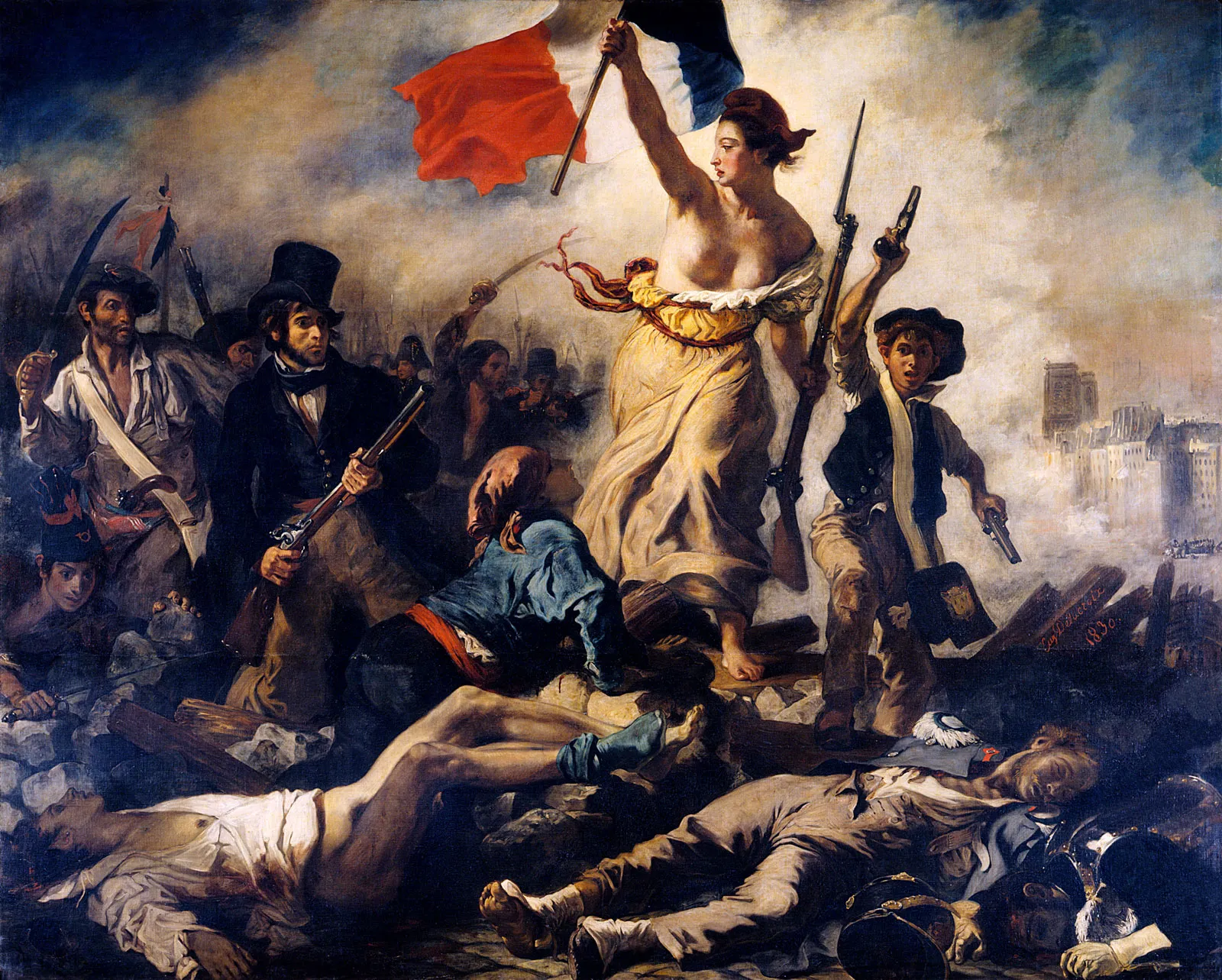
In 1830, Delacroix completed what is widely regarded as his masterpiece, “La Liberté guidant le peuple” (“Liberty Leading the People”). This iconic painting captures the spirit of the July Revolution in France, with a figure of Liberty leading the people against the oppressive forces of the monarchy. The tricolor flag she holds aloft became a symbol of French nationalism and freedom.
The painting was purchased by the French government, but its public display was delayed due to concerns about its revolutionary content. Despite this, “Liberty Leading the People” became one of the most celebrated works of the Romantic era, and it solidified Delacroix’s reputation as a leading artist of his time.
A Journey to North Africa: New Inspirations
In 1832, following the French conquest of Algeria, Delacroix embarked on a journey to North Africa as part of a diplomatic mission to Morocco. This experience had a profound impact on his art. Although Delacroix did not extensively study local art, the vibrant culture and landscapes of North Africa inspired him to create over a hundred drawings and paintings during his travels.
One of the most famous works from this period is “Femmes d’Alger dans leur appartement” (“Women of Algiers in their Apartment”), completed in 1834. This painting, which depicts the private lives of Muslim women, was groundbreaking in its subject matter and composition. Delacroix’s North African works introduced a new level of color and exoticism into his art, further distinguishing him from his European contemporaries.
Return to Paris: Public Commissions and Later Works
Upon his return to Paris, Delacroix received numerous commissions to decorate public buildings, reflecting his growing prominence in French society. In 1833, he began work on the Salon du Roi in the Palais Bourbon, home of the French National Assembly. He also created murals for the library of the Palais du Luxembourg and the church of Saint-Denis-du-Saint-Sacrement, showcasing his versatility as an artist.
In 1838, Delacroix unveiled “La Furie de Médée” (“The Fury of Medea”) at the Paris Salon. This painting, which depicts the tragic Greek myth of Medea murdering her children, caused a stir due to its graphic and emotional content. Despite the controversy, the painting was acquired by the French state and sent to the Museum of Fine Arts in Lille.
Final Years and Legacy
Delacroix’s later years were marked by both professional success and declining health. In 1857, he began work on the Chapel of the Holy Angels in the church of Saint-Sulpice, one of his most ambitious projects. However, the physical demands of this work took a toll on his health, which had already begun to deteriorate.
In 1862, Delacroix played a key role in founding the Société Nationale des Beaux-Arts, an organization dedicated to promoting French art. He was supported by notable contemporaries such as Théophile Gautier, Puvis de Chavannes, and Gustave Doré. Despite his frail health, Delacroix continued to work until the very end of his life.
On August 13, 1863, Eugène Delacroix passed away in Paris at the age of 65. His death marked the end of an era in French art, but his influence would continue to be felt for generations. Delacroix was buried in the Père Lachaise Cemetery, where his tomb remains a site of pilgrimage for art lovers and historians.
Conclusion: The Enduring Legacy of Eugène Delacroix
Eugène Delacroix’s contributions to the art world are immeasurable. As a pioneer of the Romantic movement, he broke away from the rigid confines of neoclassicism, infusing his works with emotion, color, and drama. His paintings, particularly “Liberty Leading the People,” remain symbols of revolutionary spirit and artistic innovation.
Delacroix’s influence extended beyond his own time, inspiring future generations of artists, including the Impressionists and the Symbolists. His ability to convey complex emotions and narratives through his art continues to captivate audiences today. Whether through his dramatic historical scenes, his exotic portrayals of North Africa, or his powerful revolutionary imagery, Delacroix’s work remains a testament to the enduring power of art to move and inspire.


