
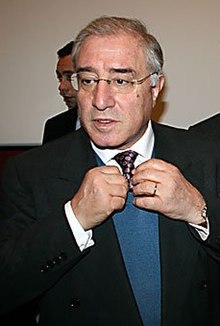
Marcello Dell’Utri, born on September 11, 1941, in Palermo, Sicily, is an Italian businessman, politician, and a controversial figure known for his close association with Silvio Berlusconi and his involvement in various legal cases related to organized crime. His life and career are a fascinating study of power, influence, and the complexities of Italian politics in the late 20th and early 21st centuries. This article explores the life of Marcello Dell’Utri, highlighting his rise to prominence, his significant contributions, and the controversies that have defined his public image.
Early Life and Education
Marcello Dell’Utri was born into a middle-class family in Palermo, a city known for its rich cultural heritage but also its deep-seated issues with organized crime. After completing his secondary education in Palermo, Dell’Utri moved to Milan, where he enrolled at the University of Milan to study law. His decision to move to Milan marked the beginning of his long association with the city and with Silvio Berlusconi, a connection that would profoundly influence his career.
Meeting Silvio Berlusconi
While studying in Milan, Dell’Utri met Silvio Berlusconi, who was then a rising entrepreneur. This meeting would prove to be a turning point in Dell’Utri’s life. After completing his law degree in 1964, Dell’Utri became Berlusconi’s personal secretary. He also managed the Torrescalla football team, which was sponsored by Berlusconi. This early connection with Berlusconi laid the groundwork for Dell’Utri’s future role as a key player in Berlusconi’s business empire and political career.
In 1965, Dell’Utri moved to Rome, where he worked at the Centro Internazionale per la Gioventù Lavoratrice, managing the sports group for the Opus Dei organization. However, his time in Rome was short-lived, as he soon returned to Palermo, where he took on the role of sports director for Athletic Bacigalupo. It was during this period that Dell’Utri came into contact with figures associated with Cosa Nostra, including Gaetano Cinà and Vittorio Mangano, connections that would later come under intense scrutiny.
Rise in Business and the Edilnord Project
Dell’Utri’s return to Milan in the early 1970s marked the beginning of his ascent in the business world. He joined Edilnord, a construction company owned by Berlusconi, where he was involved in managing the renovation of Berlusconi’s villa in Arcore. During this time, Dell’Utri introduced Vittorio Mangano, a known mafioso, to Berlusconi, ostensibly as a stableman. However, it later emerged that Mangano’s role was more likely to protect Berlusconi and his family from potential mafia-related threats.
In 1977, Dell’Utri left Edilnord to work for Inim, a company owned by Filippo Alberto Rapisarda, which was later described by the Italian police as a front for mafia activities, used to launder money from illegal operations. Dell’Utri’s association with such figures and entities would become a recurring theme in his career, leading to numerous legal battles and controversies.
Political Career and the Founding of Forza Italia
The 1980s and 1990s were a period of significant transformation for Dell’Utri, as he transitioned from the business world to politics. In 1982, he joined Publitalia ’80, a company founded by Berlusconi to handle advertising for Fininvest, Berlusconi’s media empire. Dell’Utri quickly rose through the ranks, becoming the company’s CEO and later, its president. His success at Publitalia ’80 solidified his position within Berlusconi’s inner circle and paved the way for his entry into politics.
In 1993, Dell’Utri was instrumental in the founding of Forza Italia, a political party created by Berlusconi. Forza Italia quickly became a dominant force in Italian politics, with Dell’Utri playing a crucial role in its organization and strategy. However, his political career was soon marred by legal troubles. In 1995, Dell’Utri was arrested in Turin on charges of obstructing an investigation into the illicit funds of Publitalia ’80. Despite these challenges, he was elected as a Member of Parliament for Forza Italia in 1996.
Legal Troubles and Mafia Allegations
Throughout his career, Marcello Dell’Utri has been repeatedly accused of having connections with the Sicilian mafia. In Palermo, he was investigated for mafia association, and in Turin, for tax fraud and issuing false invoices. These allegations have dogged him for decades, culminating in several high-profile court cases.
In 1999, Dell’Utri negotiated a plea bargain in the Turin case, receiving a sentence of two years and three months in prison. Despite this, he was elected to the European Parliament as a representative of Forza Italia. His time in the European Parliament was marked by relative inactivity, with Dell’Utri co-signing only nine parliamentary questions and three resolutions over five years.
The 2000s: Cultural Involvement and Continued Controversies
The 2000s saw Dell’Utri expanding his influence into the cultural sphere. In 2001, he became a member of the organizing committee for the “Città del Libro” (City of Books) festival in Campi Salentina, Lecce. The following year, he founded “Il Domenicale,” a cultural weekly magazine directed by Angelo Crespi. Dell’Utri also continued his political career, being re-elected to the Senate in 2006 and 2008, this time under the banner of the People of Freedom (PdL) party.
However, Dell’Utri’s legal troubles persisted. In 2004, he was sentenced in the first instance for external association with the mafia, a charge that alleged he had acted as an intermediary between Berlusconi and the Sicilian mafia. Despite this, Dell’Utri remained a significant figure in Italian politics and culture.
In 2007, Dell’Utri made headlines when he claimed to have acquired five handwritten diaries of Benito Mussolini, purportedly written between 1935 and 1939. These diaries were later proven to be forgeries, further tarnishing Dell’Utri’s reputation. The same year, he was appointed artistic director of the Teatro Lirico in Milan by Mayor Letizia Moratti and became a board member of the “E Polis” publishing group.
Later Years and the Mafia-State Negotiations Trial
The 2010s were a challenging decade for Dell’Utri, as he faced renewed legal scrutiny. In 2010, he was implicated in the P3 investigation, which sought to uncover an alleged clandestine network of state officials and personalities attempting to recreate the notorious P2 Masonic lodge. The investigation culminated in a 2012 request by the Rome Public Prosecutor’s Office to indict Dell’Utri and 19 others.
Additionally, Dell’Utri was investigated by the Palermo Public Prosecutor’s Office for allegedly extorting money from Berlusconi. The investigation was later transferred to Milan’s Anti-Mafia Directorate, underscoring the seriousness of the allegations.
In 2018, Dell’Utri received a first-instance sentence of twelve years in prison for his involvement in the so-called “Mafia-State negotiations,” a series of secret talks between the Italian government and mafia representatives in the early 1990s. However, in September 2021, an appeals court acquitted Dell’Utri of all charges, citing insufficient evidence.
Inheritance from Silvio Berlusconi and Final Years
In July 2023, following the death of Silvio Berlusconi, Marcello Dell’Utri was named a beneficiary in Berlusconi’s will, receiving a bequest of 30 million euros. This inheritance came as a surprise to Dell’Utri, who expressed his astonishment and gratitude in an interview with Corriere della Sera, stating, “I am surprised. I did not expect it because my friend Silvio owed me nothing. I gave everything to him, my life, everything. In return, I received affection from him. That’s why I am surprised and moved.”
This bequest is a testament to the deep bond between Dell’Utri and Berlusconi, a relationship that has spanned decades and has been marked by both loyalty and controversy.
The Legacy of Marcello Dell’Utri
Marcello Dell’Utri’s legacy is a complex one. On the one hand, he is remembered as a key architect of Silvio Berlusconi’s political and business empire, a man whose organizational skills and strategic thinking helped shape modern Italian politics. On the other hand, his career has been marred by persistent allegations of mafia involvement, legal battles, and controversies that have cast a long shadow over his achievements.
Dell’Utri’s life story is emblematic of the broader challenges facing Italy in the late 20th and early 21st centuries, a period marked by political upheaval, the rise of new media empires, and the ongoing struggle against organized crime. His close association with Berlusconi has made him a symbol of the intertwining of business, politics, and crime in Italy, a phenomenon that continues to provoke debate and concern.
Conclusion
Marcello Dell’Utri remains a significant figure in Italian history, a man whose influence on politics, business, and culture cannot be understated. His life, marked by both remarkable achievements and deep controversies, reflects the complexities and contradictions of modern Italy. As a close confidant of Silvio Berlusconi, Dell’Utri played a crucial role in the rise of one of Italy’s most powerful and polarizing figures. However, his legacy will also be forever intertwined with the legal battles and allegations of mafia involvement that have defined much of his career.
As Italy continues to grapple with the legacy of the Berlusconi era, Marcello Dell’Utri’s story serves as a reminder of the enduring challenges posed by the intersection of power, politics, and organized crime. His life and career offer valuable insights into the workings of Italian society and the delicate balance between ambition, loyalty, and the law.


