
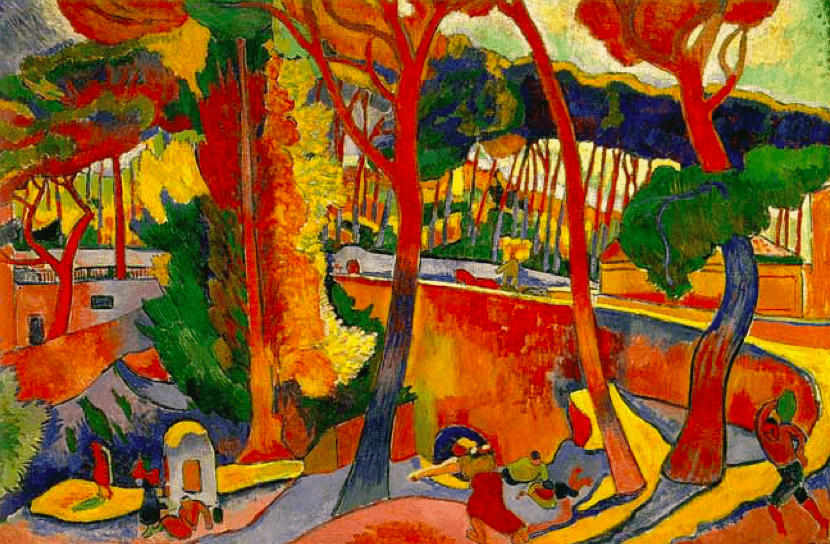
André Derain, born on June 10, 1880, in Chatou, a suburb of Paris, was one of the most influential French artists of the early 20th century. A key figure in the Fauvist movement, Derain’s work spans a range of styles and periods, reflecting both his personal evolution as an artist and the broader changes in the art world during his lifetime. His life, characterized by innovation, controversy, and a deep commitment to the classical foundations of art, offers a fascinating glimpse into the world of modern art.
Early Life and Education
André Derain was born into a well-off bourgeois family, which provided him with the stability and resources to pursue his artistic inclinations from a young age. Despite his father’s desire for him to become an engineer, Derain was drawn to the arts and enrolled in the Académie Julian in 1898. The Académie Julian was a private art school in Paris that attracted many aspiring artists who were unable to gain entry into the more prestigious École des Beaux-Arts. This period marked the beginning of Derain’s formal education in art, where he would meet several individuals who would influence his career profoundly.
During his time at the Académie, Derain became close friends with Maurice de Vlaminck and Henri Matisse, both of whom would play crucial roles in his artistic development. Vlaminck, in particular, introduced Derain to the use of vibrant, unblended colors—a technique that would later become a hallmark of the Fauvist movement. Matisse, who was slightly older and more established, also influenced Derain, encouraging him to explore the boundaries of color and composition.
The Fauvist Movement and Early Works
The early 20th century was a period of significant experimentation in the art world, with artists pushing the boundaries of traditional techniques and exploring new ways of expression. Derain, alongside Matisse and Vlaminck, became one of the leading figures of Fauvism, a movement characterized by its bold use of color, strong brushwork, and a departure from realistic representation. The Fauves, or “wild beasts,” as they were dubbed by critics, sought to express emotion through color and form rather than adhering to the realistic portrayal of subjects.
Derain’s work during this period is marked by a fearless use of color and a sense of spontaneity. His landscapes, such as those painted along the banks of the Seine, are vibrant and full of energy. He often used pure, unblended colors, applied with broad, expressive brushstrokes. These works, including L’Estaque and The Turning Road, L’Estaque (1906), exemplify the Fauvist approach and showcase Derain’s ability to capture the essence of a scene through color and composition.
Despite his association with Fauvism, Derain’s relationship with the movement was complex. While he embraced the bold use of color and the rejection of traditional techniques, he also maintained a deep respect for classical composition and structure. This tension between innovation and tradition would come to define much of his later work.
Transition and Exploration: The Move Towards Classicism
By 1907, Derain began to move away from the Fauvist style, seeking a new direction in his art. His interest in classical art and his desire for a more structured approach led him to explore the techniques of the Old Masters, particularly the use of chiaroscuro and perspective. This period marked a significant shift in Derain’s work, as he began to incorporate more traditional elements into his paintings while still retaining the vibrant color palette that had defined his earlier work.
Derain’s exploration of classicism was also influenced by his interactions with other leading artists of the time, including Pablo Picasso. Although he was drawn to the innovative ideas of Cubism, which Picasso was pioneering, Derain chose not to fully embrace the style, preferring instead to blend modern techniques with classical forms. This approach can be seen in works such as The Harlequin (1913) and The Pool of London (1906), where Derain combined the boldness of modern art with the compositional harmony of classical painting.
During this period, Derain also ventured into the world of illustration, providing artwork for several literary works. In 1909, he illustrated a collection of poems by Guillaume Apollinaire, a leading figure in the avant-garde literary scene. This project marked the beginning of a long and fruitful collaboration between Derain and some of the most prominent writers of his time, including André Breton and Max Jacob.
The Gothic Period and Return to Tradition
In the years leading up to World War I, Derain entered what is often referred to as his “Gothic Period.” This phase of his career was characterized by a renewed interest in medieval art, particularly the sculpture and architecture of the Gothic era. Derain’s work from this period reflects a fascination with the solemnity and spiritual intensity of medieval art, which he sought to incorporate into his own paintings.
Derain’s Gothic Period also saw him experimenting with the influence of African sculpture, which had become increasingly popular among European artists in the early 20th century. This interest in non-Western art forms was part of a broader movement within modern art to explore and incorporate elements from different cultural traditions. Derain’s work during this time, such as The Dance (1913), combines the austerity of Gothic art with the dynamism and expressiveness of African sculpture.
As the 1920s dawned, Derain’s focus shifted once again, this time towards a more pronounced return to classical forms and techniques. This “return to order,” as it was known, was part of a broader trend in European art following the upheaval of World War I. Artists across the continent sought to reconnect with the stability and continuity of classical art, and Derain was no exception. His works from this period, such as The Bathers (1921), reflect a calm, measured approach, with a focus on balance, harmony, and clarity.
World War II and Controversy
The outbreak of World War II and the subsequent occupation of France by Nazi Germany presented significant challenges for artists, including Derain. During the German occupation, Derain chose to remain in Paris, a decision that would later come under intense scrutiny. In 1941, he was invited by the German authorities to visit Berlin as part of a delegation of French artists. This visit, which was intended to showcase the collaboration between France and Nazi Germany, would have lasting repercussions for Derain’s reputation.
Although Derain’s trip to Berlin was largely seen as a gesture of goodwill towards the German occupiers, it was later exploited by Nazi propaganda, which sought to present him as a supporter of the regime. After the liberation of France in 1944, Derain was accused of being a collaborator, a charge that led to his ostracization by many in the French art community. Although he was never formally charged with collaboration, the stigma associated with his wartime actions would haunt him for the rest of his life.
Legacy and Influence
Despite the controversies that marred his later years, André Derain’s contributions to modern art are undeniable. His work helped to define the Fauvist movement, and his exploration of color, form, and composition influenced a generation of artists. Derain’s ability to blend innovation with tradition set him apart from many of his contemporaries, allowing him to create a body of work that is both diverse and cohesive.
Derain’s legacy is also reflected in his influence on later movements in modern art. His early experiments with color and form can be seen as a precursor to the abstract expressionism that would dominate the mid-20th century, while his later work foreshadowed the postwar return to realism. Artists such as Henri Matisse and Pablo Picasso, who were both contemporaries and collaborators of Derain, also drew inspiration from his ability to navigate the complex relationship between modernism and tradition.
In the years following his death, Derain’s work continued to be celebrated and studied, with major retrospectives held in leading museums around the world. His paintings, drawings, and illustrations are now considered essential components of the modernist canon, reflecting both the innovative spirit of the early 20th century and the enduring power of classical art.
Conclusion
André Derain’s life and work offer a fascinating window into the world of modern art, a world defined by rapid change, experimentation, and the constant tension between tradition and innovation. From his early days as a Fauvist pioneer to his later years as a champion of classical forms, Derain remained committed to exploring the possibilities of art and pushing the boundaries of what was possible. His legacy, marked by both triumph and controversy, continues to resonate in the art world today, offering valuable insights into the challenges and opportunities faced by artists in the modern era.
As we reflect on Derain’s contributions to art, it is clear that his work represents more than just a series of paintings; it is a testament to the power of creativity, the importance of innovation, and the enduring relevance of tradition. In a world that often seems to value the new at the expense of the old, Derain’s career serves as a reminder that true artistic greatness lies in the ability to bridge the gap between the past and the present, creating works that speak to the universal human experience.


