
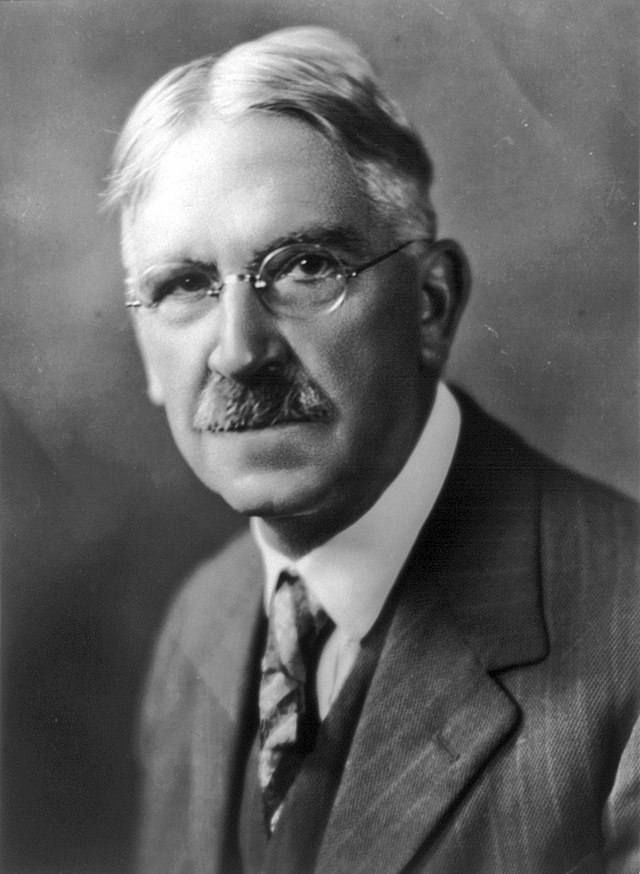
John Dewey, born on October 20, 1859, in Burlington, Vermont, is one of the most influential philosophers and educators in American history. His work in education, philosophy, and social reform has had a lasting impact on the way people think about learning, democracy, and the role of education in society. This article delves into John Dewey’s life, his rise to fame, and the key highlights of his intellectual journey, while also exploring the historical context that shaped his ideas and legacy.
Early Life and Education
John Dewey was born into a middle-class family in Burlington, Vermont, a town known for its intellectual and cultural vibrancy. The environment in which Dewey was raised played a significant role in shaping his intellectual curiosity. He received a typical bourgeois education of the time, which emphasized classical studies and moral instruction. However, Dewey’s interests soon extended beyond the traditional curriculum.
Dewey enrolled at the University of Vermont, where he graduated in 1879. His interest in philosophy was sparked during his undergraduate years, leading him to pursue further studies at Johns Hopkins University in Baltimore. At Johns Hopkins, Dewey was influenced by neo-Hegelian philosophy, which emphasized the importance of historical and social context in understanding human thought and behavior. He completed his doctorate in 1884 with a dissertation on the psychology of Immanuel Kant, marking the beginning of a lifelong engagement with philosophical inquiry.
The Rise of Pragmatism and Dewey’s Philosophical Contributions
John Dewey’s intellectual journey was deeply influenced by the pragmatism movement, a distinctly American school of thought that emerged in the late 19th century. Pragmatism, pioneered by thinkers like Charles Sanders Peirce and William James, emphasized the practical consequences of ideas and the role of experience in shaping knowledge. Dewey’s work extended and refined these ideas, making significant contributions to both philosophy and education.
Dewey’s philosophical approach, often referred to as “instrumentalism,” argued that knowledge and ideas should be understood as tools for solving problems and improving human life. He believed that the purpose of philosophy was not to provide abstract, absolute truths but to guide action and inquiry in the real world. This perspective was revolutionary in its rejection of traditional metaphysics and its emphasis on the practical application of knowledge.
One of Dewey’s most significant philosophical contributions is his theory of inquiry, detailed in his 1938 work Logic: The Theory of Inquiry. In this book, Dewey argued that the process of inquiry is inherently social and collaborative, involving the active engagement of individuals with their environment. This idea laid the foundation for Dewey’s later work in education, where he advocated for learning through experience and experimentation.
Dewey’s Impact on Education: The Laboratory School
John Dewey’s influence on education cannot be overstated. His ideas revolutionized the way educators think about teaching, learning, and the role of schools in society. Dewey’s educational philosophy was grounded in the belief that education should be a process of active learning, where students engage with the material and participate in their own learning process. He rejected the traditional model of rote memorization and passive reception of information, advocating instead for an approach that emphasized critical thinking, creativity, and problem-solving.
In 1894, Dewey joined the faculty at the University of Chicago, where he established the Laboratory School, an experimental elementary school designed to test and refine his educational theories. The Laboratory School became a testing ground for Dewey’s ideas about experiential learning, where students learned by doing, rather than by merely absorbing information. This approach emphasized the importance of social interaction, collaboration, and real-world problem-solving in the learning process.
Dewey’s educational philosophy was encapsulated in his 1916 book Democracy and Education, where he argued that education is not only a means of personal development but also a fundamental component of a democratic society. Dewey believed that schools should prepare students to be active, informed citizens who are capable of contributing to the democratic process. This idea was revolutionary at the time and has since become a cornerstone of modern educational theory.
The Columbia Years and Social Reform
Dewey’s tenure at the University of Chicago was marked by intellectual ferment and experimentation, but it was also fraught with controversy. His progressive views on education and his challenges to traditional methods led to conflicts with university administrators, ultimately prompting Dewey to leave Chicago in 1904. He moved to New York City, where he joined the faculty of Columbia University.
At Columbia, Dewey continued to develop his educational theories and expanded his work into the realm of social and political philosophy. He was a strong advocate for progressive social reforms, including women’s suffrage, labor rights, and the defense of civil liberties. Dewey’s commitment to social justice was reflected in his involvement in various political movements, including his support for the anarchists Sacco and Vanzetti, who were controversially convicted and executed in the 1920s.
Dewey’s belief in the connection between education and democracy led him to advocate for a more active and engaged citizenry. He argued that democracy is not just a form of government but a way of life that requires continuous participation and communication among citizens. Dewey’s ideas about democracy and education influenced a generation of educators, social reformers, and policymakers, helping to shape the progressive movement in the United States.
Dewey’s Later Life and Legacy
John Dewey retired from active teaching in 1930, but his intellectual activity continued unabated. He remained a prolific writer, producing influential works on education, philosophy, and social issues well into his 80s. Dewey’s later works, such as Experience and Nature (1925) and Art as Experience (1934), explored the relationship between human experience and the natural world, emphasizing the importance of creativity and aesthetic experience in human life.
Dewey’s influence extended far beyond the United States. His ideas were embraced by educators and philosophers around the world, particularly in Europe and Asia. Dewey’s work in China, where he lectured extensively in the 1910s and 1920s, had a profound impact on Chinese educational reformers and intellectuals, including figures like Hu Shih, who helped to introduce Dewey’s ideas to Chinese academia.
John Dewey passed away on June 1, 1952, at the age of 93, leaving behind a vast body of work that continues to influence educators, philosophers, and social reformers today. His contributions to education, philosophy, and social thought have made him one of the most important intellectuals of the 20th century.
Historical Context: The American Progressive Era
To fully understand John Dewey’s impact, it is essential to consider the historical context in which he lived and worked. Dewey’s life spanned a period of profound social, economic, and political change in the United States. The late 19th and early 20th centuries, known as the Progressive Era, were characterized by rapid industrialization, urbanization, and the growth of corporate power. These changes brought about significant social problems, including labor unrest, political corruption, and widespread poverty.
The Progressive Era was marked by a widespread belief in the need for social reform and the improvement of society through education, regulation, and government intervention. Dewey was a leading figure in this movement, advocating for educational reform as a means of addressing social problems and promoting democratic values. His work reflected the broader progressive belief that education could be a tool for social change, helping to create a more just and equitable society.
Dewey’s ideas were also shaped by the intellectual currents of his time, including the rise of pragmatism, the influence of Darwinian evolution, and the growing emphasis on scientific inquiry. These ideas led Dewey to reject traditional notions of absolute truth and to emphasize the importance of experimentation, inquiry, and the practical application of knowledge.
Dewey’s Enduring Influence on Modern Education
John Dewey’s impact on modern education is both profound and enduring. His emphasis on experiential learning, critical thinking, and the social nature of education has become central to contemporary educational theory and practice. Dewey’s ideas about the role of education in a democratic society continue to inspire educators and policymakers around the world.
In recent years, Dewey’s work has experienced a resurgence of interest, particularly in the context of debates about educational reform and the role of schools in promoting social justice. Dewey’s belief that education should be a means of preparing students for active citizenship and participation in democratic life is more relevant than ever in today’s increasingly complex and interconnected world.
Dewey’s influence can be seen in a wide range of educational practices, from project-based learning and collaborative classrooms to the integration of technology and the emphasis on critical thinking and problem-solving skills. His ideas continue to shape the way educators approach teaching and learning, and his legacy is evident in the ongoing efforts to create more inclusive, equitable, and effective educational systems.
Conclusion: John Dewey’s Legacy in Education and Philosophy
John Dewey’s life and work represent a remarkable fusion of philosophy, education, and social activism. His contributions to the development of educational theory, his advocacy for democratic values, and his commitment to social reform have left an indelible mark on the intellectual and cultural landscape of the 20th century.
Dewey’s legacy is not just a matter of historical interest; it is a living tradition that continues to influence educators, philosophers, and social reformers around the world. His ideas about the importance of experience, inquiry, and the social nature of knowledge remain central to contemporary debates about education and democracy.
As we continue to grapple with the challenges of the 21st century, John Dewey’s vision of education as a means of fostering democratic citizenship, social responsibility, and personal growth remains as relevant and inspiring as ever. His work serves as a reminder of the power of education to transform lives and shape the future of society.


