
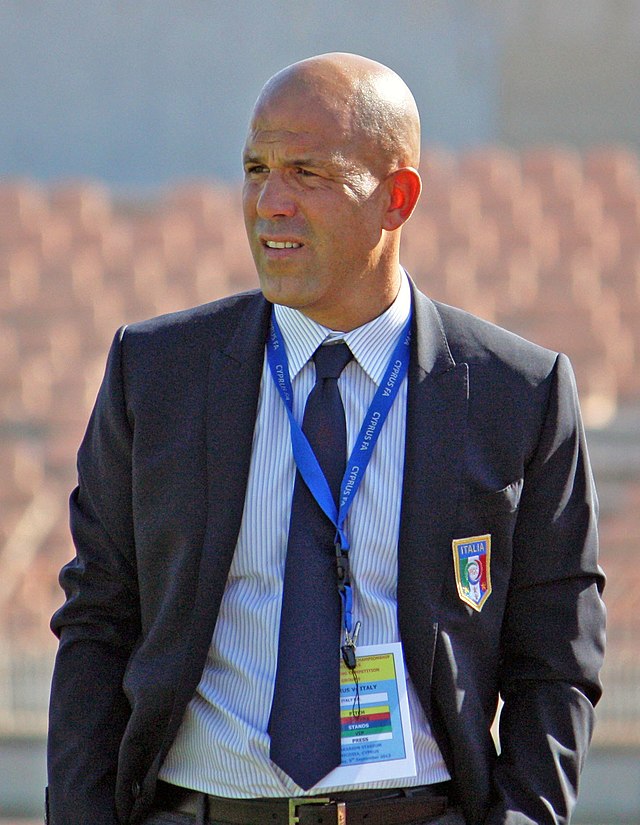
Luigi Di Biagio, born on June 3, 1971, in Rome, Italy, is a former professional footballer who played as a midfielder. Known for his tactical versatility, physical resilience, and precise shooting from distance, Di Biagio made a significant impact in Italian football during the 1990s and early 2000s. His journey from a young player in Rome to a well-known figure in international football is a story of perseverance, talent, and tactical intelligence. In this article, we will delve into the life and career of Luigi Di Biagio, exploring his achievements on the field, his role in the Italian national team, and his transition into coaching.
Early Life and Beginnings in Football
Luigi Di Biagio was born and raised in Rome, a city with a rich footballing history and a deep passion for the sport. From a young age, Di Biagio showed a keen interest in football, and his talent quickly became apparent. His early development as a footballer was shaped by the vibrant football culture of Rome, which nurtured many of Italy’s great players.
Di Biagio began his professional career with Lazio, one of Rome’s premier football clubs. He made his Serie A debut on June 11, 1989, in a match against Juventus. Although Lazio lost 4-2, this game marked the beginning of Di Biagio’s long and storied career in Italian football. Despite the defeat, his performance caught the eye of coaches and scouts, who recognized his potential as a midfielder capable of both defensive solidity and offensive contribution.
Rise to Prominence: Foggia and Roma
After his debut with Lazio, Di Biagio moved to Monza, where he spent three seasons playing in Serie B and Serie C1. During his time at Monza, he helped the team win the Coppa Italia Serie C in 1991, a significant achievement that further bolstered his reputation as a promising young player.
In 1992, Di Biagio made a pivotal move to Foggia, a team that was gaining attention for its dynamic style of play under the guidance of coach Zdenek Zeman. Zeman was known for his innovative tactics, which emphasized high pressing and quick, attacking football. Under Zeman’s tutelage, Di Biagio flourished, becoming a key player for Foggia and gaining valuable experience in Serie A.
Di Biagio’s success at Foggia earned him a transfer to Roma in 1995. Returning to his hometown club was a significant step in his career, as Roma was one of the most prestigious teams in Italy. At Roma, Di Biagio played under several prominent coaches, including Carlo Mazzone, Carlos Bianchi, and Zdenek Zeman, who had also made the move to the capital. During his time at Roma, Di Biagio became known for his tactical intelligence, ability to read the game, and knack for scoring crucial goals, particularly from long range.
International Career: Making His Mark with the Azzurri
Luigi Di Biagio’s international career began on January 28, 1998, when he made his debut for the Italian national team in a friendly match against Slovakia, which Italy won 3-0. His performances at club level had caught the attention of the national team selectors, and he was soon included in the squad for the 1998 FIFA World Cup in France.
Di Biagio’s contributions to the Italian team during the World Cup were significant. He scored a goal in the group stage against Cameroon, which was notable not only for its importance in the match but also because it was Italy’s 100th goal in World Cup history. He also provided a crucial assist to Christian Vieri in the Round of 16 match against Norway.
However, Di Biagio is perhaps most remembered for his role in the quarterfinal match against France, where Italy was eliminated in a penalty shootout. Unfortunately, Di Biagio missed a decisive penalty, which led to Italy’s exit from the tournament. Despite this, his overall performance in the World Cup was highly regarded, and he remained an important player for the national team in the following years.
In 2000, Di Biagio was part of the Italian squad that reached the final of the UEFA European Championship. Italy’s journey to the final was marked by strong performances, and Di Biagio played a crucial role in midfield. The final against France was a dramatic affair, with Italy losing to a golden goal scored by David Trezeguet. Despite the disappointment, Di Biagio’s contributions to the team were widely acknowledged.
He continued to represent Italy in the 2002 FIFA World Cup in Japan and South Korea, where he once again provided an assist for Vieri in the opening match against Ecuador. Di Biagio’s international career spanned several years, during which he earned 31 caps and scored two goals for the Azzurri.
Club Success and the Move to Inter Milan
In 1999, after a successful stint with Roma, Luigi Di Biagio made a high-profile move to Inter Milan. At Inter, he became an integral part of the team’s midfield, known for his leadership on the pitch and his ability to score from distance. Di Biagio’s time at Inter was marked by several notable achievements, including helping the team reach the semifinals of the UEFA Champions League in 2003.
Inter’s run to the semifinals of the Champions League was one of the highlights of Di Biagio’s club career. The team faced local rivals AC Milan in a closely contested semifinal, which ended in a draw over two legs, with Milan advancing on away goals. Although Inter did not reach the final, the team’s performance in the Champions League that season was a testament to Di Biagio’s influence and importance in the squad.
During his four seasons at Inter, Di Biagio made 163 appearances and scored 18 goals across all competitions. His consistent performances made him a fan favorite and a respected figure within the club.
Later Career and Retirement
In 2003, Luigi Di Biagio left Inter Milan and joined Brescia, where he continued to perform at a high level. His experience and leadership were invaluable to the team, and he remained with Brescia until 2006. After leaving Brescia, Di Biagio briefly played for Ascoli, where he scored two goals in seven appearances. Despite his efforts, Ascoli was relegated at the end of the season, and Di Biagio decided to retire from professional football in the summer of 2007.
Di Biagio’s retirement marked the end of an illustrious playing career that spanned nearly two decades. Throughout his career, he was known for his professionalism, tactical intelligence, and ability to perform in crucial moments. His contributions to Italian football, both at the club and international levels, have left a lasting legacy.
Transition to Coaching: Developing the Next Generation
Following his retirement from playing, Luigi Di Biagio quickly transitioned into coaching. His first coaching role came in 2008 when he was appointed as the coach of the Giovanissimi Regionali (Under-15 team) for Polisportiva La Storta. This initial experience provided Di Biagio with valuable insights into youth coaching and the development of young talent.
In 2011, Di Biagio took a significant step forward in his coaching career when he was appointed as the coach of the Italy Under-20 national team. His work with the Under-20s was widely praised, and in 2013, he was promoted to coach the Italy Under-21 national team, replacing Devis Mangia.
As the coach of the Italy Under-21s, Di Biagio was responsible for nurturing the next generation of Italian football talent. He led the team to qualification for the 2015 UEFA European Under-21 Championship, although Italy was eliminated in the group stage. Despite this setback, Di Biagio continued to focus on developing young players and preparing them for senior international football.
In 2017, Di Biagio led the Italy Under-21 team to the semifinals of the European Championship, where they were narrowly defeated by Spain. His work with the Under-21s was highly regarded, and he was praised for his ability to inspire and mentor young players.
Interim Role with the Senior National Team
In February 2018, following the resignation of Gian Piero Ventura after Italy’s failure to qualify for the 2018 FIFA World Cup, Luigi Di Biagio was appointed as the interim head coach of the Italian national team. This role was a significant responsibility, as Di Biagio was tasked with leading the team in friendly matches against Argentina and England.
Although Di Biagio’s tenure as interim coach was brief, it was an important moment in his coaching career, as it demonstrated the trust and confidence that the Italian Football Federation had in his abilities. After his interim role, Di Biagio returned to his position with the Under-21 team, where he continued to work until 2019.
Conclusion: A Legacy of Football Excellence
Luigi Di Biagio’s journey from a young player in Rome to a respected figure in Italian football is a story of dedication, talent, and perseverance. His playing career, marked by significant achievements at both club and international levels, established him as one of Italy’s most reliable and versatile midfielders.
Di Biagio’s transition into coaching has allowed him to pass on his knowledge and experience to the next generation of Italian footballers. His work with the Italy Under-21 team, in particular, has been instrumental in developing future stars and ensuring the continued success of Italian football on the international stage.
As we reflect on Luigi Di Biagio’s career, it is clear that his contributions to the sport go beyond his achievements on the pitch. His legacy is one of excellence, both as a player and as a coach, and his impact on Italian football will be felt for years to come.


