
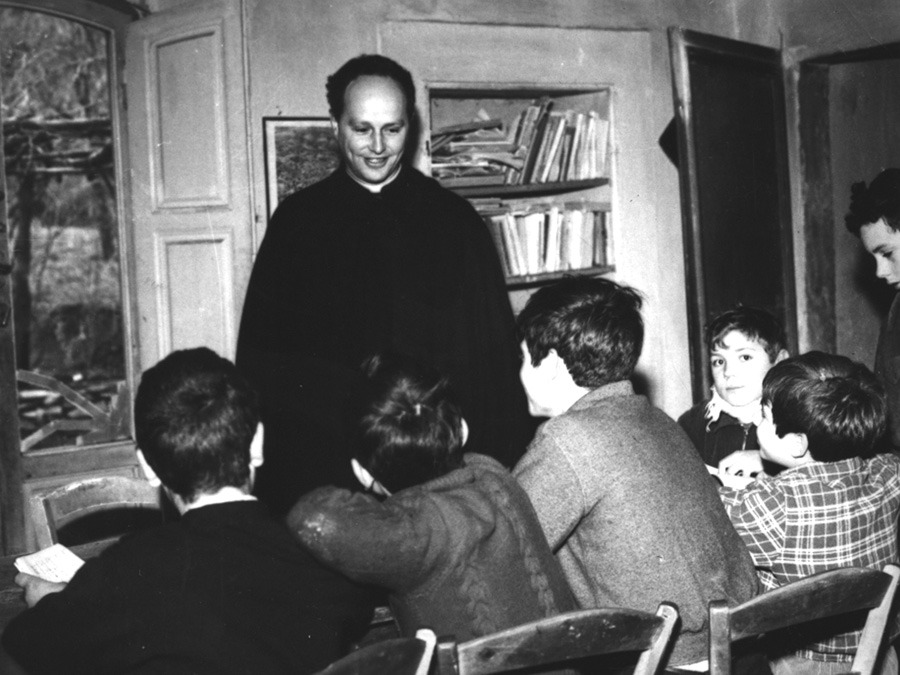
Don Lorenzo Milani (May 27, 1923 – June 26, 1967) was an Italian Roman Catholic priest, educator, and writer whose life and work left a profound impact on Italian society, particularly in the fields of education and social justice. His innovative approach to teaching and his unwavering commitment to the underprivileged made him a controversial figure during his lifetime but also cemented his legacy as one of the most influential educators of the 20th century.
Early Life and Family Background
Lorenzo Carlo Domenico Milani Comparetti was born into an affluent and intellectual family in Florence, Italy. His father, Albano Milani, was a chemist and property owner in Montespertoli, while his mother, Alice Weiss, was an Austrian-Italian of Jewish descent and a student of the famous writer James Joyce. Lorenzo grew up in an environment steeped in culture and intellectualism, yet his family held agnostic and anti-clerical views, which isolated them socially, particularly after they moved to Milan in 1930 due to economic reasons.
Despite his family’s secular beliefs, Lorenzo’s mother, concerned about the family’s social isolation, decided to baptize her children and marry in the church, which would later influence Lorenzo’s spiritual journey. As a child, Lorenzo exhibited a keen interest in art, particularly painting, and he enrolled in the Brera Academy in Milan to pursue this passion.
A Turning Point: Conversion and the Priesthood
Lorenzo Milani’s path took a significant turn during the summer of 1942 when, while on vacation in Gigliola, he encountered an old missal in a chapel and began reading it with great interest. This experience sparked a spiritual awakening that led to his conversion to Catholicism. In 1943, following a pivotal conversation with Don Raffaele Bensi, a local priest, Lorenzo decided to dedicate his life to the Church. On June 12, 1943, he was confirmed by Cardinal Elia Dalla Costa, and by November of the same year, he entered the seminary at Cestello in Oltrarno.
Milani’s seminary years were marked by tension and conflict. His direct and often confrontational style clashed with the more conservative and cautious approach of the Church hierarchy. He found many of the Church’s customs and rules to be at odds with the sincerity and immediacy of the Gospel, a belief that would shape his future ministry and educational philosophy.
Despite these challenges, Lorenzo Milani was ordained a priest on July 13, 1947, by Cardinal Dalla Costa in the Cathedral of Florence. He was assigned as an assistant priest in San Donato di Calenzano, a small town near Florence. It was here that Don Milani began to develop his revolutionary ideas on education and social justice.
The School at San Donato and “Esperienze Pastorali”
At San Donato, Don Milani quickly realized that many of the young people in his parish were illiterate or had received only minimal education. He responded by founding a “people’s school” for the working-class children and adults of the area. His approach to education was radical for its time: he believed that education was not just about imparting knowledge but about empowering individuals to think critically and engage with the world around them.
During this period, Don Milani collaborated with Agostino Ammannati, a high school teacher, and began writing Esperienze Pastorali (“Pastoral Experiences”), a book that critiqued the Church’s approach to pastoral care and highlighted the social injustices faced by the working class. Although the book initially received the Church’s approval (the imprimatur), it was later withdrawn from circulation due to its controversial content.
Don Milani’s outspoken nature and his challenges to the Church’s traditional practices did not sit well with the ecclesiastical authorities. In 1954, after a series of conflicts with the Florence Curia, he was reassigned to the remote parish of Barbiana, a small, isolated village in the mountainous region of Mugello. This move was widely seen as an attempt to silence him, but it instead became the setting for some of his most important work.
Barbiana and the School for the Poor
Barbiana was a small, impoverished community with few resources and limited access to education. Don Milani’s response to this situation was to create a full-time school for the local children, most of whom came from poor farming families. This school was not just a place of learning; it was a revolutionary experiment in education. Don Milani’s pedagogical approach emphasized collective learning, critical thinking, and social consciousness.
The school at Barbiana operated year-round, with students spending their days engaged in rigorous study and discussion. Don Milani believed that traditional education systems favored the wealthy and perpetuated social inequalities. His goal was to provide an education that was accessible to all, regardless of their social or economic background, and that would equip students with the tools to challenge and change the structures of power that oppressed them.
One of the most significant innovations at the Barbiana school was the practice of collective writing, where students would work together to write essays and letters, discussing and debating their ideas as a group. This collaborative approach not only improved the students’ literacy and communication skills but also fostered a deep sense of community and shared purpose.
The 1960s and the Fight for Social Justice
The 1960s were a period of intense social and political change in Italy, and Don Milani’s work reflected the growing demand for social justice and equality. In 1965, he published L’obbedienza non è più una virtù (“Obedience is No Longer a Virtue”), a collection of documents from his trial for advocating conscientious objection to military service. This publication, along with his outspoken support for the right to refuse military service on moral grounds, earned him both admiration and criticism. He was accused of being a cattocomunista (a derogatory term for left-leaning Catholics), despite his consistent opposition to totalitarianism in all its forms, including communism.
In the same year, Don Milani published Obiezione di Coscienza (“Conscientious Objection”), a work that further articulated his arguments in favor of conscientious objection and the rights of individuals to act according to their moral convictions, even in the face of legal or institutional opposition. His writings on this subject were considered so controversial that he was put on trial for incitement, though he was ultimately acquitted in the first trial.
In 1967, Don Milani and his students at Barbiana published Lettera a una professoressa (“Letter to a Teacher”), a scathing critique of the Italian education system. The book argued that the system was designed to maintain the status quo by favoring children from wealthy families while neglecting or actively discriminating against those from poorer backgrounds. The letter challenged the idea that education should be a tool for social mobility, instead advocating for an education system that promoted equality and justice.
Lettera a una professoressa became a seminal text in the Italian student movement of the late 1960s, influencing debates on education reform and social justice across Italy and beyond. The book’s core message—that education should be a right for all, not a privilege for the few—resonated deeply in a time of widespread social unrest and demands for change.
The Final Years and Legacy
As Don Milani’s influence grew, so did the challenges he faced. By the mid-1960s, his health was in decline due to a severe form of lymphoma. Despite his illness, he continued to teach and write, remaining deeply committed to his students and his mission until the very end. Don Milani passed away on June 26, 1967, at the age of 44. He died at his mother’s home in Florence, surrounded by the students and friends who had been part of his journey.
Don Milani’s death marked the end of a short but impactful life. His work and writings continued to inspire educators, activists, and social reformers long after his passing. The school at Barbiana, though no longer active, remains a symbol of his innovative approach to education and his tireless advocacy for the rights of the poor and marginalized.
Educational Philosophy and Impact
Don Milani’s educational philosophy was rooted in the belief that education is a fundamental right and a powerful tool for social change. He viewed literacy and critical thinking as essential components of a just society, and he worked tirelessly to ensure that even the most disadvantaged members of society had access to these tools.
His approach to teaching was characterized by a deep commitment to the individual needs of each student, combined with a strong emphasis on collective learning and social responsibility. Don Milani believed that education should not only prepare students for the workforce but also empower them to participate fully in society as informed and engaged citizens.
Today, Don Milani is remembered as a pioneer in progressive education and a champion of social justice. His ideas continue to influence educational theory and practice, particularly in the areas of inclusive education, critical pedagogy, and the rights of students. His legacy is preserved through the ongoing work of educators and activists who strive to create more equitable and just educational systems.
Conclusion: Don Milani’s Enduring Legacy
Don Lorenzo Milani’s life and work have left an indelible mark on the world of education and social justice. His unwavering commitment to the poor and marginalized, his innovative approach to teaching, and his fearless advocacy for human rights have inspired generations of educators and activists. Don Milani’s legacy is a powerful reminder of the transformative potential of education and the importance of standing up for what is right, even in the face of opposition.
As the world continues to grapple with issues of inequality and social justice, Don Milani’s teachings remain as relevant as ever. His vision of an education system that serves all people, regardless of their background or social status, is a goal that educators and policymakers continue to strive towards. Don Milani’s life serves as an enduring example of the power of education to change lives and to create a more just and equitable world.


