
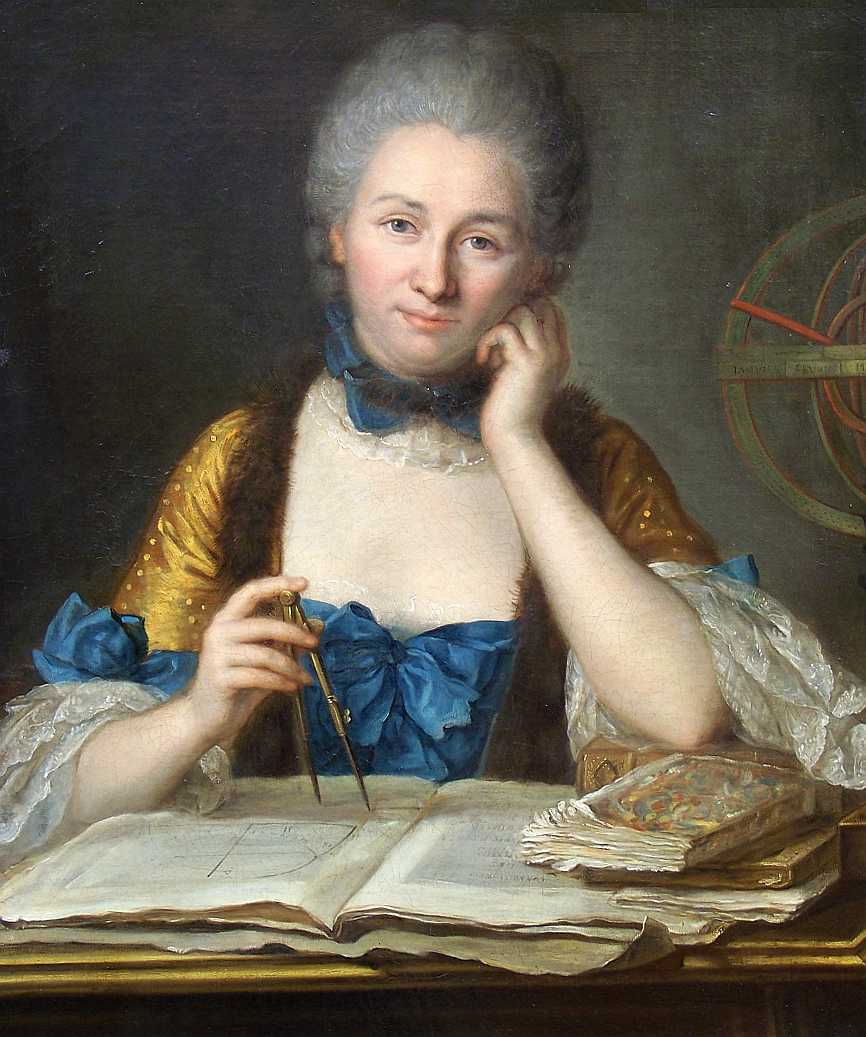
Émilie du Châtelet, born Gabrielle Émilie Le Tonnelier de Breteuil on December 17, 1706, in Paris, was an extraordinary figure in the history of science and philosophy. Despite the social constraints of her time, she carved out a significant place for herself in the intellectual circles of 18th-century France. Her life story is a fascinating blend of privilege, intellectual pursuit, and defiance of societal norms, making her one of the most remarkable women of her era.
Early Life and Background
Émilie was born into an aristocratic family, her father being a respected figure at the court of King Louis XIV. This privileged background afforded her access to an education that was rare for women of her time, especially in the realms of science and languages. From a young age, she demonstrated a keen interest in intellectual pursuits, studying German, Greek, and Latin, along with music, dance, and theater. At just sixteen, she was introduced to the court, where she continued her education while engaging in the social life expected of someone of her status.
Her marriage to Florent Claude du Châtelet at the age of nineteen was primarily a political arrangement, typical of aristocratic unions at the time. Although the marriage produced three children, it was not one of close companionship. Florent Claude’s military career kept him away, and the couple spent little time together. This distance provided Émilie with the freedom to pursue her intellectual interests more fervently.
Intellectual Pursuits and Achievements
Émilie du Châtelet’s most significant contribution to the intellectual world was her work in mathematics and physics. In an era where women were largely excluded from scientific discourse, Émilie’s achievements were nothing short of revolutionary. Her most famous work was the translation of Isaac Newton’s “Principia Mathematica” into French, which included her own commentary and insights. This translation, completed in 1749, remains one of the most important in history and was crucial in spreading Newtonian physics throughout France and the rest of Europe.
Before this monumental work, Émilie had already established herself as a serious scholar with the publication of “Elements of Newton’s Philosophy” in 1737, co-authored with her lover, the famous philosopher Voltaire. This book aimed to make Newton’s ideas more accessible to the general public and played a significant role in popularizing his theories in France.
Émilie’s intellectual journey did not stop there. In the early 1740s, she published “Institutions de Physique,” a book that outlined the ideas of the German philosopher and mathematician Gottfried Wilhelm Leibniz. This work further cemented her reputation as a leading thinker of her time. Émilie was not just a translator or a popularizer of ideas; she was an original thinker in her own right, contributing to the development of scientific and philosophical thought.
Relationship with Voltaire
One of the most intriguing aspects of Émilie du Châtelet’s life was her relationship with Voltaire, one of the most prominent intellectuals of the Enlightenment. The two met in 1733, and their relationship quickly blossomed into a deep intellectual partnership as well as a romantic one. They moved to Cirey-sur-Blaise, where they lived together for several years, engaging in scientific experiments and writing. Their relationship was an open secret, defying the conventions of the time, and they both thrived in each other’s intellectual company.
Voltaire often praised Émilie’s brilliance, and their collaboration was instrumental in many of his works. However, their relationship was not without its challenges. Despite their deep connection, Émilie eventually became infatuated with another man, the poet Saint-Lambert, in 1746. This new relationship marked the end of her partnership with Voltaire, though they remained friends until her death.
Tragic End and Legacy
Émilie du Châtelet’s life ended tragically at the age of forty-two. In 1749, she became pregnant by Saint-Lambert, a situation that was fraught with danger given her age. The pregnancy was risky, and she gave birth to a daughter in September of that year. Unfortunately, the baby died shortly after birth, and Émilie herself passed away just six days later on September 10, 1749, in Lunéville.
Her death was a significant loss to the intellectual community. Voltaire, who was present during her final days, was devastated by her passing. He later ensured that her translation of Newton’s “Principia Mathematica” was published, a testament to her enduring influence on the world of science.
Historical Context and Influence
To fully appreciate Émilie du Châtelet’s contributions, it is important to understand the historical context in which she lived. The early 18th century was a time of great scientific advancement, but it was also a time when women were largely excluded from formal education and intellectual pursuits. Émilie’s ability to break through these barriers was extraordinary.
Her work helped bridge the gap between the scientific revolution of the 17th century and the Enlightenment of the 18th century. By making Newton’s work accessible to a French-speaking audience, she played a crucial role in spreading the ideas that would eventually lead to the modern scientific worldview.
Moreover, Émilie’s life challenges the conventional narratives of women’s roles in history. She was not merely a passive muse or a supporter of male intellectuals; she was an active participant in the creation of knowledge. Her achievements in mathematics, physics, and philosophy demonstrate that women have always been capable of contributing to these fields, even when societal norms have tried to limit their potential.
Émilie du Châtelet in Modern Times
Today, Émilie du Châtelet is increasingly recognized for her contributions to science and philosophy. She has become a symbol of the overlooked achievements of women in history, inspiring a new generation of scholars to explore the contributions of women who have been marginalized or forgotten.
Her work is studied in courses on the history of science and philosophy, and her life story is often used as a case study in discussions about gender and intellectual history. In recent years, there has been a growing interest in her life and work, with several biographies and academic studies dedicated to exploring her contributions in greater detail.
Conclusion
Émilie du Châtelet’s life was a testament to the power of intellect and determination. In a world that sought to confine women to the private sphere, she broke through the barriers of her time to make significant contributions to science and philosophy. Her translation of Newton’s “Principia Mathematica” remains a monumental achievement, and her work continues to inspire scholars and thinkers today.
Her life is a reminder that the pursuit of knowledge knows no gender and that the contributions of women to the intellectual history of the world are invaluable. Émilie du Châtelet was not just a brilliant mind; she was a trailblazer who paved the way for future generations of women in science and philosophy.


