
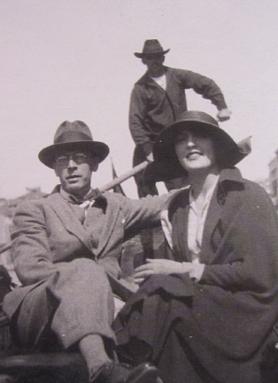
Marcello Dudovich, born on March 21, 1878, in Trieste, Italy, is celebrated as one of the pioneers of modern advertising and poster art. A master of visual communication, Dudovich’s work spanned various forms, including illustration, painting, and decorative arts, earning him a place among the most influential artists of the early 20th century. This article delves into Dudovich’s life, his rise to fame, and the significant milestones that defined his career.
Early Life and Artistic Foundations
Marcello Dudovich was born into a culturally rich environment in Trieste, a city that was then part of the Austro-Hungarian Empire and a melting pot of different artistic influences. This diverse cultural background played a crucial role in shaping Dudovich’s artistic sensibilities. From a young age, he exhibited a keen interest in art, which was nurtured by his family, particularly his cousin Guido Grimani, who introduced him to the vibrant artistic circles of Trieste.
Dudovich’s formal education began at the “Reali” schools in Trieste, where he received a foundation in traditional artistic techniques. However, his true passion lay in the emerging fields of applied arts and graphic design, which were beginning to gain prominence in Europe. This led him to move to Milan around 1898, a city that was quickly becoming a hub for modern industrial design and commercial art.
Rise to Prominence at Officine Ricordi
Upon his arrival in Milan, Dudovich’s career took a significant leap forward when he was hired by the Officine Ricordi, one of the most prestigious printing and publishing houses in Italy. At Ricordi, Dudovich had the opportunity to work under Leopoldo Metlicovitz, a renowned poster artist and lithographer. Metlicovitz recognized Dudovich’s exceptional talent and entrusted him with increasingly important projects, including the creation of preliminary sketches and chromatic studies for advertising posters.
During his time at Ricordi, Dudovich refined his skills in lithography, a technique that would become central to his work as a poster artist. His early works from this period demonstrate a mastery of color, composition, and the ability to convey complex ideas through simple, yet powerful, visual elements. These qualities would become hallmarks of Dudovich’s style and set him apart from his contemporaries.
Bologna and the Expansion of His Career
In 1899, Dudovich received an invitation from the lithographer Edmondo Chappuis to move to Bologna, where he began producing advertising posters, as well as illustrations for various publications. This period marked the beginning of Dudovich’s exploration of different media, including magazine covers, sketches, and caricatures. He contributed to several prominent Italian publications, including Italia Ride (1900) and was one of the founders of Fantasio (1902), a humor magazine that showcased his versatility as an artist.
It was also in Bologna that Dudovich met Elisa Bucchi, who would later become his wife. The couple married in 1911, and their relationship played an important role in Dudovich’s life, providing him with both personal and professional support.
International Recognition and the Paris Exposition
Dudovich’s talent was soon recognized on an international scale. In 1900, he was awarded the gold medal at the Exposition Universelle in Paris, an achievement that solidified his reputation as one of the leading poster artists of his time. The award brought Dudovich considerable acclaim and opened doors for further opportunities to collaborate with prominent publishers and advertisers across Europe.
Following his success in Paris, Dudovich continued to work for several high-profile publications, including Novissima (1901-1913) and Il Giornalino della Domenica (from 1906), both of which featured his illustrations and cover art. His work also appeared in other popular periodicals of the time, such as Varietas, Ars et Labor, and Secolo XX, where his illustrations captured the cultural and social dynamism of the early 20th century.
Return to Milan and Continued Success at Officine Ricordi
After a brief period in Genoa, Dudovich returned to Milan in 1905 to resume his work at Officine Ricordi. This phase of his career was marked by some of his most iconic creations, including the famous advertising posters for the Mele Department Stores in Naples (1907-1914) and the Borsalino hat company, for which he won a prestigious award in 1911.
Dudovich’s posters for Mele were particularly groundbreaking. They featured elegant, fashionably dressed women set against minimalist backgrounds, a style that emphasized the product and conveyed a sense of modernity and sophistication. These posters not only promoted the brand but also played a significant role in shaping the visual identity of early 20th-century Italian advertising.
In 1906, Dudovich won the competition to design the commemorative poster for the Simplon Tunnel, a major engineering achievement of the time. Although the poster was never printed, the commission itself was a testament to Dudovich’s standing as one of Italy’s leading poster artists.
Munich and International Collaboration
In 1911, Dudovich was invited to Munich to replace the Austrian artist Reznicek as an illustrator for the influential magazine Simplicissimus, which was known for its satirical take on contemporary society. Dudovich’s work for Simplicissimus focused on fashion and high society, and his illustrations captured the glamour and elegance of the period.
Dudovich’s time in Munich was a fruitful period both personally and professionally. He married Elisa Bucchi during this time, and their daughter Adriana was born. Despite the demands of his work in Munich, Dudovich continued to collaborate with Ricordi and traveled extensively throughout Europe, drawing inspiration from the different cultures and artistic traditions he encountered.
World War I and the Post-War Period
The outbreak of World War I in 1914 brought an abrupt end to Dudovich’s stay in Munich. Returning to Italy, he became involved in various war-related propaganda efforts, contributing to anti-Austrian publications such as Gli Unni… e gli altri! (1915) and satirical magazines like Pasquino and Satana Beffa (1919).
During the post-war years, Dudovich continued to produce advertising posters, this time for some of Italy’s most prominent companies, including Fiat, Alfa Romeo, Pirelli, and Carpano. His work from this period reflects the technological advancements and industrial growth that characterized post-war Italy. Dudovich’s ability to adapt his style to the changing times while maintaining his distinctive artistic voice ensured that he remained at the forefront of the Italian advertising industry.
The 1920s: A Decade of Innovation and Expansion
The 1920s were a period of significant growth and innovation for Dudovich. He created a series of posters for La Rinascente, Milan’s leading department store, which were printed by the Officine d’Arti Grafiche Gabriele Chiattone. These posters are celebrated for their dynamic composition, bold use of color, and innovative design, which captured the spirit of the Roaring Twenties.
In 1922, Dudovich was appointed artistic director of IGAP (Industria Grafica Artistica Pubblicitaria), a major Italian advertising agency. This position allowed him to influence the direction of Italian commercial art and mentor a new generation of graphic designers. Dudovich also participated in several high-profile exhibitions during this decade, including the Venice Biennale (1920 and 1922) and the International Exhibition of Modern Decorative and Industrial Arts in Paris (1925), where he won a gold medal for his work.
Later Years and Artistic Evolution
As Dudovich’s career progressed into the late 1920s and 1930s, his work evolved to reflect the changing artistic trends of the time. While he continued to produce elegant and visually striking posters, his illustrations began to incorporate elements of chiaroscuro and a more pronounced sense of volume, influenced by the Novecento Italiano movement, which emphasized a return to classical forms and monumental composition.
Despite these stylistic shifts, Dudovich’s work retained the elegance, clarity, and sophistication that had always defined his art. In the 1930s, he contributed to a number of Italian publications, including Dea (1933), Mammina (1937), Le Grandi Firme, and Il Milione (1938). He also undertook large-scale projects, such as the fresco decoration of the dining hall at the Ministry of Aeronautics in Rome (1931-1932).
Dudovich’s international travels continued throughout his career. He spent time in Libya in 1936-1937 and returned there in 1951, drawing inspiration from the landscapes and cultures he encountered.
Final Years and Legacy
In 1945, Dudovich suffered the loss of his wife, Elisa Bucchi, a significant emotional blow. Despite this, he continued to work and remained active in the art world until his death. Marcello Dudovich passed away on March 31, 1962, in Milan, due to a cerebral hemorrhage.
Dudovich’s legacy as one of the pioneers of modern advertising and poster art is unquestionable. His ability to merge artistic innovation with commercial appeal set new standards for visual communication and influenced countless artists and designers who followed in his footsteps. His work not only reflects the cultural and social changes of the early 20th century but also continues to be celebrated for its timeless elegance and artistic excellence.
Conclusion
Marcello Dudovich was more than just a poster artist; he was a visionary who helped shape the visual language of modern advertising. His work bridged the gap between fine art and commercial art, creating a new aesthetic that continues to inspire designers today. Dudovich’s life and career serve as a testament to the power of art to influence and reflect society, and his contributions to the field of graphic design remain a lasting legacy in the world of visual arts.


