
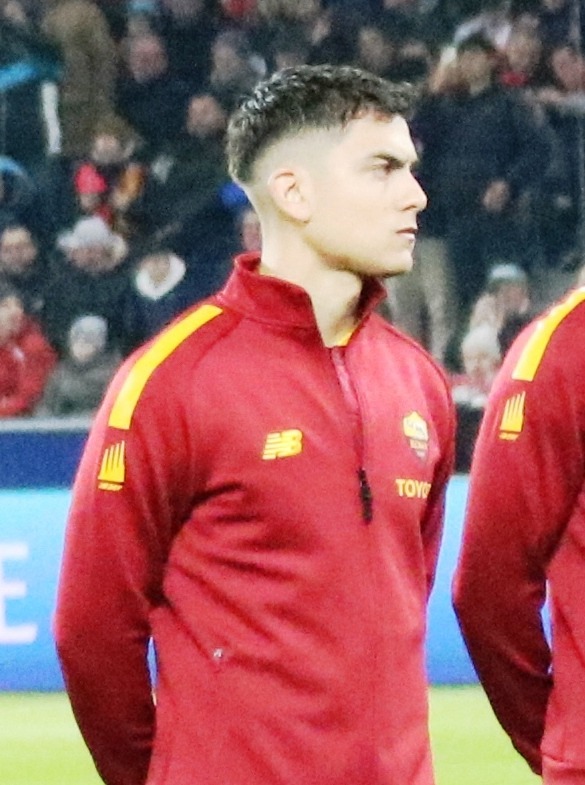
Paulo Exequiel Dybala, born on November 15, 1993, in Laguna Larga, Argentina, is an international football star whose journey from a small town in Argentina to the grand stadiums of Europe has been nothing short of remarkable. Known for his exceptional technical skills, vision on the field, and ability to score goals from almost any position, Dybala has earned his place among the elite footballers of his generation. This article explores Dybala’s life, rise to fame, and the significant highlights that have shaped his illustrious career.
Early Life and Background
Paulo Dybala was born into a family with a rich cultural heritage. His paternal grandfather was of Polish descent, having fled to Argentina during the turbulent years of World War II. Growing up in a small town like Laguna Larga, Dybala was immersed in a humble environment where football was not just a sport but a way of life.
From a very young age, Dybala showed a natural affinity for football. He began playing in local leagues, and his talent was evident from the start. His father, Adolfo Dybala, was a significant influence on Paulo’s early footballing journey, nurturing his passion for the game and dreaming of seeing his son play for a big club one day. However, tragedy struck when Dybala was just 15 years old; his father passed away, a loss that deeply impacted him. Despite this, Dybala remained focused on his football career, a commitment that would soon pay off.
Early Career: Instituto and the Rise of “La Joya”
Dybala’s professional career began with Instituto Atlético Central Córdoba, a club in Argentina’s second division, Primera B Nacional. He made his debut in 2011 at the age of 18, and it didn’t take long for him to make an impact. In his first season, Dybala scored 17 goals in 38 appearances, setting several records along the way. He became the first player in the history of the club to play 38 consecutive matches in a professional league and was the youngest player to score a hat-trick.
It was during this time that Dybala earned the nickname “La Joya,” which means “The Jewel” in Spanish. The moniker was given to him by an Argentine journalist who was captivated by Dybala’s technical abilities, vision, and composure on the ball—traits that set him apart from other players his age.
Move to Europe: Palermo and Introduction to Italian Football
Dybala’s performances in Argentina caught the attention of European scouts, and in 2012, he made the move to Italy, signing with Palermo in Serie A. The transfer was a significant investment for the Sicilian club, costing them €12 million, the highest fee they had ever paid for a player at the time.
Dybala’s adaptation to Italian football was not without its challenges. In his first season, Palermo struggled in Serie A, and despite Dybala’s potential, the team was relegated to Serie B. However, this setback proved to be a turning point for both the club and Dybala. Under new management, Palermo won the Serie B title in the 2013-2014 season, with Dybala playing a crucial role, scoring five goals and providing numerous assists.
Back in Serie A for the 2014-2015 season, Dybala truly began to shine. He scored 13 goals and provided 10 assists, attracting the attention of top European clubs. His performances against big teams like AC Milan and Juventus showcased his ability to perform on the biggest stages, and it became clear that Dybala was destined for greater things.
The Juventus Era: Titles, Fame, and International Recognition
In the summer of 2015, Dybala completed a high-profile transfer to Juventus, one of Italy’s most prestigious clubs. The transfer fee was reported to be around €32 million, a significant sum that underscored the expectations placed on the young Argentine.
Dybala’s impact at Juventus was immediate. He quickly became a key player for the team, known for his versatility—able to play as a forward, attacking midfielder, or winger. His technical skills, combined with his ability to score and assist, made him one of the most dangerous players in Serie A. In his first season with Juventus, Dybala scored 23 goals across all competitions, helping the team secure both the Serie A title and the Coppa Italia.
Over the following seasons, Dybala’s star continued to rise. He formed a formidable partnership with Gonzalo Higuaín and later Cristiano Ronaldo, becoming one of the most feared attacking forces in European football. Dybala’s ability to perform in crucial moments was evident in the 2017 Champions League campaign, where he scored a memorable brace against Barcelona in the quarterfinals, leading Juventus to a 3-0 victory in the first leg.
Despite his success, Dybala’s time at Juventus was not without challenges. The arrival of Ronaldo in 2018 shifted the dynamics of the team, and Dybala found himself in a more secondary role at times. However, he remained a vital part of the squad, contributing to Juventus’ domestic dominance with several more Serie A titles.
International Career: Wearing the Albiceleste
Dybala’s journey with the Argentine national team has been one of both promise and frustration. He was first called up to the senior team in 2015 and made his debut in a World Cup qualifier against Paraguay. However, breaking into a team that already boasted attacking talents like Lionel Messi, Sergio Agüero, and Gonzalo Higuaín was no easy task.
Dybala’s international career has seen him struggle for consistent playing time, often being used as a substitute or playing out of his preferred position. Despite this, he has had his moments of brilliance for Argentina. He was part of the squad that reached the Copa América final in 2016 and 2019, although both campaigns ended in heartbreak for Argentina.
One of the most significant moments of Dybala’s international career came in 2019 during the Copa América, where he scored his first competitive goal for Argentina in the third-place match against Chile. This goal was seen as a potential turning point, with hopes that Dybala would become a more integral part of the national team moving forward.
Challenges and Transitions: The Move to AS Roma
After seven successful years at Juventus, where he won five Serie A titles, four Coppa Italia trophies, and reached a Champions League final, Dybala’s time at the club came to an end in 2022. His departure was influenced by a combination of factors, including injuries, changes in the team’s tactical approach, and contract negotiations that did not reach a resolution.
In July 2022, Dybala signed with AS Roma, where he was welcomed by José Mourinho. This move marked a new chapter in his career, one that offered Dybala the opportunity to be the focal point of a team again, something that had become less frequent during his final years at Juventus. His arrival at Roma was met with great enthusiasm from the club’s supporters, who saw him as a key player capable of elevating the team’s performances both domestically and in European competitions.
Personal Life and Public Image
Off the pitch, Paulo Dybala has cultivated a public image that blends professionalism with accessibility. He is known for his humility and dedication to his craft, qualities that have endeared him to fans around the world. Dybala is also active on social media, where he shares insights into his life, including his relationship with Argentine singer and model Oriana Sabatini, whom he began dating in 2018.
Dybala’s influence extends beyond football; he has been involved in various charitable activities, including supporting children’s hospitals and participating in campaigns to raise awareness for various social issues. His down-to-earth personality, combined with his on-field success, has made him one of the most popular footballers globally.
Legacy and Impact
Paulo Dybala’s journey from a small town in Argentina to the grand stages of European football is a testament to his talent, determination, and resilience. His career has been marked by moments of brilliance, and while he has faced challenges, particularly with injuries and changes in his role within teams, Dybala has consistently demonstrated his quality at the highest level.
Dybala’s legacy in football is still being written. As he continues his career at AS Roma, there is a sense that he still has much to offer. Whether through his elegant playmaking, his deadly finishing, or his ability to perform in the clutch moments, Dybala remains a player who can change the course of a match with a single touch.
Conclusion
Paulo Dybala’s career is a story of a young boy from Argentina who dreamed of playing football at the highest level and made that dream a reality through talent and perseverance. From his early days at Instituto to his stardom at Juventus and now at AS Roma, Dybala has consistently been a player who excites fans and terrifies opponents. His journey serves as an inspiration to aspiring footballers everywhere, proving that with dedication and passion, even the most ambitious dreams can come true.
As Dybala continues to add to his legacy, both at the club and international levels, he remains one of the most exciting and beloved players in the world of football. His story is far from over, and as he enters the next phase of his career, fans can look forward to many more moments of magic from “La Joya.”


