
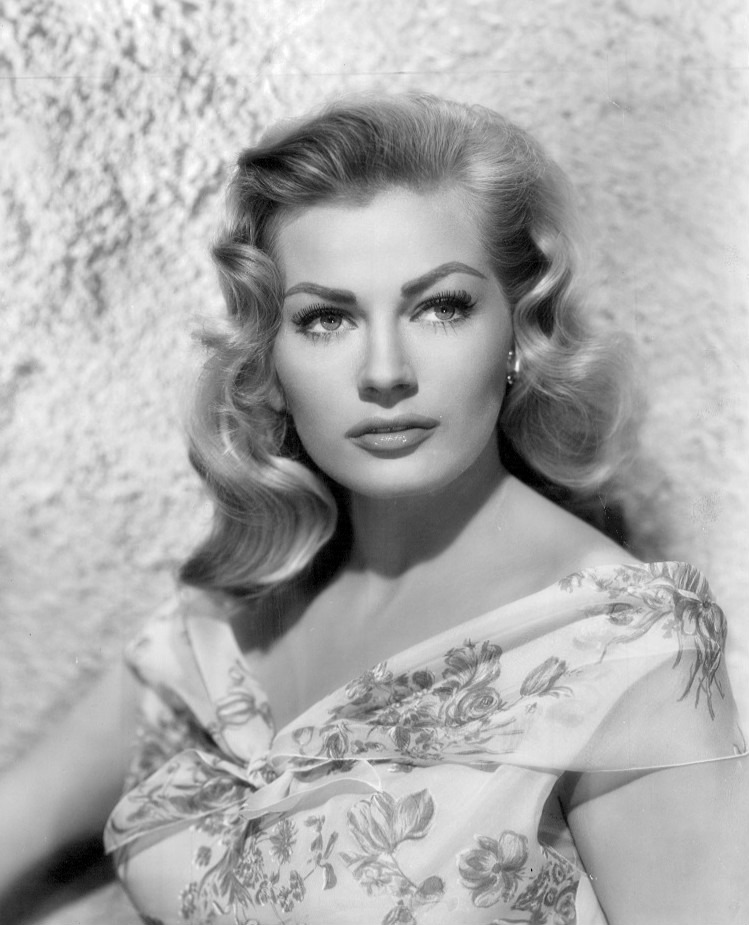
Anita Ekberg is a name that resonates with the golden era of Hollywood and the opulent world of European cinema. Born as Kerstin Anita Marianne Ekberg on September 29, 1931, in Malmö, Sweden, she was the embodiment of the Nordic beauty ideal, capturing the hearts of audiences worldwide. Over the course of her life, Ekberg achieved fame, endured controversies, and became an iconic figure, especially remembered for her role in Federico Fellini’s masterpiece, La Dolce Vita. This article delves into the life, career, and enduring legacy of Anita Ekberg, a woman who remains a symbol of glamour and mystery.
Early Life and Rise to Fame
Anita Ekberg’s early life was rooted in a large and bustling family in Malmö, Sweden. Growing up with seven siblings, Ekberg developed a strong sense of independence and resilience. Her journey to stardom began in 1950 when she won the Miss Sweden title, a victory that opened the doors to international opportunities. The young beauty queen soon found herself participating in the Miss Universe pageant, where, although she did not win the crown, she caught the eye of influential figures in the entertainment industry.
The Hollywood Dream
After her appearance in the Miss Universe contest, Ekberg moved to the United States. Her striking looks and statuesque figure quickly garnered attention in Hollywood, but her journey was far from easy. Initially, she signed a contract with RKO Pictures, facilitated by the legendary aviator and filmmaker Howard Hughes. However, this contract did not immediately lead to film roles, as Hughes seemed more interested in her as a potential spouse than as an actress, a proposal that Ekberg declined.
Determined to succeed in the film industry, Ekberg invested time in refining her acting skills, studying diction, and learning horseback riding—essential skills for an actress in 1950s Hollywood. Her efforts paid off when she secured her debut role in the 1953 film Abbott and Costello Go to Mars, where she played a Venusian guard. Although it was a minor role, it marked the beginning of her acting career.
Ekberg’s early Hollywood years were marked by a blend of minor film roles and strategic publicity stunts. She understood the power of her image and wasn’t afraid to leverage it. One such stunt involved her posing nude for Playboy, which, combined with her calculated “wardrobe malfunction” at a London hotel, kept her in the public eye. These actions, while controversial, contributed to her growing fame and established her as a sex symbol of the era.
Breakthrough with La Dolce Vita
While Ekberg had gained some recognition in Hollywood, it was her role in Federico Fellini’s La Dolce Vita (1960) that catapulted her to international stardom. The film, now considered a classic, featured Ekberg in the iconic scene where she wades into Rome’s Trevi Fountain, beckoning Marcello Mastroianni’s character to join her. This scene not only became the defining moment of her career but also an enduring image in the history of cinema.
Fellini and Ekberg’s collaboration extended beyond La Dolce Vita. She appeared in other films directed by Fellini, including Boccaccio ’70 (1962), The Clowns (1970), and Intervista (1987). Her association with Fellini cemented her status as a muse of European cinema, and her performances in these films showcased her range as an actress beyond her glamorous image.
Life Beyond the Silver Screen
Ekberg’s personal life was as colorful as her on-screen roles. In 1956, she married British actor Anthony Steel, a union that lasted only two years. Her second marriage was to American actor Rik Van Nutter in 1963, which ended in divorce in 1975. Despite the brevity of her marriages, Ekberg remained a popular figure in the tabloid press, often linked romantically with high-profile figures such as Gianni Agnelli, the Italian industrialist, and Dino Risi, the acclaimed Italian director.
By the late 1960s, Ekberg had relocated to Italy, a country that had embraced her as one of its own. She became a staple in European cinema, starring in films such as Scusi, lei è favorevole o contrario? (1966) alongside Alberto Sordi and Sette volte donna (1967), directed by Vittorio De Sica. Her later years saw her taking on roles in lower-budget films and television, but she remained a beloved figure in the industry.
The Decline and Legacy
As the years passed, Ekberg’s career began to decline. She appeared in a number of B-movies during the 1970s, such as Casa d’appuntamento (1972) and Suor Omicidi (1978), and even ventured into the spaghetti western genre with The Killer Wore Gloves (1974). Despite the downturn in the quality of her film projects, Ekberg maintained her status as a cultural icon, largely due to her earlier work and the indelible mark she left on the film industry.
Ekberg’s later life was marked by a return to the public eye, albeit in a different light. She appeared in Bambola (1996), directed by Bigas Luna, where she played the mother of Valeria Marini’s character, and The Red Dwarf (1998), in which she portrayed an aging opera singer. Her final on-screen appearance was in the Italian television series Il bello delle donne in 2005.
In her final years, Ekberg lived a relatively quiet life in a villa outside Rome. She had long since left Sweden and rarely returned, stating that she would only go back after her death. Despite this, she maintained a connection with her homeland, often welcoming Swedish journalists into her home and participating in Swedish radio programs.
Anita Ekberg passed away on January 11, 2015, at the age of 83. Her death marked the end of an era, but her legacy lives on. The image of Ekberg in the Trevi Fountain remains one of the most iconic moments in film history, a testament to her enduring appeal and the lasting impact she made on cinema.
The Iconic Legacy of Anita Ekberg
Anita Ekberg’s legacy is multifaceted. She is remembered not only as a Hollywood starlet but also as a muse of European cinema. Her work with Federico Fellini, particularly in La Dolce Vita, solidified her place in the pantheon of film legends. However, Ekberg was more than just a beautiful face; she was a savvy, independent woman who understood the complexities of fame and navigated them with a unique blend of charm and tenacity.
Ekberg’s life story is a testament to the transient nature of fame and the enduring power of cinematic art. While her career had its ups and downs, the impact of her work, especially in the 1960s, cannot be overstated. She remains a symbol of the glamorous and often tumultuous world of film, a world that she both conquered and was, at times, overwhelmed by.
In the end, Anita Ekberg’s life was a reflection of the roles she played—larger-than-life, full of passion, and indelibly marked by moments of brilliance. Her story is one of a woman who lived on her own terms, leaving behind a legacy that continues to inspire and captivate audiences around the world.


