
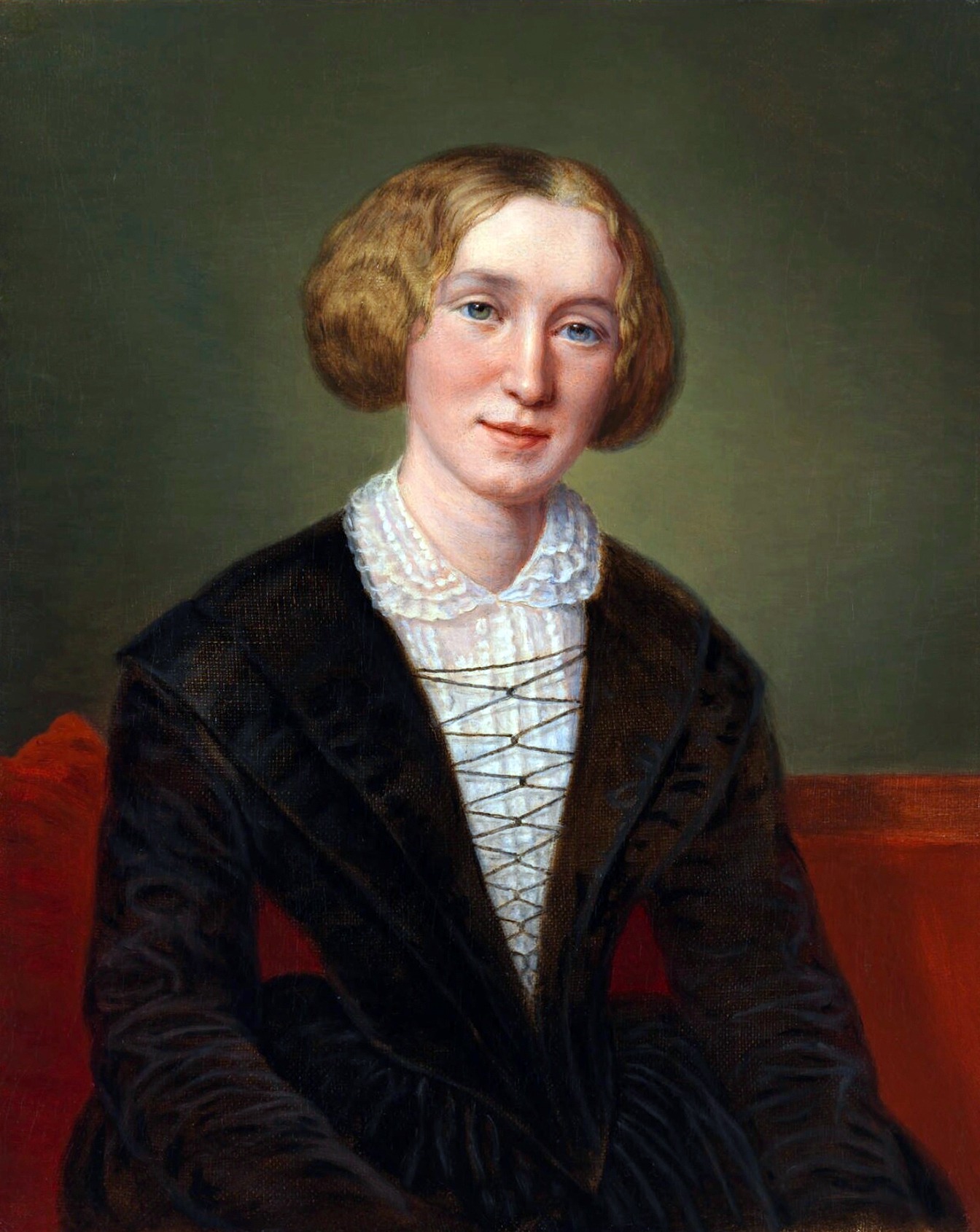
George Eliot, a name synonymous with profound literary genius, is the pen name of Mary Anne Evans. Born on November 22, 1819, in the idyllic Warwickshire countryside of England, Eliot is celebrated for her nuanced storytelling, complex characters, and deep exploration of social and moral issues. Her life and work have left an indelible mark on English literature, making her one of the most significant writers of the Victorian era.
Early Life and Education
Mary Anne Evans was born into a comfortable rural life, the youngest child of Robert Evans and his second wife, Christiana Pearson Evans. Her father, a loving and supportive figure, managed an estate for a wealthy family, providing a stable and nurturing environment for Mary and her siblings. From a young age, Mary demonstrated a voracious appetite for literature, frequenting the local church library and devouring books with an insatiable curiosity.
Her education began in 1824, where she was mentored by Miss Maria Lewis, the governess of Mrs. Wallington’s School in Nuneaton. This period of Mary’s life was crucial in shaping her intellectual development. She excelled in her studies, learning to play the piano, studying foreign languages, and beginning to write her own stories and poems. However, her intense academic focus led her to question her religious beliefs, a theme that would later permeate her literary works.
Transition to Adulthood and Literary Beginnings
In 1836, Mary’s life took a dramatic turn when her mother passed away from cancer. She returned home to care for her father and continued her education with the help of a private tutor. It was during this time that her first story was published in the “Christian Observer” in 1840, marking the beginning of her writing career.
The real turning point in Mary’s life occurred when her father retired and moved to Coventry. Here, Mary, who had long struggled with her appearance and feared a life of solitude, found solace and inspiration in the vibrant intellectual circles of Coventry. She became acquainted with free-thinkers like Charles Bray and began reading the works of non-religious authors, including Thomas Carlyle, Ralph Waldo Emerson, and Walter Scott. This intellectual awakening was a catalyst for her literary ambitions.
The Birth of George Eliot
After her father’s death, Mary traveled extensively in Italy and Switzerland with the Bray family. Upon her return to England, she settled in London, where she began working as a journalist under the pseudonym Marian Evans. Her work for the “Westminster Review,” where she eventually took on significant editorial responsibilities, further honed her writing skills and deepened her connections in the literary world.
Mary’s personal life was marked by her unconventional relationship with George Henry Lewes, a married man in an open relationship. Despite societal disapproval, the couple lived together as husband and wife until Lewes’ death in 1878. Lewes was a staunch supporter of Mary’s literary career, encouraging her to write under the pseudonym George Eliot—a name that would become legendary.
The decision to adopt a male pseudonym was strategic. Mary wanted her work to be judged on its merit, free from the biases associated with female authors at the time. This choice also reflected her desire to distance her literary identity from her personal life, which had been scandalized by her relationship with Lewes.
Literary Achievements and Fame
George Eliot’s literary debut came with the publication of “Scenes of Clerical Life” in 1858, a collection of stories that offered a vivid portrayal of rural English life. The work was well-received, and it paved the way for her first full-length novel, “Adam Bede,” published in 1859. The novel was an immediate success, earning Eliot widespread acclaim and solidifying her reputation as a formidable literary talent.
Eliot’s subsequent novels continued to explore the complexities of human nature and society. “The Mill on the Floss” (1860) delved into the intricate relationships within a rural family, while “Silas Marner” (1861) explored themes of redemption and community. In “Romola” (1863), Eliot turned her attention to historical fiction, crafting a richly detailed narrative set in Renaissance Florence.
However, it was “Middlemarch,” published in 1871-72, that secured Eliot’s place among the greatest novelists of all time. Widely regarded as her masterpiece, “Middlemarch” offers a panoramic view of provincial life, examining the interplay of politics, religion, and individual aspirations. The novel’s depth and insight into the human condition have earned it a place in the canon of English literature.
Eliot’s final novel, “Daniel Deronda” (1876), continued her exploration of social and moral themes, this time focusing on Jewish identity and the Zionist movement. Though not as universally acclaimed as “Middlemarch,” “Daniel Deronda” has been praised for its pioneering exploration of Jewish culture and identity, topics that were largely ignored by her contemporaries.
Later Life and Legacy
After the death of George Henry Lewes in 1878, Eliot retreated from public life, though she continued to write and maintain close relationships with a select few. In 1880, she shocked her acquaintances by marrying John Walter Cross, a man twenty years her junior. The marriage, however, was short-lived; Eliot passed away later that year on December 22, 1880.
Eliot’s legacy is profound. Her works have been lauded for their psychological depth, social realism, and moral complexity. Unlike many of her contemporaries, Eliot eschewed romanticism and sentimentality, instead offering a more nuanced and often stark portrayal of life. Her characters are not merely heroes or villains but fully realized individuals shaped by their circumstances and inner struggles.
Eliot’s influence extends beyond literature. Her exploration of gender, religion, and societal norms continues to resonate with readers and scholars alike. Her work has inspired countless adaptations in film, television, and theater, ensuring that her stories remain relevant in the modern era.
Historical Context and Impact
To fully appreciate George Eliot’s contributions to literature, it is essential to understand the historical context in which she wrote. The Victorian era was a time of significant social and economic change in England. The Industrial Revolution had transformed the landscape, leading to the rise of the middle class and the decline of rural communities. These changes are reflected in Eliot’s works, which often grapple with the tensions between tradition and progress.
Eliot’s writing also reflects the intellectual currents of the time. She was influenced by the works of contemporary philosophers and thinkers, including Feuerbach and Comte, whose ideas on religion, society, and human nature are woven into her narratives. Her novels often challenge the religious orthodoxy of her day, reflecting her own complex relationship with faith.
Moreover, Eliot’s use of a male pseudonym highlights the gender dynamics of the Victorian literary scene. Women writers were often marginalized, their work dismissed as trivial or overly sentimental. By adopting a male pen name, Eliot was able to navigate these challenges and establish herself as one of the foremost writers of her time.
Conclusion
George Eliot, born Mary Anne Evans, was not just a remarkable novelist but also a trailblazer who challenged the conventions of her time. Her works remain a testament to her intellectual rigor, empathy, and literary genius. Through her exploration of human nature and society, Eliot has left an enduring legacy that continues to inspire and challenge readers around the world.
Her life, marked by personal challenges and professional triumphs, serves as a reminder of the power of resilience and the importance of staying true to one’s vision. As we reflect on her contributions to literature, it is clear that George Eliot’s insights into the human condition are as relevant today as they were in the 19th century.


