
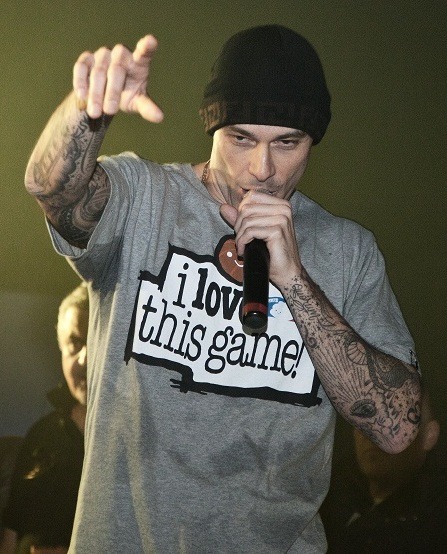
Fabri Fibra, born Fabrizio Tarducci on October 17, 1976, in Senigallia, a charming seaside town in the Marche region of Italy, is a name synonymous with the Italian rap scene. Rising to fame in the 2000s, Fibra’s journey from a small-town boy to one of Italy’s most influential rappers is a story of talent, resilience, and an unfiltered approach to music. His career spans over two decades, marked by chart-topping albums, controversial lyrics, and a unique style that has resonated with a generation of fans. This article explores Fabri Fibra’s life, his rise to fame, and the highlights of his illustrious career.
Early Life: The Formation of Fabri Fibra
Fabri Fibra’s early years were shaped by the challenges of growing up in a small Italian town. His parents’ separation when he was just twelve years old left a significant impact on him. This period of his life was characterized by solitude and a sense of alienation. Fibra was not a particularly successful student; he struggled to connect with the conventional education system and found solace in music, particularly rap.
At the age of thirteen, Fibra discovered rap music, which quickly became his passion. Influenced by the raw energy and rebellious spirit of rap, he began writing his own lyrics, using music as a way to express the frustrations and emotions that he felt during his adolescence. This creative outlet would eventually pave the way for his future career.
By the time he was seventeen, Fibra had become deeply involved in the underground rap scene. His first major influence was the Italian rap group Sangue Misto. Inspired by their work, Fibra began experimenting with his own sound, recording his first demo tapes. These early recordings were rough but showed promise, capturing the attention of those in the local hip-hop community.
The 1990s: Building a Foundation in Rap
Fabri Fibra’s journey into the music industry began in earnest in the late 1990s. Before he became known as Fabri Fibra, he performed under the name Fabri Fil, honing his skills in various local bands. He was a member of several groups, including Uomini di Mare, Qustodi del tempo, Teste Mobili, and Piante Grasse. These early experiences provided him with a foundation in performance and collaboration, essential skills for his future success.
In 1999, Fabri Fibra and Uomini di Mare released their first LP, Sindrome di fine millennio. This album, which also featured his younger brother Nesli, along with other collaborators like Lato, Esa, Inoki, and Joe Cassano, was well-received within the Italian hip-hop community. The album marked a turning point in Italian rap, introducing a style that was both introspective and socially conscious.
The success of Sindrome di fine millennio established Fabri Fibra as a rising star in the Italian rap scene. However, it was his decision to pursue a solo career that would truly set him on the path to fame.
Early 2000s: The Breakthrough with “Turbe Giovanili”
In 2002, Fabri Fibra made his solo debut with the album Turbe Giovanili. This album was a significant departure from his earlier work, showcasing his growth as a lyricist and a performer. Turbe Giovanili was produced by Neffa, a former member of Sangue Misto and a respected figure in the Italian music industry. Neffa’s influence helped shape the album’s sound, blending traditional hip-hop with elements of Italian pop music.
The album was described as “underground neurotic,” a fitting label for its dark, introspective themes. Fibra’s lyrics dealt with issues like mental health, social alienation, and the struggles of young people in contemporary society. Despite its unconventional approach, Turbe Giovanili resonated with a broad audience, establishing Fibra as a new voice in Italian music.
Critics praised Fabri Fibra for his technical skills and his ability to address complex issues in his music. His rapid-fire delivery, combined with his willingness to tackle controversial topics, set him apart from other rappers of the time. Turbe Giovanili was a critical success, but it was also a sign of things to come. Fabri Fibra was just getting started.
Mid-2000s: Commercial Success and Mainstream Recognition
The mid-2000s were a period of rapid growth for Fabri Fibra. In 2004, he released Mr. Simpatia, an album that would become a cornerstone of his career. Mr. Simpatia was a raw, unfiltered look at Italian society, filled with sharp social commentary and unapologetic language. The album’s provocative content drew both praise and criticism, but it undeniably solidified Fabri Fibra’s place in the Italian music industry.
Mr. Simpatia was released by Vibra Records, an independent label, but its success quickly attracted the attention of major labels. The album’s sales were strong, and it became a cult hit among fans of Italian rap. The success of Mr. Simpatia led to a contract with Universal Music Italia, one of the largest music labels in the country.
With the backing of a major label, Fabri Fibra’s next album, Tradimento, released in 2006, catapulted him to mainstream success. The album’s lead single, “Applausi per Fibra,” became a hit, reaching the top of the Italian charts. Tradimento was a commercial triumph, selling over 100,000 copies and earning platinum certification.
However, the album was not without controversy. Fabri Fibra’s lyrics, which often included explicit language and references to drug use, were criticized by some for being too vulgar and aggressive. Despite this, or perhaps because of it, Tradimento resonated with a wide audience, particularly among young people who identified with Fibra’s rebellious spirit.
In December 2006, Tradimento was re-released as a “platinum edition,” featuring a second disc titled Pensieri Scomodi, which included ten new tracks and the popular song “Ah Yeah Mr. Simpatia.” The success of Tradimento marked Fabri Fibra’s transition from an underground rapper to a mainstream star.
Late 2000s: Consolidation and Continued Success
Following the success of Tradimento, Fabri Fibra continued to build on his momentum. In 2007, he released Bugiardo, an album that further cemented his reputation as one of Italy’s leading rappers. Bugiardo was a deeply personal album, with Fibra exploring themes of deception, both in his personal life and in society at large.
The album was re-released in 2008 as Bugiardo 2, which included additional tracks and a collaboration with renowned Italian singer Gianna Nannini. Bugiardo and its re-release were both commercial successes, earning gold and platinum certifications.
In 2009, Fabri Fibra released Chi Vuol Essere Fabri Fibra?, an album that accompanied a documentary film about his life. The documentary provided fans with an inside look at Fibra’s life, both in the studio and on stage. The album featured ten tracks, including a reimagined version of Tiromancino’s “Incomprensioni,” which became a hit.
Fabri Fibra’s success was not limited to music. He also made a name for himself on television, collaborating with MTV on several projects. His visibility on TV helped him reach a broader audience, further solidifying his status as a mainstream artist.
2010s: Expanding Influence and New Ventures
The 2010s were a period of experimentation and expansion for Fabri Fibra. In 2010, he released Controcultura, an album that featured 18 tracks and debuted at number one on the Italian charts. Controcultura was a return to Fibra’s roots, with lyrics that addressed social and political issues in Italy.
Around this time, several authorized biographies of Fabri Fibra were published, including Lo spettro. La storia di Fabri Fibra by Episch Porzioni and Io odio Fabri Fibra, controstorie di un rivoluzionario del rap by Michele Monina. However, the most definitive biography was Dietrologia – I soldi non finiscono mai, published in 2011 by Rizzoli, which included a preface by Italian journalist Marco Travaglio.
In 2011, Fabri Fibra took a significant step in his career by founding his own record label, Tempi Duri. The label’s first release was Soundboy by Entics, an album that showcased Fibra’s talents as a producer and mentor to emerging artists.
Fabri Fibra continued to release successful albums throughout the 2010s, including Guerra e pace in 2013, Squallor in 2015, and Fenomeno in 2017. Each album demonstrated his ability to evolve as an artist while staying true to his roots in rap and hip-hop.
Legacy and Influence
Fabri Fibra’s impact on the Italian music scene is undeniable. He has been a pioneer of Italian rap, bringing the genre from the underground to the mainstream. His willingness to tackle controversial topics, combined with his technical skill as a rapper, has earned him a loyal fanbase and critical acclaim.
Fabri Fibra’s influence extends beyond music. He has become a cultural icon, known for his unapologetic approach to life and art. His music has inspired a new generation of Italian rappers, and his legacy continues to grow.
Conclusion
Fabri Fibra’s journey from a small-town boy with a passion for rap to one of Italy’s most influential musicians is a testament to his talent, perseverance, and willingness to push boundaries. With a career spanning over two decades, he has not only achieved commercial success but has also left a lasting mark on the Italian music industry. As Fabri Fibra continues to create and innovate, his legacy as a trailblazer in Italian rap is firmly established.


