
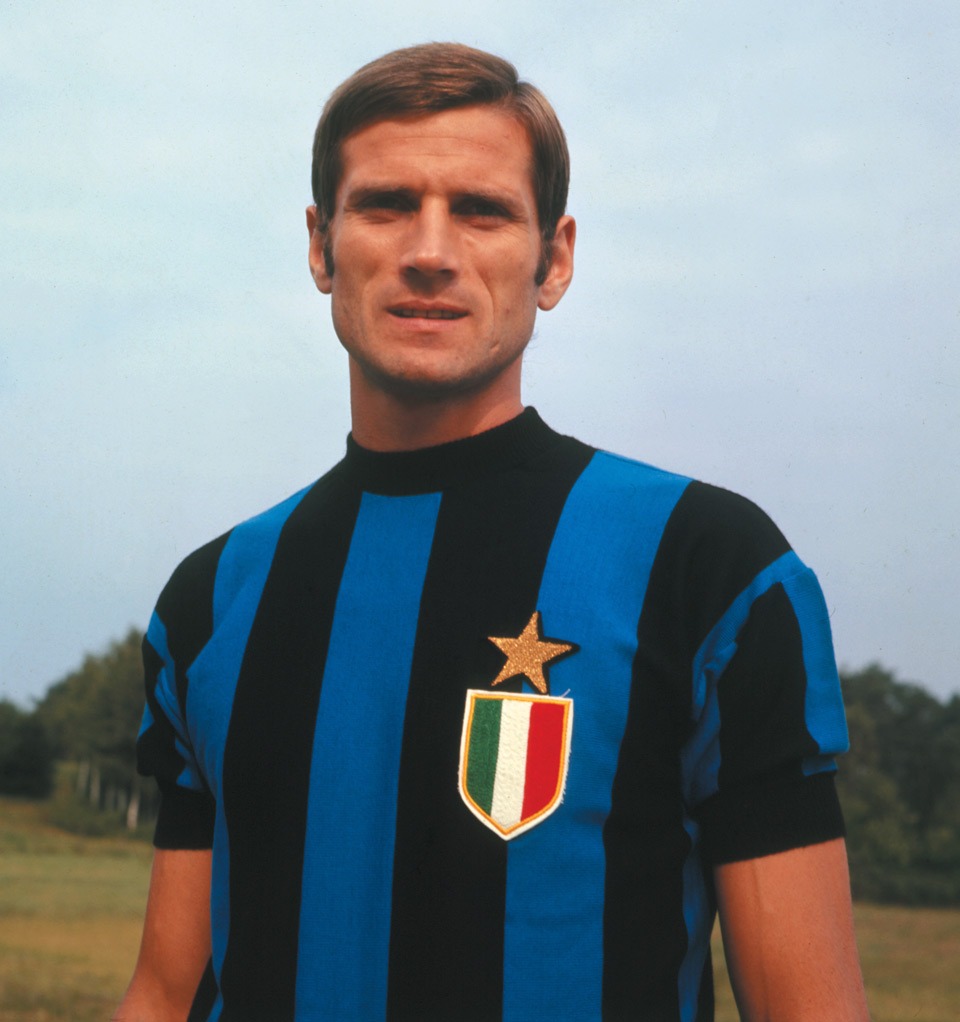
Giacinto Facchetti, born on July 18, 1942, in Treviglio, Italy, was a legendary footballer who became an iconic figure in the world of soccer. His contributions to the sport, both on and off the field, have left an indelible mark on Italian football history. This article delves into the life and career of Giacinto Facchetti, exploring his rise to fame, his significant achievements, and the lasting legacy he left behind.
Early Life and Career Beginnings
Giacinto Facchetti began his football journey in his hometown of Treviglio, playing as a forward for his local team, Trevigliese. However, it was his transition to a defensive role under the guidance of Helenio Herrera, the renowned coach of Inter Milan, that set the stage for his illustrious career. Facchetti made his Serie A debut on May 21, 1961, in a match between Roma and Inter, which ended in a 2-0 victory for the Milanese club. Despite initial skepticism about his abilities as a defender, Herrera’s prediction that Facchetti would become a cornerstone of Inter proved to be true.
The Transformation of a Position
Facchetti’s role as a left-back was revolutionary. Unlike traditional defenders of his time, he possessed the speed and agility of a forward, which allowed him to contribute significantly to both defensive and offensive plays. His ability to advance up the field and score goals was unprecedented for a defender, earning him a reputation as a goal-scoring defender—a rare and valuable asset in football. Facchetti’s style of play not only elevated his status within Inter Milan but also redefined the role of the full-back in modern football.
The Grande Inter Era
The 1960s were a golden era for Inter Milan, often referred to as the “Grande Inter” period. Under the leadership of Helenio Herrera, Inter Milan dominated both domestically and internationally, winning multiple Serie A titles and European Cups. Facchetti was a crucial part of this success, contributing to the team’s solid defense and dynamic attacking play. His performances during this time were exemplary, and he quickly became one of the most respected and admired players in Italian football.
National Team Success and Challenges
Facchetti’s talent did not go unnoticed on the international stage. He earned his first cap for the Italian national team on March 27, 1963, in a European Championship qualifier against Turkey, where Italy secured a 1-0 victory. However, his early years with the national team were marked by mixed results. Despite his individual brilliance, Italy struggled to find consistent success, leading to tensions between Facchetti and the national team’s management, particularly with coach Edmondo Fabbri.
One of the most challenging moments in Facchetti’s international career came during the 1966 World Cup in England. Italy’s shocking defeat to North Korea in the group stage led to widespread criticism and disappointment. Facchetti, who was captain at the time, shouldered much of the blame for the team’s early exit. However, this setback only fueled his determination to succeed.
Redemption and Glory
Facchetti’s redemption came in the 1968 European Championship, where he captained Italy to victory. The tournament was a turning point for both Facchetti and the Italian national team, as they triumphed in a dramatic final against Yugoslavia. The victory was a testament to Facchetti’s leadership and resilience, solidifying his place as one of Italy’s greatest footballers.
The 1970 World Cup in Mexico was another significant chapter in Facchetti’s career. Italy’s famous 4-3 victory over West Germany in the semi-final, often referred to as the “Game of the Century,” remains one of the most memorable matches in World Cup history. Although Italy lost to Brazil in the final, Facchetti’s performances throughout the tournament were widely praised, and he once again demonstrated his ability to inspire and lead his team on the world stage.
The Later Years and Transition to Management
As the 1970s progressed, Facchetti’s role on the field began to evolve. He transitioned from a full-back to a libero, a more central defensive position, under the coaching of his former teammate Luis Suárez. Despite his advancing age, Facchetti continued to perform at a high level, earning a place in the Italian squad for the 1974 World Cup. However, an injury in 1978 forced him to retire from international football, ending a remarkable international career with 94 caps, a record that would later be surpassed by Dino Zoff and Paolo Maldini.
After retiring from playing, Facchetti began a new chapter in his football career as a club executive. He briefly served as vice-president of Atalanta before returning to Inter Milan, where he held various management roles, including that of vice-president and later president. His deep understanding of the game, coupled with his leadership qualities, made him an invaluable asset to the club’s administration.
Legacy and Lasting Impact
Giacinto Facchetti passed away on September 4, 2006, after a battle with illness. His death was a significant loss to the world of football, and tributes poured in from across the globe. Facchetti’s legacy extends far beyond his achievements on the field. He is remembered as a pioneer who changed the way defenders play the game, a captain who led by example, and a gentleman who embodied the spirit of fair play.
Inter Milan honored his memory by retiring the number 3 jersey, which he wore throughout his career, ensuring that his contributions to the club will never be forgotten. Additionally, the Giacinto Facchetti Foundation was established to support charitable initiatives, reflecting Facchetti’s commitment to giving back to society.
Conclusion
Giacinto Facchetti’s life and career are a testament to the power of perseverance, innovation, and leadership. From his early days as a forward in Treviglio to his transformation into one of football’s greatest defenders, Facchetti consistently demonstrated an ability to adapt and excel. His influence on the game, particularly in redefining the role of the full-back, continues to be felt in modern football. As a player, captain, and executive, Facchetti’s contributions to Inter Milan and the Italian national team are unparalleled, and his legacy will forever be etched in the annals of football history.


