
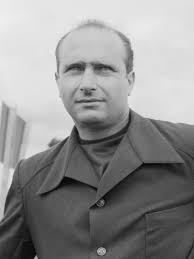
Juan Manuel Fangio, often referred to as “El Maestro,” is one of the most legendary figures in the history of motorsport. Born on June 24, 1911, in Balcarce, Argentina, Fangio became a symbol of excellence in Formula 1 racing, setting records that stood for decades and earning the admiration of fans and fellow racers alike. His career, characterized by skill, determination, and an insatiable desire to win, left an indelible mark on the world of motorsports.
Early Life and Introduction to Racing
Juan Manuel Fangio was born into a family of Italian immigrants in Balcarce, a small town in Argentina. His mother, Erminia Derano, hailed from Tornareccio, while his father, Loreto Fangio, was from Castiglion Messer Marino in the province of Chieti. Growing up in a working-class family, Fangio’s early life was far removed from the world of motorsports. He left school after completing the sixth grade and began working as an apprentice in a mechanical workshop, where he developed a passion for automobiles.
Fangio’s first experience in racing came at the age of 18, albeit as a co-pilot. It wasn’t until he was 25 that he got his first official role as a driver. However, his early racing career was anything but promising. Despite his love for racing, Fangio struggled to achieve significant results and faced financial difficulties that made it hard to sustain his racing ambitions. At one point, he considered abandoning racing altogether to focus on his work as a mechanic.
However, fate had other plans. The people of Balcarce, recognizing Fangio’s potential, organized a fundraiser to buy him a Chevrolet, which allowed him to continue racing. This act of generosity marked a turning point in Fangio’s career. The new car, though not the latest model, was powerful enough to help him secure his first victories on the track, igniting his path to greatness.
Rise to Prominence in South America
Fangio’s racing career gained momentum in the years following World War II. In 1948, he participated in the “Temporada” racing series in South America, driving a Maserati and competing against some of the best European drivers. His performances caught the attention of the Argentine Automobile Club and the government of Juan Domingo Perón, who decided to support Fangio’s racing career in Europe.
In 1949, Fangio moved to Europe to compete on a larger stage. Driving a Ferrari 125, he secured six victories, including a win at the prestigious Grand Prix of Monza. His success in Europe attracted the attention of major manufacturers, and by 1950, he had joined the Alfa Romeo team for the inaugural Formula 1 World Championship.
Dominance in Formula 1
The 1950 season marked the beginning of Fangio’s dominance in Formula 1. Driving the Alfa Romeo 158, known as the “Alfetta,” Fangio quickly established himself as one of the top drivers in the sport. Despite stiff competition, he finished second in the championship, narrowly losing the title to his teammate, Nino Farina.
In 1951, Fangio returned to Formula 1 with the upgraded Alfa Romeo 159. That season, he engaged in a thrilling battle with Ferrari’s Alberto Ascari. Fangio’s skill and determination prevailed, and he secured his first Formula 1 World Championship, solidifying his status as a top-tier driver.
After a brief hiatus in 1952 due to injuries sustained in a crash during a non-championship race, Fangio returned to racing in 1953 with Maserati. However, Ferrari’s dominance that season meant that Fangio had to settle for less glory, finishing behind Ascari.
The 1954 season saw Fangio switch teams mid-season, starting with Maserati before joining the newly formed Mercedes-Benz team. The Mercedes W196 was a groundbreaking car, and Fangio made the most of it, winning the championship with ease. He repeated this success in 1955, securing his third World Championship and further enhancing his reputation as the best driver in the world.
Continued Success with Ferrari and Maserati
In 1956, Fangio made another team switch, this time to Ferrari. The move came after Mercedes decided to withdraw from motorsport following the tragic 1955 Le Mans disaster. Ferrari provided Fangio with the Lancia D50, a car that had been acquired from the Lancia team after the death of driver Alberto Ascari.
Fangio’s tenure at Ferrari was marked by tension between him and the team, as well as his continued success on the track. Despite the internal conflicts, he managed to win his fourth World Championship, proving once again that he was the dominant force in Formula 1.
For the 1957 season, Fangio returned to Maserati, driving the 250F. This season is often regarded as his finest. At the age of 46, Fangio was still at the peak of his powers, and his victory at the German Grand Prix at the Nürburgring is considered one of the greatest drives in the history of the sport. Starting from pole position, Fangio lost time during a pit stop but made an incredible comeback, overtaking both Ferrari drivers, Mike Hawthorn and Peter Collins, in the final laps to win the race and clinch his fifth World Championship.
Legacy and Retirement
After winning his fifth World Championship, Fangio was satisfied with his achievements and began to lose motivation for racing. The 1958 season saw Fangio participate in only a few races before retiring from Formula 1 after the French Grand Prix at Reims, where he finished fourth. His decision to retire was influenced by the increasing dangers of the sport and the loss of friends and fellow drivers in racing accidents.
Fangio’s career statistics are remarkable. He won 24 of the 51 Formula 1 races he entered, a win rate of nearly 47%, which remains one of the highest in the history of the sport. He also secured 35 podium finishes, 29 pole positions, and 23 fastest laps, making him one of the most successful drivers of all time.
Even after retiring from active racing, Fangio remained involved in the sport. He became a representative for Mercedes-Benz in Argentina and managed the company’s operations in Buenos Aires. Fangio also played a key role in establishing a motorsport museum and a racing circuit in his hometown of Balcarce, ensuring that his legacy would inspire future generations.
Final Years and Death
In his later years, Juan Manuel Fangio became a revered figure in the world of motorsport. He was honored with numerous awards and accolades, including being named a Grand Officer of the French Legion of Honor. Fangio’s achievements and his character made him a beloved figure not only in Argentina but around the world.
However, Fangio’s health began to decline in the 1980s and 1990s. He suffered from various ailments, including diabetes, which required him to undergo dialysis treatments. Despite these health challenges, Fangio remained active in the motorsport community until his death on July 17, 1995, at the age of 84, following a bout with pneumonia.
The Legacy of Juan Manuel Fangio
Juan Manuel Fangio’s legacy in motorsport is unparalleled. His five World Championships remained a record for nearly half a century until Michael Schumacher surpassed it in 2003. Fangio’s approach to racing, which combined technical skill, strategic thinking, and an unrelenting desire to win, set a standard that few have matched.
Fangio’s influence extended beyond the racetrack. He was instrumental in elevating the status of Formula 1 to a global sport, and his success helped to popularize racing in South America. Fangio’s story, from his humble beginnings in rural Argentina to becoming a global icon, continues to inspire drivers and fans alike.
Fangio is remembered not only for his achievements but also for his sportsmanship and humility. He was known for his respect for his competitors and his willingness to share his knowledge and experience with younger drivers. Fangio’s commitment to safety and his concern for the well-being of his fellow racers also left a lasting impact on the sport.
Conclusion
Juan Manuel Fangio’s life and career are a testament to the power of passion, determination, and skill. From his early days as a mechanic’s apprentice in Argentina to his dominance in Formula 1, Fangio’s journey was one of extraordinary achievement. His records, his legacy, and his character have secured his place as one of the greatest drivers in the history of motorsport.
Fangio’s story is not just one of racing success but also one of perseverance and the pursuit of excellence. He remains a symbol of what can be achieved through hard work, dedication, and a relentless drive to be the best. Juan Manuel Fangio is more than just a racing legend; he is an enduring icon of the sport, whose influence will be felt for generations to come.


