
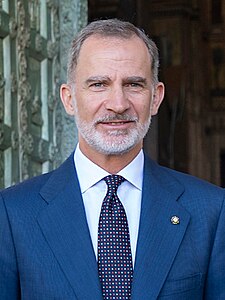
Felipe VI, the current King of Spain, represents the continuation of a long and storied history of Spanish monarchy. Born Felipe Juan Pablo Alfonso de Todos los Santos de Borbón y Grecia on January 30, 1968, in Madrid, he is the son of King Juan Carlos I and Queen Sofía of Spain. This article provides an in-depth look at Felipe VI’s life, from his early years to his ascent to the Spanish throne, exploring his education, military training, and significant contributions to both Spain and the global community.
Early Life and Royal Heritage
Felipe VI was born into the Spanish royal family during a time of significant political change. His father, Juan Carlos I, was not yet the reigning monarch when Felipe was born; he was still a prince under the dictatorship of General Francisco Franco. Felipe’s birth was seen as a symbol of continuity for the Bourbon dynasty, which had been restored to the Spanish throne after a period of republican rule and dictatorship.
Felipe’s names reflect his deep connections to Spanish history and his family’s legacy. “Felipe” is in honor of Felipe V, the first Bourbon king of Spain, while “Juan” and “Pablo” are in honor of his grandfathers. “Alfonso” refers to Alfonso XIII, his great-grandfather, who was the last king of Spain before the monarchy was abolished in 1931. This strong lineage tied Felipe to the historical roots of Spanish royalty from an early age.
Education and Early Responsibilities
Felipe’s education was meticulously planned to prepare him for his future role as the king of Spain. He attended the prestigious Santa Maria de los Rosales school in Madrid, a public institution where he was educated alongside children from various social backgrounds, a departure from the traditional private education usually given to royalty. This was part of an effort to modernize the monarchy and make the future king more relatable to the people of Spain.
After completing his early education, Felipe was sent to Canada to attend Lakefield College School in Ontario, further broadening his international perspective. This period was critical in shaping Felipe’s understanding of different cultures and political systems, an understanding that would later inform his approach to leadership.
In 1981, at the age of 13, Felipe was appointed as a Knight of the Order of the Golden Fleece, one of the most prestigious orders of knighthood in Spain. This early recognition marked the beginning of his official duties as a member of the royal family. Over the next few years, Felipe received numerous other honors, including the Collar of the Order of Charles III, which further cemented his status as the heir to the Spanish throne.
On January 30, 1986, on his 18th birthday, Felipe took an important step in his royal career by swearing allegiance to the Constitution and to his father, King Juan Carlos I, in the Spanish Parliament. This act not only affirmed his role as the future king but also demonstrated his commitment to the democratic principles that had been established in Spain following the end of Franco’s dictatorship.
Military Training and Further Education
Following his formal induction into royal duties, Felipe VI embarked on a rigorous program of military training, a tradition for Spanish royalty. He attended the General Military Academy of Zaragoza, the Naval Military School in Marín, and the General Air Academy in San Javier. This comprehensive military education provided him with the skills and experience necessary to serve as the Commander-in-Chief of the Spanish Armed Forces, a role he would assume upon becoming king.
Felipe’s military training was complemented by his academic pursuits. He studied law at the Autonomous University of Madrid, where he gained a solid understanding of legal principles that would later guide his constitutional role as king. Additionally, Felipe pursued a Master’s degree in International Relations at Georgetown University in Washington, D.C., alongside his cousin, Crown Prince Pavlos of Greece. This international education gave Felipe a broad perspective on global affairs and diplomacy, which would prove invaluable in his later role as a representative of Spain on the world stage.
Olympic Endeavors and Public Life
Felipe’s life has not been confined solely to royal duties and formal education. He has also actively participated in sports, particularly sailing, a passion he shares with his mother, Queen Sofía, and his uncle, King Constantine II of Greece. In 1992, Felipe had the honor of being Spain’s flag bearer at the opening ceremony of the Barcelona Summer Olympics, where he also competed as part of the Spanish sailing team. His team finished sixth in their category, marking a significant personal achievement and further enhancing his public image.
Throughout the 1990s, Felipe increasingly took on more public responsibilities, representing Spain at various international events and state functions. He visited numerous Spanish autonomous communities, engaging directly with citizens and strengthening his connection to the people. These visits were part of a broader effort to modernize the monarchy and make it more accessible and relevant to contemporary Spain.
Felipe also represented Spain at the inaugurations of Latin American presidents, a role that highlighted the deep historical and cultural ties between Spain and Latin America. His diplomatic efforts during this period helped to solidify Spain’s relationships with countries across the Americas, Europe, and Asia, showcasing his ability to navigate complex international relations.
Marriage and Family Life
On November 1, 2003, Felipe announced his engagement to Letizia Ortiz Rocasolano, a journalist from Asturias. The announcement surprised many, as Letizia was a commoner and a well-known news anchor. Their marriage, which took place on May 22, 2004, at the Almudena Cathedral in Madrid, was a major event in Spain, attracting attention from around the world. The wedding was broadcast live on television, with millions of viewers tuning in to watch the future king marry a woman from outside the traditional circles of European royalty.
Letizia, who became the Princess of Asturias upon her marriage, brought a modern and relatable image to the Spanish royal family. The couple has two daughters: Leonor, born on October 31, 2005, and Sofia, born on April 29, 2007. Leonor, as the elder daughter, is the heir presumptive to the Spanish throne, marking a potential historic moment for Spain, as she could become the country’s first reigning queen since the 19th century.
Ascension to the Throne
In June 2014, King Juan Carlos I announced his abdication in favor of his son, Felipe. This decision was influenced by a combination of factors, including declining public support for Juan Carlos due to various scandals and a desire to rejuvenate the monarchy with a new, younger king. On June 19, 2014, Felipe was formally proclaimed King of Spain as Felipe VI in a ceremony held in the Spanish Parliament.
As king, Felipe VI has worked to restore the credibility of the Spanish monarchy, focusing on transparency, accountability, and maintaining a strong connection with the Spanish people. His reign has been marked by efforts to navigate Spain through significant challenges, including the Catalan independence crisis, economic struggles, and the COVID-19 pandemic.
Challenges and Achievements
Felipe VI’s reign has not been without challenges. One of the most significant issues he has faced is the ongoing debate over Catalonia’s independence. The Catalan independence referendum of 2017, which the Spanish government declared illegal, led to widespread protests and political turmoil. Felipe VI took a firm stance against the independence movement, emphasizing the importance of national unity and the rule of law. His speeches during this period were widely covered in the media and were seen as crucial in shaping public opinion on the matter.
In addition to domestic challenges, Felipe VI has also played a key role in representing Spain on the international stage. He has strengthened Spain’s ties with other European Union member states and has been an advocate for a united Europe. His efforts to promote Spain’s interests globally have included state visits to countries across Latin America, the United States, and Asia, where he has emphasized the importance of economic cooperation and cultural exchange.
Felipe VI’s commitment to transparency and modernization has also been evident in his efforts to reform the Spanish monarchy. He has implemented measures to increase the transparency of the royal family’s finances and has taken steps to distance himself from scandals that have affected other members of the royal family. These actions have helped to restore public confidence in the monarchy and have reinforced Felipe VI’s image as a modern, forward-thinking leader.
Legacy and Future Prospects
As Felipe VI continues his reign, he remains focused on guiding Spain through its current challenges while preserving the monarchy as a symbol of national unity. His leadership style, characterized by a commitment to duty, transparency, and the welfare of the Spanish people, has earned him respect both at home and abroad.
Felipe VI’s legacy will likely be shaped by his ability to adapt the Spanish monarchy to the demands of the 21st century while maintaining the traditions that have defined it for centuries. His efforts to modernize the institution and connect with a younger generation of Spaniards will be crucial in ensuring the monarchy’s relevance in the years to come.
Conclusion
Felipe VI of Spain is a monarch who embodies both tradition and modernity. His life and career reflect a deep commitment to his country and a willingness to confront the challenges of the present while honoring the legacy of the past. From his early years as a prince to his current role as king, Felipe VI has demonstrated a dedication to public service and a vision for a united, prosperous Spain.
As Spain continues to navigate a rapidly changing world, Felipe VI’s leadership will be essential in guiding the country forward. His ability to balance the demands of a constitutional monarchy with the expectations of a modern society will determine the future of the Spanish monarchy and its place in the global community.


