
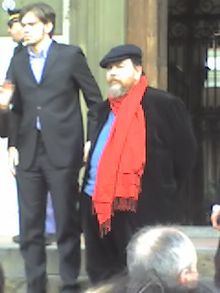
Giuliano Ferrara, born on January 7, 1952, in Rome, is a prominent figure in Italian journalism, television, and politics. His life and career, marked by significant shifts in political alliances and a dynamic presence in media, reflect the complex socio-political landscape of Italy from the late 20th century to the present. This article delves into the life, career, and influence of Giuliano Ferrara, examining his contributions to Italian journalism, his political engagements, and the controversies that have shaped his public persona.
Early Life and Family Background
Giuliano Ferrara was born into a politically active family. His father, Maurizio Ferrara, was a communist senator and a significant figure in Italian politics, serving as the President of the Lazio Region and the Director of the newspaper “L’Unità.” His mother, Marcella de Francesco, was a former partisan and a close associate of Palmiro Togliatti, a key leader of the Italian Communist Party (PCI). This strong political lineage undoubtedly influenced Giuliano’s early engagement with politics and shaped his ideological journey.
Education and Early Political Involvement
Giuliano Ferrara began his academic journey in the field of law, enrolling in the Faculty of Law at the University of Rome. However, his passion for politics soon overshadowed his academic pursuits, leading him to leave his studies without obtaining a degree. The late 1960s were a period of intense political activism in Italy, and Ferrara became actively involved in the student movements of the time. He participated in the famous clashes at Valle Giulia in 1968, a pivotal moment in the student protests against the establishment.
During this period, Ferrara also ventured into the world of entertainment, participating as a chorister in “Then an Alley,” Italy’s first rock opera, which featured music by the iconic Bob Dylan. Despite this foray into the arts, Ferrara’s true passion remained politics.
Entry into Politics: The PCI Years
In the early 1970s, Giuliano Ferrara formally entered the political arena by joining the Italian Communist Party (PCI). His early political career was closely tied to the PCI’s activities in Turin, where he became responsible for the coordination of Fiat workers within the party. By 1979, Ferrara had risen through the ranks to become the city secretary of the PCI in Turin and later served as a city councilor.
Ferrara’s political career within the PCI was marked by his involvement in the cultural and educational sectors of the party. However, his growing disillusionment with the party’s direction, particularly in relation to international issues such as the Lebanon War of 1982, led to a significant turning point in his career.
The 1982 Crisis and Departure from the PCI
The Lebanon War in 1982 was a critical moment for Giuliano Ferrara, leading to a dramatic exit from the PCI. During this period, Ferrara served as a delegate for the mayor of Turin, tasked with organizing relief efforts for those affected by the conflict. However, a dispute during a musical event in Turin’s Piazza San Carlo, where Ferrara’s request to dedicate a concert to the victims of the Sabra and Shatila massacres was denied, led to a public controversy. This incident culminated in Ferrara’s resignation from both the PCI and the Turin City Council.
Ferrara’s departure from the PCI marked a significant ideological shift. His subsequent writings and political engagements demonstrated a clear move to the right, aligning him more closely with the emerging neo-conservative movement in Italy.
Transition to Journalism: A Voice from the Right
Following his departure from the PCI, Giuliano Ferrara embarked on a successful career in journalism. He began writing for major Italian publications such as “Il Corriere della Sera” and “L’Espresso,” where his critiques of the PCI from a right-wing perspective gained widespread attention. Ferrara’s writing style, characterized by its incisive analysis and sharp wit, quickly established him as a prominent voice in Italian media.
In the mid-1980s, Ferrara’s political trajectory took another turn when he was approached by Claudio Martelli, a leading figure in the Italian Socialist Party (PSI). Although Ferrara initially declined to join the PSI, his admiration for the policies of Bettino Craxi, then the leader of the PSI, was evident. Despite this, Ferrara refrained from formally entering the electoral arena at that time.
Television Career: From Infotainment to Political Commentary
Giuliano Ferrara’s television career began in 1987 with the program “Linea Rovente” on Raitre, followed by “Il Testimone” on Raidue. These programs, among the first examples of infotainment on Italian television, showcased Ferrara’s ability to blend serious political discussion with entertainment, making complex political issues accessible to a broader audience.
In 1989, Ferrara made a significant career move by joining Fininvest, the media empire owned by Silvio Berlusconi. At Fininvest, Ferrara hosted several popular programs, including “Radio Londra” and “Il Gatto.” His growing influence in television was complemented by his election as a Member of the European Parliament (MEP) for the PSI in 1989. However, Ferrara temporarily stepped back from television during his tenure as an MEP.
Ferrara returned to television in 1991 with a new edition of “Radio Londra” and later launched the program “L’Istruttoria” on Italia 1. The latter program became particularly influential during the “Tangentopoli” corruption scandals of the early 1990s, where Ferrara’s critiques of the judiciary, particularly the “Mani Pulite” investigation, were highly controversial.
Political Alliance with Berlusconi: Ministerial Role and “Il Foglio”
The early 1990s saw Giuliano Ferrara align himself more closely with Silvio Berlusconi, particularly after the collapse of the PSI and the rise of Forza Italia. In 1994, following Berlusconi’s victory in the general elections, Ferrara was appointed as the Minister for Parliamentary Relations in Berlusconi’s first government. However, this role was short-lived due to the political instability caused by the withdrawal of support from Umberto Bossi’s Northern League.
In 1996, Ferrara made a significant contribution to Italian media and politics by founding the daily newspaper “Il Foglio.” The paper, known for its neo-conservative stance and support for Berlusconi’s policies, quickly became a leading voice in Italian journalism. Under Ferrara’s direction, “Il Foglio” became a platform for conservative intellectuals and a key player in the ideological battles of the time.
Continued Influence and Later Career
Giuliano Ferrara continued to play a prominent role in Italian media and politics into the 2000s. In 2001, he launched the television program “Otto e Mezzo” on La7, which he hosted until 2008. The program, known for its in-depth political analysis, allowed Ferrara to further solidify his position as a leading conservative commentator in Italy.
In addition to his television work, Ferrara published several books, including “Non Dubitare. Contro la Religione Laicista” (2005), a collection of essays advocating for the protection of Christian and Jewish values in the face of secularism. His outspoken views on issues such as abortion, which he equated with murder, led to the formation of the political movement “Association for the Defense of Life” in 2008. However, his foray into electoral politics with this movement was unsuccessful, as it failed to secure a significant share of the vote in the 2008 general elections.
Final Years in Media
In 2011, Giuliano Ferrara returned to television with “Qui Radio Londra,” a political commentary program on Raiuno. Although the show was short-lived, it highlighted Ferrara’s enduring ability to engage with current political issues. In 2015, Ferrara stepped down as the director of “Il Foglio,” passing the torch to Claudio Cerasa, a younger journalist. This move marked the end of an era for the newspaper, which had been shaped by Ferrara’s vision and editorial direction for nearly two decades.
Legacy and Impact
Giuliano Ferrara’s legacy in Italian journalism and politics is one of complexity and controversy. His ideological journey from the far-left roots of the PCI to the conservative circles of Forza Italia and his alignment with Berlusconi reflects the broader shifts in Italian politics over the past fifty years. Ferrara’s influence as a journalist, editor, and television personality has left an indelible mark on Italian public discourse, particularly in the realms of conservative thought and media.
As a polarizing figure, Ferrara’s career has been marked by both admiration and criticism. His ability to navigate the turbulent waters of Italian politics, combined with his sharp intellect and provocative style, has ensured his place as one of Italy’s most influential public figures. Despite stepping back from the limelight in recent years, Giuliano Ferrara’s contributions to Italian journalism and politics continue to resonate, offering insights into the complex interplay between media, politics, and ideology in contemporary Italy.


