
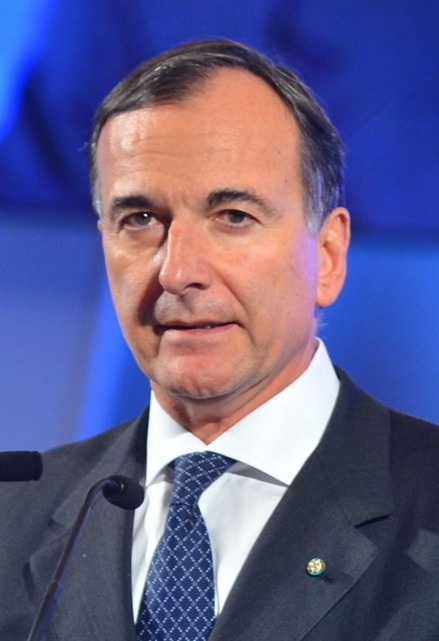
Franco Frattini was a prominent Italian politician and magistrate, known for his significant contributions to both the Italian government and the European Union. Born on March 14, 1957, in Rome, Frattini’s life was marked by a relentless pursuit of excellence in public service, culminating in numerous high-profile positions such as Minister of Foreign Affairs, European Commissioner, and President of the Italian Council of State. His journey is one of intellectual rigor, political acumen, and a steadfast commitment to the principles of justice and diplomacy.
Early Life and Education
Franco Frattini was born into a well-educated family in Rome, which set the stage for his impressive academic achievements. He attended the prestigious La Sapienza University of Rome, where he graduated with a degree in law at the remarkably young age of 22. His early entry into the legal profession was a testament to his intellectual capabilities and his deep understanding of legal principles.
After earning his degree, Frattini quickly made his mark in the legal world. He began his career as a prosecutor, followed by roles as a State Attorney and a magistrate in the Regional Administrative Court (TAR) of Piedmont. His work during this period was not confined to the courtroom; he was also a prolific writer, contributing numerous scholarly articles on administrative procedural law, contracts, and public procurement. These writings not only established his expertise in these areas but also paved the way for his future roles in public administration and politics.
Entry into Politics
Frattini’s transition from law to politics was marked by a series of strategic appointments that showcased his legal expertise. In 1986, he became the legal advisor to the Italian Minister of Treasury, a role that brought him into the inner circles of government decision-making. His reputation as a reliable and knowledgeable advisor grew, leading to his appointment as a State Councilor through a public competition.
From 1990 to 1992, Frattini served as the legal advisor to the Deputy Prime Minister and subsequently to the Prime Minister of Italy. His involvement at the highest levels of government during this period was crucial in shaping his understanding of the complex interplay between law and politics. This experience culminated in his appointment as the Deputy Secretary-General of the Presidency of the Council of Ministers in 1993, and later as the Secretary-General in 1994.
These roles were a precursor to his formal entry into politics. In 1996, Frattini resigned from his government position to run for office as a candidate for Forza Italia, the political party founded by Silvio Berlusconi. His campaign was successful, and he was elected as a Member of Parliament, a position he would hold until 2004.
Ministerial Roles and European Commission
Frattini’s political career was marked by his tenure as a minister in various capacities. His first ministerial role was as Minister for Public Administration and Regional Affairs under Prime Minister Lamberto Dini from 1995 to 1996. This role highlighted his ability to manage complex governmental structures and his commitment to public service reform.
However, it was his role as Minister of Foreign Affairs that brought him international recognition. Frattini first served as Foreign Minister from 2002 to 2004 in the second Berlusconi government. During this period, he was involved in several high-profile international negotiations and was instrumental in shaping Italy’s foreign policy in the early 2000s.
In 2004, Frattini was appointed as the European Commissioner for Justice, Freedom, and Security, a role that positioned him at the heart of European Union governance. As Vice-President of the European Commission, he was responsible for significant portfolios, including justice, civil liberties, and immigration. His work in the European Commission was marked by his efforts to enhance judicial cooperation across the EU, improve security measures, and manage the complex issues surrounding immigration.
Frattini’s work at the European level earned him a reputation as a dedicated and effective leader. His tenure was characterized by his ability to navigate the often-turbulent waters of EU politics, and his efforts to promote a more integrated and secure Europe were widely recognized.
Later Career and Return to Italy
After his term at the European Commission ended, Frattini returned to Italian politics and public service. He was reappointed as Minister of Foreign Affairs in 2008, a role he held until 2011 during Berlusconi’s fourth government. His second tenure as Foreign Minister was marked by his handling of several international crises, including the aftermath of the global financial crisis and the complexities of Italy’s relationships with its European neighbors.
In 2011, Frattini was appointed as President of the Italian Society for International Organization (SIOI), becoming the first politician to hold this position, traditionally reserved for diplomats and academics. His work with SIOI further cemented his status as a key figure in Italian diplomacy and international relations.
Frattini’s later years were characterized by his continued involvement in international diplomacy and public service. In 2013, he was Italy’s candidate for the position of NATO Secretary-General, though the role ultimately went to Jens Stoltenberg. Despite this setback, Frattini remained an influential figure in international politics, serving as a consultant to the Serbian government on its European Union integration efforts and as a special representative for the OSCE in conflict resolution processes.
Personal Life and Legacy
Franco Frattini’s personal life was marked by his two marriages. He was first married to Chantal Sciuto, a dermatologist from Sicily, with whom he had a daughter, Carlotta, born in 1991. The couple divorced in 2009. In 2010, Frattini married Stella Coppi, the daughter of Gaetano Coppi, a former skiing athlete and president of the Italian Winter Sports Federation (FISI).
Frattini’s life came to a tragic end on December 24, 2022, when he passed away at the age of 65 at the Gemelli Hospital in Rome after a prolonged illness. His death marked the end of a remarkable career in public service that spanned over four decades.
Conclusion
Franco Frattini’s life and career are a testament to his unwavering dedication to public service and his profound impact on both Italian and European politics. His legacy is that of a statesman who navigated the complexities of law and politics with skill and integrity. From his early days as a legal scholar to his roles in the highest echelons of government, Frattini’s contributions have left an indelible mark on the institutions he served. His work in shaping Italy’s foreign policy, his efforts to promote European integration, and his commitment to justice and security will be remembered as defining features of his illustrious career.
As we reflect on Franco Frattini’s life, it is clear that his influence extended far beyond the borders of Italy. He was a true European statesman, whose vision for a more united and secure Europe continues to resonate today. His life is a reminder of the importance of public service and the impact that dedicated individuals can have on the world stage.


