
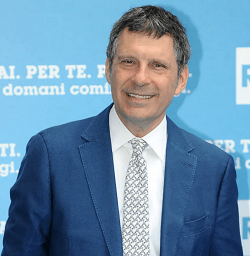
Fabrizio Frizzi, born on February 5, 1958, in Rome, Italy, was one of the most beloved television presenters in Italian history. Known for his warm demeanor, charismatic personality, and enduring presence on Italian television, Frizzi’s career spanned several decades, during which he became a household name. This article explores the life of Fabrizio Frizzi, his journey to fame, and the significant highlights of his career and personal life.
Early Life and Career Beginnings
Fabrizio Frizzi was born into a family with a strong connection to the entertainment industry. His father was a prominent film distributor, and his brother Fabio Frizzi would go on to become a successful composer, contributing music to numerous television shows and films. Growing up in Rome, Frizzi attended the “Cesare Nobili” elementary school and later graduated from the “San Giuseppe Calasanzio” Institute.
Frizzi’s first foray into the world of entertainment came through private radio and television, where he honed his skills as a young presenter. His natural talent and charm quickly caught the attention of industry professionals, leading to his early appearances on RAI, the national public broadcasting company of Italy. In the early 1980s, Frizzi began his television career with shows like “Il barattolo” and “Tandem,” a children’s program hosted by Enza Sampò. His role in “Tandem” involved interacting with schoolchildren through various games and activities, which helped him build a rapport with younger audiences.
Rise to Fame: The 1980s and 1990s
Fabrizio Frizzi’s breakthrough came in 1988 when he was selected by Michele Guardì to host “Europa Europa,” a Saturday night program that paired him with co-host Elisabetta Gardini. This show significantly raised Frizzi’s profile, and the same year, he took on the role of hosting the “Miss Italia” beauty pageant, a position he would hold for an impressive fifteen years. His association with “Miss Italia” cemented his status as a leading television personality in Italy.
During this period, Frizzi also hosted other major events, including the “Festival di Castrocaro” and “Miss Italia nel mondo.” However, it was “Scommettiamo che…?” that truly defined his career. The show, an Italian adaptation of the German format “Wetten, dass…?”, aired from 1991 to 1995 and again in later years. Co-hosted with Milly Carlucci and later with international stars like Afef Jnifen and Valeria Mazza, “Scommettiamo che…?” became a Saturday night staple, drawing millions of viewers and solidifying Frizzi’s place in Italian television history.
The 1990s were a period of intense activity for Frizzi. He became a regular fixture on RAI’s programming, hosting a variety of shows, including “Luna Park,” a popular pre-news quiz show that alternated between hosts like Mara Venier, Pippo Baudo, and Milly Carlucci. Frizzi’s versatility was on full display as he also took on more formal roles, such as presenting the “Festival Disney” in 1995 and numerous editions of the “Partita del Cuore,” a charity soccer match.
In addition to his television work, Frizzi explored voice acting, lending his voice to Woody, the main character in the Italian versions of Pixar’s “Toy Story” films. His work as Woody in “Toy Story,” “Toy Story 2,” “Toy Story 3,” and related media endeared him to a new generation of fans, showcasing his ability to connect with audiences across different formats.
Expanding Horizons: The 2000s and Beyond
As the new millennium began, Fabrizio Frizzi continued to diversify his career. In 1999, he ventured into acting with a role in the television series “Non lasciamoci più,” starring alongside Debora Caprioglio. Though acting was not his primary focus, Frizzi’s foray into this medium demonstrated his willingness to explore new creative avenues.
Frizzi also made brief appearances on Canale 5 with shows like “Come sorelle” and returned to RAI to host “Piazza Grande” from 2003 to 2004. Although this period saw a slight decline in his presence on prime-time television, he remained a beloved figure, especially through his participation in charity events like Telethon, where he became a regular host.
In 2007, Frizzi made a successful comeback with the game show “I soliti ignoti – Identità nascoste” on Raiuno. The show, which involved contestants guessing the identities of strangers based on clues, quickly became a hit, consistently outperforming rival programs. This success reaffirmed Frizzi’s place in the hearts of Italian viewers and marked the beginning of a new chapter in his career.
Throughout the late 2000s and early 2010s, Frizzi continued to host various programs, including “Premio Barocco,” “La botola,” and “Ciak, si canta.” He also tested new formats like “Mettiamoci all’opera,” a talent show focused on opera singing, and “Attenti a quei due – La sfida,” a competition show he co-hosted with Max Giusti. His versatility and enduring appeal were evident as he seamlessly transitioned between different types of shows, from light entertainment to cultural programming.
Personal Life and Legacy
Fabrizio Frizzi’s personal life was often in the public eye, especially his relationships. He was first married to Rita Dalla Chiesa, a well-known television presenter. The couple divorced in 2002, and later that year, Frizzi began a relationship with Carlotta Mantovan, a journalist whom he met during an edition of “Miss Italia.” The couple welcomed their daughter, Stella, in 2013 and married in 2014. Frizzi’s devotion to his family was well-known, and he often spoke about the joy his daughter brought into his life.
Outside of his professional achievements, Frizzi was also known for his charitable work. He was a passionate supporter of various causes, particularly those related to health and children. His involvement in Telethon, the annual fundraising event for research into genetic diseases, was a testament to his commitment to giving back to the community.
In recognition of his contributions to Italian television and society, Fabrizio Frizzi was named an Officer of the Order of Merit of the Italian Republic in 2008. This honor reflected the high esteem in which he was held by both the public and his peers.
Final Years and Passing
In the later years of his life, Frizzi continued to work despite facing serious health challenges. In October 2017, he suffered a stroke while recording an episode of “L’eredità,” a popular quiz show he had been hosting since 2014. Though he took a brief hiatus to recover, Frizzi returned to the show, demonstrating his characteristic resilience and dedication to his work.
Tragically, Fabrizio Frizzi passed away on March 26, 2018, at the age of 60, due to a brain hemorrhage. His death was met with an outpouring of grief from fans, colleagues, and the wider public. Tributes poured in from across Italy, with many recalling his kindness, professionalism, and the joy he brought to countless viewers over the years.
Frizzi’s funeral, held in Rome, was attended by thousands, including many of Italy’s most prominent media figures. The event was a poignant reminder of the deep connection he had with the Italian public, who viewed him not just as a television presenter, but as a friend and companion who had been a constant presence in their lives for decades.
Legacy and Impact
Fabrizio Frizzi’s legacy is one of warmth, generosity, and a genuine love for his work. Over the course of his career, he hosted some of Italy’s most iconic television programs, becoming a symbol of reliability and good humor in the process. His ability to connect with audiences of all ages, coupled with his versatility across different genres, ensured that he remained relevant throughout his career.
Frizzi’s impact on Italian television is undeniable. He helped define an era of programming that balanced entertainment with cultural enrichment, always prioritizing the audience’s enjoyment and engagement. His work in voice acting also introduced him to a new generation, ensuring that his influence extended beyond traditional television.
Moreover, Frizzi’s commitment to charity and his role in events like Telethon highlighted his belief in using his platform for the greater good. This dedication to helping others, coupled with his professional achievements, solidified his reputation as one of Italy’s most beloved public figures.
In the years since his passing, Fabrizio Frizzi’s memory continues to be honored through various tributes, including the naming of television studios and awards in his honor. His influence on Italian culture and media remains profound, with many of today’s presenters citing him as an inspiration and role model.
Conclusion
Fabrizio Frizzi’s life and career are a testament to the power of kindness, resilience, and passion. From his early days in radio and television to his status as a beloved national figure, Frizzi’s journey was marked by a deep connection with his audience and an unwavering commitment to his craft. His legacy lives on in the countless lives he touched through his work, and he remains a cherished figure in the annals of Italian entertainment history.


